WatchSat › Blog › How many times can a Falcon 9 booster fly? The reuse record
How many times can a Falcon 9 booster fly? The reuse record
Falcon 9 booster B1067 flew a record 37th time on August 25, 2026. SpaceX says its boosters are built for up to 40 flights.
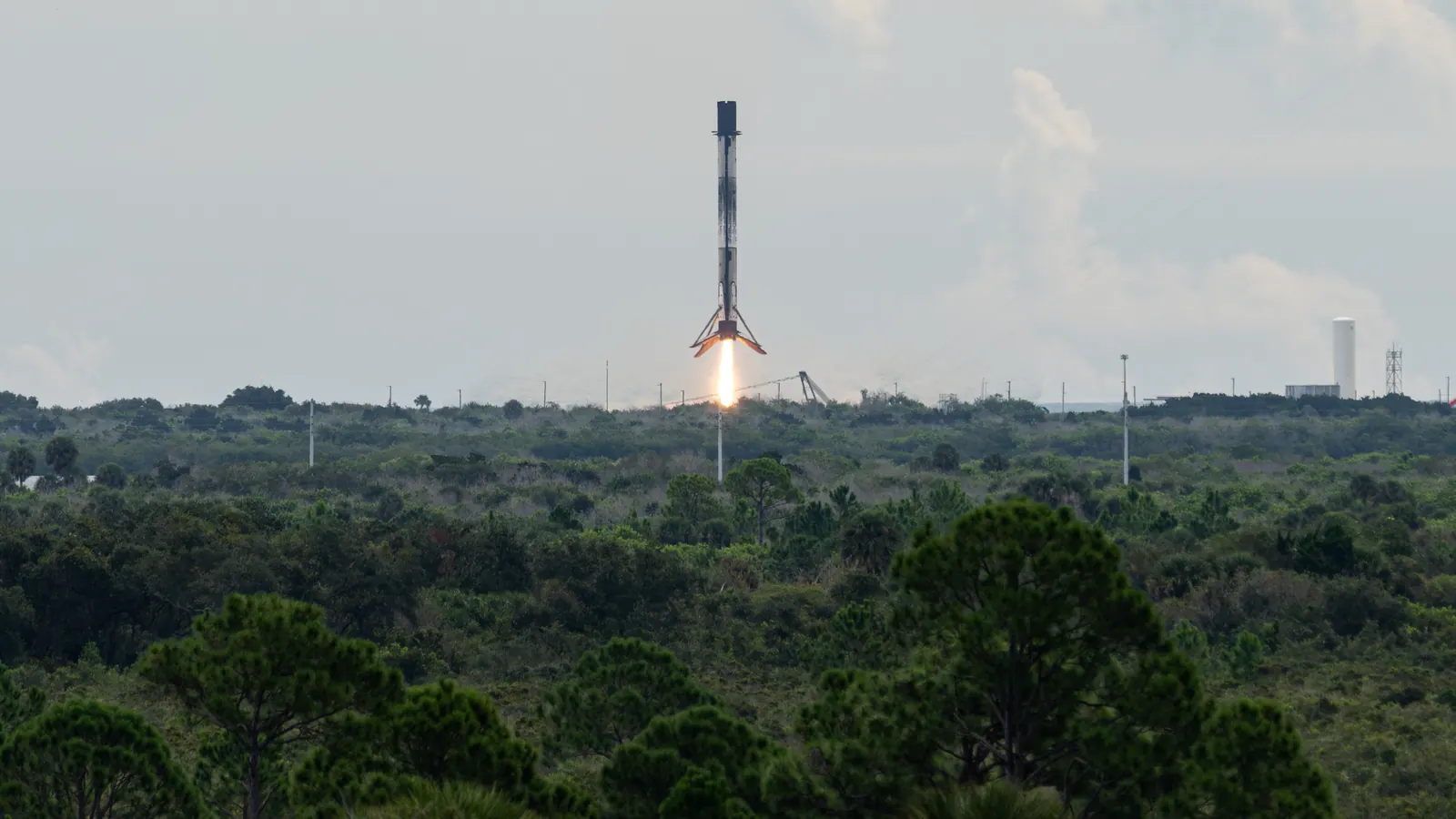
A Falcon 9 booster has flown as many as 37 times. Booster B1067 made its 37th flight at 09:33 UTC (5:33 a.m. EDT) on August 25, 2026, launching Starlink satellites from Cape Canaveral, and then landed on the droneship A Shortfall of Gravitas, Spaceflight Now reported. No other orbital-class booster has flown as often. SpaceX says Falcon 9 boosters are built to fly up to 40 times, which leaves the record holder three flights short. We looked for reports of a 38th flight through October 12, 2026, and found none, so 37 is the latest count we can confirm.
B1067 entered service on June 3, 2021, launching the CRS-22 mission, and in January 2025 it became the first Falcon 9 booster to reach 25 flights, according to the Orbit Codex booster log. AIAA relayed the report, and Space.com's preview of the launch also called it a record 37th flight.
Our launch schedule lists the next Falcon 9 flights, and since most carry Starlinks, the Starlink train page shows when a fresh batch will pass over you.
How many times can a Falcon 9 booster fly?
SpaceX's goal for each booster has doubled twice. It went from 10 flights to 20, Space Explored reported in May 2024, and a later Space Explored story described the next step, to as many as 40. Elon Musk has said the boosters will keep flying "until something breaks," the site reported.
The 40-flight figure also appears in SpaceX's IPO filing, according to press reports. BGR wrote in September 2026 that the filing describes the booster as engineered and demonstrated to handle up to 40 flights, and in July Cislunar Space cited SpaceX's pre-IPO documents for the same number. We haven't seen the filing itself. Reporters also differ on whether the boosters are certified for that many flights. In December 2025, Spaceflight Now described SpaceX as "one step closer" to its goal of certifying boosters for up to 40 missions. We found no statement from SpaceX or the FAA that the certification is finished, so we treat 40 as SpaceX's design figure.
According to TechTimes, the same filing gives the boosters a much shorter accounting life of 25 flights, an estimate based on how SpaceX expects to use them as it shifts toward Starship. Past 25 flights a booster is worth nothing on SpaceX's books, but several keep flying. B1080 flew for the 27th time on June 12, 2026, already past that line, TechTimes reported. Spaceflight Now has pointed out that each booster's final count also depends on its missions, and on whether SpaceX needs it for an expendable launch, where the booster isn't recovered.
B1067 has set every new record since late 2025. Its 32nd flight, on December 7, 2025, carried the 3,000th Starlink satellite SpaceX launched that year. After a 33rd flight, the 34th came on March 30, 2026, the 35th flight in early June, the 36th on July 9 and the 37th on August 25. By our count, it made five flights in the 261 days from December 7 to August 25, one every 52 days on average. If it kept that pace, three more flights would take it to 40 around the end of January 2027.
It may not keep that pace. Spaceflight Now said the August 25 launch could be the last Starlink mission from Cape Canaveral "for a while," with no more on SpaceX's near-term schedule at the time. KeepTrack, a satellite-tracking site, went further and said SpaceX had halted Florida Starlink launches until Starship arrives. We couldn't confirm the reason, but as our 2026 launch count reports, NASASpaceflight.com said in October that no more Falcon 9 Starlink missions were planned from Florida.
Before B1067's 37th flight, Space.com listed B1071 at 35 flights, B1063 at 34 (35 in BGR's September tally), B1069 at 32, and B1077 and B1078 at 30 each. In June, Spaceflight Now counted seven Falcon boosters with more than 25 flights.
When did SpaceX first land and reuse a Falcon 9 booster?
SpaceX first landed an orbital-class booster on December 21, 2015. A Falcon 9 lifted off from Space Launch Complex 40 at Cape Canaveral at 8:29 p.m. EST with 11 ORBCOMM OG2 satellites. About nine minutes later, at 8:38 p.m. (01:38 UTC on December 22), its first stage touched down at Landing Zone 1, according to the US Air Force and the 45th Space Wing.
The first reflight came 15 months later. On March 30, 2017, booster B1021 launched the 5,282 kg SES-10 satellite toward geostationary transfer orbit from Launch Complex 39A and landed on the droneship Of Course I Still Love You. It had first flown on April 8, 2016, on the CRS-8 mission, about 356 days earlier. Space Launch Now and Everyday Astronaut call it the first orbital-class stage to fly two orbital missions and be recovered both times. Retired after that flight, B1021 has stood on display at DISH headquarters in Littleton, Colorado, since October 2023, Orbit Codex says.
The wait between flights has since shrunk from about a year to days. In April 2022, B1062 flew twice in 21 days. SpaceX said nine of those days went on hands-on refurbishment and most of the rest on towing the booster back to port, Spaceflight Now reported. The fastest turnaround we found is nine days from launch to launch, set by B1088 in March 2025, when it launched NROL-57 for the National Reconnaissance Office from Vandenberg. It beat B1080's record of 13.5 days, according to Spaceflight Now and BGR. We found no faster turnaround since, though we can't rule one out.
SpaceX also recovers the payload fairing, the two-piece nose cone that shields satellites on the way up, and one fairing half has already outflown B1067. That half, SN155, flew for the 40th time on September 20, 2026, on the Starlink 15-27 mission from Vandenberg, TeslaNorth reported, citing SpaceX. TeslaNorth said SpaceX has reflown fairing halves more than 300 times.
| Date | Milestone |
|---|---|
| December 21, 2015 | First landing of an orbital-class booster, at Landing Zone 1 |
| March 30, 2017 | First reflight, as B1021 launches SES-10 |
| June 3, 2021 | B1067's first flight, on CRS-22 |
| April 2022 | B1062 flies twice in 21 days |
| January 2025 | B1067 becomes the first booster to reach 25 flights |
| March 2025 | B1088 sets the nine-day turnaround record |
| April 19, 2026 | 600th Falcon booster landing |
| August 25, 2026 | B1067's record 37th flight |
| September 20, 2026 | A fairing half flies for the 40th time |
Falcon 9 landings, launch pace and Starlink's share
Spaceflight Now counted the 600th Falcon booster landing on April 19, 2026, when B1097 returned from the Starlink 17-22 launch at Vandenberg. The 653rd came on August 22, after B1100's Starlink 15-20 launch, also from Vandenberg, and B1067's landing three days later was expected to be the 654th. By our arithmetic, boosters landed 53 more times in the 125 days after the 600th, about once every 2.4 days. We couldn't find a total newer than August, so the real count on October 12 is higher.
In 2025, SpaceX flew 165 Falcon 9 missions and no Falcon Heavy, Space.com reported, up from 134 Falcon 9 launches and two Falcon Heavy flights in 2024. Boosters came back from all but three of the 165, 98% by our arithmetic. Two Spainsat NG launches to geostationary transfer orbit left their boosters without enough propellant to return. On March 3, 2025, another booster landed on its droneship after a Starlink launch, then tipped over after a fire near its base. We found no reliable figure for the program's whole history.
Space.com also counted 123 of the 165 launches in 2025 as Starlink missions, about three in four. Through August, the 2026 pace was a little slower. Spaceflight Now dated SpaceX's 100th Falcon 9 launch of 2025 to August 17, 2025. This year's 100th came in the last week of August. Space.com and Spaceflight Now call B1067's August 25 flight the 100th Falcon 9 launch of 2026. KeepTrack gives that number to the Starlink 15-20 launch on August 22, which Spaceflight Now called SpaceX's 100th orbital mission of the year, a count that may include Starship. In August, KeepTrack extrapolated about 155 Falcon 9 launches for 2026, 10 fewer than in 2025, but the pace has fallen since, as our running count of 2026 rocket launches shows.
Starlink launches in WatchSat's satellite data
Starlink is the biggest customer for these boosters. WatchSat's October 11 snapshot of CelesTrak's active-satellite list holds 16,701 objects. Of those, 11,129 are Starlinks, two of every three, as in our earlier post on Starlink's two-thirds share. You can browse them in the Starlink constellation view or the full satellite directory.
Each entry's international designator records its launch year and that launch's number within the year, so we can group the Starlinks by launch. Our guide to TLEs explains the format, and the methodology page describes how we use the list.
Satellites launched in 2025 make up the biggest group, 3,139 of the active Starlinks, and 2026 launches have added 2,163 so far. Together that's 5,302, or 48% of the total. Earlier years trail off, from 1,855 still active from 2024 launches down to 12 from 2019.
The 2025 Starlinks on the list came from 122 separate launches. Space.com counted 123 Starlink missions that year, and we haven't traced which one is missing from our list or why.
For 2026, the list has Starlinks from 82 launches. One is Starship Flight 14, international designator 2026-225, whose 26 Starlinks we followed in our Flight 14 post. The other 81 batches went up on Falcon 9. All but one of the 82 still have between 24 and 29 satellites on the list, with a median of 25, and 30 batches still have 29. The exception, 2026-126, has 21 on the list, in a near-polar orbit inclined at 97.3 degrees.
Those counts fit the slower pace in the launch tallies. If the 122 Starlink launches of 2025 had been spread evenly through the year, about 95 would have flown by October 12. Our list has 81 Falcon 9 Starlink batches from 2026, 14 short of that even pace. Our guide to how many satellites are in orbit puts the Starlink numbers next to everyone else's, and the live satellite map shows where each batch is now.
Sources
- CelesTrak, active satellite element sets, WatchSat snapshot of October 11, 2026
- TeslaNorth, SpaceX Nose Cone Just Hit 40 Flights, a New Reuse Record, September 20, 2026
- BGR, SpaceX Just Proved Rocket Reuse Works Better Than Anyone Expected, September 2026
- AIAA, SpaceX Falcon 9 Booster Sets Reuse Record With 37th Flight, August 25, 2026
- Spaceflight Now, SpaceX launches Starlink mission on a Falcon booster's record-breaking 37th flight, August 24, 2026
- Space.com, SpaceX will set rocket-reuse record on 100th Falcon 9 launch of the year early Aug. 25: Watch it live, August 2026
- KeepTrack, SpaceX brief, August 22, 2026, August 22, 2026
- Spaceflight Now, SpaceX launches 100th orbital mission of 2026, August 21, 2026
- Spaceflight Now, SpaceX launches Falcon 9 rocket on record-breaking 36th flight, July 9, 2026
- Cislunar Space, SpaceX Falcon 9 B1067 Sets Reuse Record with 36th Flight, July 9, 2026
- TechTimes, Falcon 9 reusability passes 650 flights; Block 5 now flies past its accounting life, June 12, 2026
- Spaceflight Now, SpaceX launches Falcon 9 rocket booster on record-breaking 35th flight, June 7, 2026
- Spaceflight Now, SpaceX makes 600th Falcon booster landing during West Coast Starlink mission, April 18, 2026
- Space.com, SpaceX shatters its rocket launch record yet again: 165 orbital flights in 2025, around the end of 2025
- Spaceflight Now, SpaceX launches 3,000th Starlink satellite in 2025 on record-setting 32nd flight of Falcon 9 booster, December 7, 2025
- Spaceflight Now, SpaceX flies 24 Starlink satellites on its 100th Falcon 9 rocket launch of 2025, August 17, 2025
- Spaceflight Now, SpaceX launches 450th Falcon 9 rocket, breaks booster turnaround record on NRO mission, March 20, 2025
- Space Explored, SpaceX Falcon 9: from throwaways to 20 flights and soon more, May 9, 2024, and a later report on the 40-flight goal, undated
- Spaceflight Now, SpaceX launches Falcon 9 booster for second time in three weeks, April 29, 2022
- US Air Force, 45th SW launches ORBCOMM, lands first stage booster, December 2015
- Patrick Space Force Base, 45th Space Wing successfully launches ORBCOMM; historically lands first stage booster, December 2015
- BGR, How Quickly Can SpaceX's Falcon 9 Rocket Be Ready To Relaunch?, undated
- Orbit Codex, Falcon 9 B1067, Falcon 9 First Booster Landing and Falcon 9 First Booster Reflight, undated
- Space Launch Now, Falcon 9 Full Thrust, SES-10, undated
- Everyday Astronaut, Falcon 9 Full Thrust, SES-10, undated
Follow by RSS. Share this post: Bluesky · X · Reddit · Email
More from the blog
-
How far away is the Moon? Distance, perigee and supermoons
How far away is the Moon? 384,400 km (238,855 miles) on average. In 2026 it ranges from 356,641 to 406,407 km, closest on December 24.
-
What is Kessler syndrome? How a space debris cascade works
Kessler syndrome is a runaway chain of collisions in orbit, first described in 1978. ESA's 2026 report projects low-orbit collisions climbing fast.
-
What is the Kp index? How to read an aurora forecast
The Kp index rates geomagnetic activity from 0 to 9 every three hours. Kp 5 is a G1 storm, and each step brings the aurora about 2 degrees nearer the equator.
-
Leonid meteor shower 2026: peak time, Moon and next storm
The Leonid meteor shower 2026 peaks around 23:45 UTC on November 17, at a ZHR of about 15, under a half-lit Moon that sets by about midnight.
-
When is Mars closest to Earth? 2027 date and distance
Mars is closest to Earth on February 20, 2027 (UTC), 101.41 million km away, hours after opposition. By our count it's the farthest such approach of 2001-2100.
Home · Live satellite map · Satellite directory · Starlink · OneWeb · Navigation satellites · Space stations · Other active satellites · Track the ISS · ISS visible passes · Starlink train · Rocket launches · Aurora forecast · Humans in space · Solar System · Deep Space · Embed widgets · Blog · Guide: spot the ISS · Guide: what is a TLE? · Guide: how many satellites? · Guide: satellite trackers compared · Discovery: Elias 2-24 b · About · FAQ · Data & methodology · Credits · Editorial policy · Accessibility · Contact · Privacy · Terms
© 2026 WatchSat · Not affiliated with any space agency or satellite operator.