WatchSat › Blog › When is Mars closest to Earth? 2027 date and distance
When is Mars closest to Earth? 2027 date and distance
Mars is closest to Earth on February 20, 2027 (UTC), 101.41 million km away, hours after opposition. By our count it's the farthest such approach of 2001-2100.
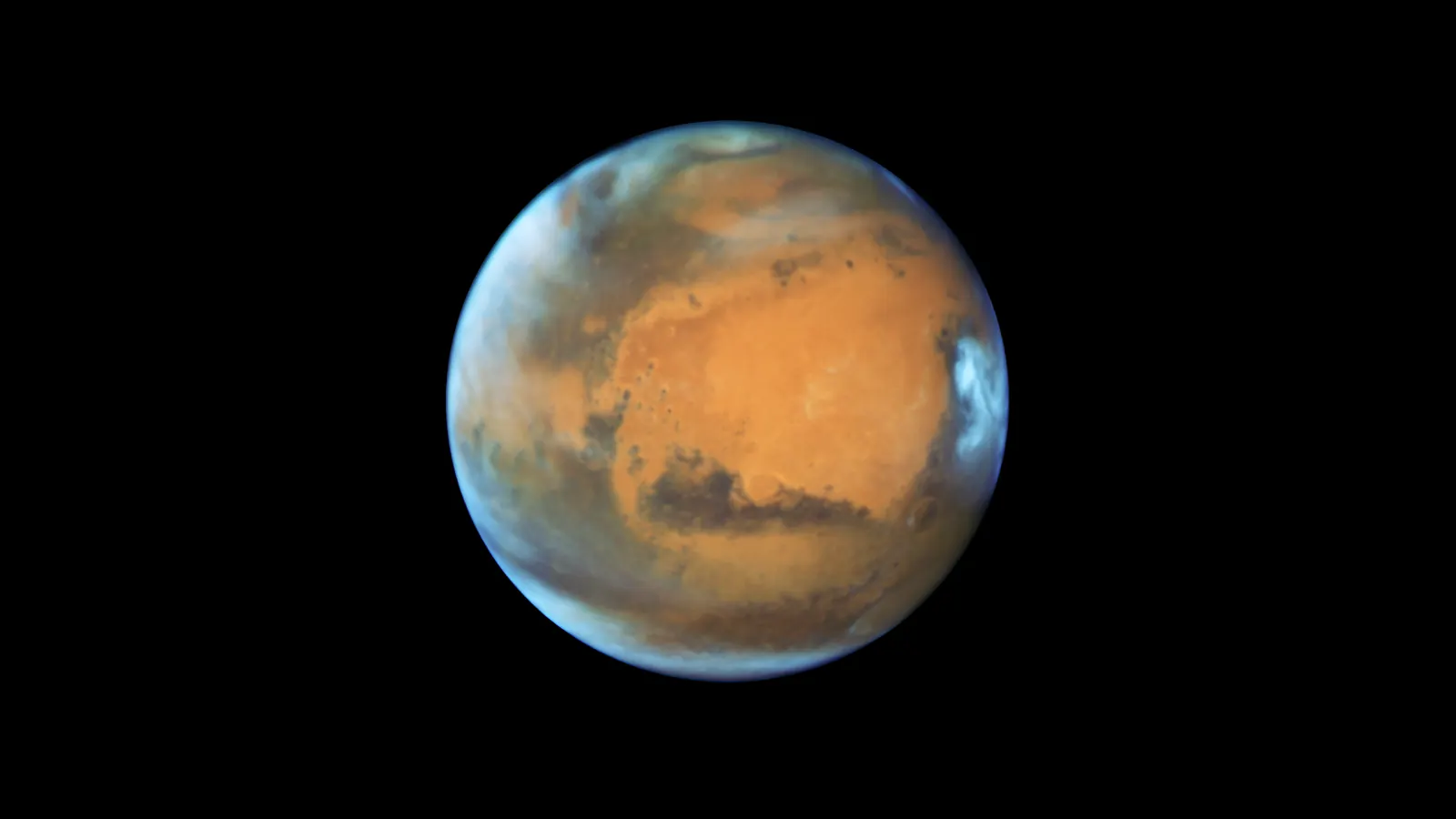
Mars will be closest to Earth at 00:14 UTC on February 20, 2027, according to EarthSky, with 101.41 million km (63.01 million miles) between the two planets. In the Americas it'll still be February 19, in the afternoon or evening depending on the time zone. Closest approach comes about eight and a half hours after opposition, the alignment that puts Earth between the Sun and Mars, which Sky at Night Magazine times at 15:44 UTC on February 19.
The 2027 approach is a distant one. Opposition falls close to aphelion, the point where Mars is farthest from the Sun, which keeps Mars about 1.8 times as far from us as it was at the record approach of August 27, 2003. By our calculation it's the most distant closest approach of all 47 oppositions between 2001 and 2100. Mars will still shine at magnitude −1.2 in the constellation Leo, Sky at Night says. On that scale, lower numbers mean brighter objects.
What is the difference between Mars opposition and closest approach?
At opposition, Earth lies between the Sun and Mars, so Mars sits on the opposite side of our sky from the Sun. Closest approach is the moment the distance between the planets bottoms out. NASA's explainers point out that if both planets moved on perfect circles, the two would happen together. Both orbits are ellipses, so closest approach lands at a slightly different time. A JPL scientist has likened the planets to cars on two race tracks that keep changing shape, size and orientation, so the place where the tracks come closest keeps moving.
In 2016, NASA noted, opposition fell on May 22 and closest approach on May 30, eight days later. Our own calculation gives the same two dates. In 2003 the order was reversed. EarthSky dates closest approach to August 27 and opposition to August 28.
Jeffrey Beish of the Association of Lunar and Planetary Observers (ALPO) writes that the two dates can fall as much as two weeks apart. In our run of the 16 oppositions from 2003 to 2035, the widest gap was eight calendar days, in 2005, 2016 and 2031. In 2027 they're only hours apart, and for anyone looking up on the night of February 19 the difference won't show.
Why are some Mars oppositions so much closer than others?
Earth moves around the Sun faster than Mars does, going round almost twice in the time Mars takes to go round once. It catches up with and passes Mars roughly every 26 months, according to the Planetary Society and NASA. NASA's Mars fact sheet gives the average interval, called the synodic period, as 779.94 days, or about 25.6 months.
Mars's orbit is noticeably stretched, so where Earth catches up matters. The fact sheet gives its eccentricity, a measure of how far an orbit departs from a circle, as 0.0934. Mars comes within 206.65 million km of the Sun at perihelion and swings out to 249.26 million km at aphelion, a difference of about 42.6 million km. NASA puts the range of closest-approach distances at about 35 million to 63 million miles (56 million to 101 million km).
Extra-close oppositions near perihelion come every 15 to 17 years, EarthSky says, and the last two were in 2003 and 2018. The 2003 approach holds the modern record at 55.76 million km (34.6 million miles), according to EarthSky and the National Astronomical Observatory of Japan. NASA has said Mars hadn't come that close in nearly 60,000 years, and EarthSky expects the record to stand until August 29, 2287. The 2018 pass, the closest in 15 years according to Phys.org, came within 57.58 million km by our numbers.
EarthSky's next extra-close opposition is in 2035. Beish dates it to 19:33 UTC on September 15, 2035, with closest approach on September 11, when Mars will show a disc 24.6 arcseconds wide. An arcsecond is 1/3,600 of a degree. ScienceAlert gives the 2035 distance as 56.9 million km (35.4 million miles), close to the 2003 record without beating it.
2027 sits at the other extreme. Sky at Night says Mars reaches aphelion on March 2, 2027, less than two weeks after opposition. Astronomy-engine, the ephemeris library our sky pages use, puts aphelion two days later, on March 4.
Mars oppositions from 2003 to 2035 in our data
WatchSat places the Sun, Moon and planets with astronomy-engine, an open-source library that our methodology page describes and our credits page lists. It positions Mars on the 3D solar system map and in the Mars view of our live map, and it supplies Earth's position for the live distances on our deep space tracker. For this post we used it to find every opposition from 2001 to 2100. We counted opposition as the moment Mars and the Sun are 180 degrees apart in ecliptic longitude, which is measured along the Sun's yearly path across the sky. Closest approach is the minute when the distance between the centers of Earth and Mars is smallest. All dates in the table are UTC.
| Year | Opposition | Closest approach | Distance at closest approach |
|---|---|---|---|
| 2003 | August 28 | August 27 | 55.76 million km |
| 2016 | May 22 | May 30 | 75.28 million km |
| 2018 | July 27 | July 31 | 57.58 million km |
| 2020 | October 13 | October 6 | 62.07 million km |
| 2022 | December 8 | December 1 | 81.45 million km |
| 2025 | January 16 | January 12 | 96.08 million km |
| 2027 | February 19 | February 20 | 101.41 million km |
| 2029 | March 25 | March 29 | 96.82 million km |
| 2031 | May 4 | May 12 | 82.78 million km |
| 2033 | June 28 | July 5 | 63.28 million km |
| 2035 | September 15 | September 11 | 56.91 million km |
We get opposition at 15:44 UTC on February 19, 2027, the same minute as Sky at Night. Forecast Bar, which lists events derived from JPL data, gives 16:10 UTC, 26 minutes later, and we couldn't find which definition of opposition it uses. For closest approach we get 00:21 UTC on February 20, seven minutes after the published 00:14, at 101,413,647 km (0.6779 AU). An AU is the average distance between Earth and the Sun. EarthSky's 101.41 million km and Sky at Night's 0.68 AU agree with our figure to the precision they give.
The minutes hardly matter. By our numbers the distance changes by less than half a kilometer between 00:14 and 00:21, and it's about 17,000 km greater a day before or after.
Among the century's 47 oppositions, 2027's lead as the most distant is narrow. Next come 2059 at 101.25 million km, 2074 at 101.19 million km and 2012 at 100.78 million km. At the other end, 2003 is the closest of the century, ahead of 2082 at 55.88 million km and 2050 at 55.96 million km. Our list stops in 2100, so it can't test EarthSky's 2287 date, but nothing in it beats 2003.
Distance decides how big and bright Mars looks. By our numbers its disc will be 13.8 arcseconds across in February 2027. In 2003 it was 25.1 arcseconds. Mars reached magnitude −2.88 at that opposition, against −1.21 in 2027, which made it about 4.7 times as bright.
Even at its 2003 best, Mars was tiny next to the Moon. That year an email began claiming that Mars would look as large as the full Moon to the naked eye on August 27, as Wikipedia's history of the hoax and Universe Today recount. According to Wikipedia's account, the original text said Mars would look that big through a telescope magnifying 75 times, and the line break that made that clear got lost in forwarding. Seventy-five is about the right factor. By our calculation the Moon's disc is 70 to 80 times as wide as Mars's was in 2003, depending on how far away the Moon is, and 128 to 146 times as wide as Mars's will be in February 2027. The email has gone round again every year since, the Christian Science Monitor noted in 2015.
How the 26-month cycle sets Mars launch windows
The rhythm that brings Mars close also decides when spacecraft can leave for it. Launch windows open about every 26 months, when the two planets line up for an efficient transfer. The next one falls in November and December 2026 and lasts roughly a month, according to a piece from The Conversation.
NASA's ESCAPADE mission plans to use it. Its twin Rocket Lab-built spacecraft, Blue and Gold, launched on November 13, 2025, on the second flight of Blue Origin's New Glenn, Spaceflight Now and Sky & Telescope reported. In February 2026 Rocket Lab said both had finished commissioning and moved onto a loiter path near L2, the Lagrange point on Earth's far side from the Sun. UC Berkeley's mission-design page has them firing toward Mars in November 2026, about three months before opposition, and arriving in September 2027, about seven months after it. We haven't seen an update to that plan. Japan's MMX, a sample-return mission to the Martian moon Phobos, is set to leave a little earlier, on October 20 Japan time, as our MMX post explains.
SpaceX has put off its own plans for this window. In May 2025, Elon Musk put the chance of an uncrewed Starship reaching Mars by the end of 2026 at 50-50, Al Jazeera reported, and said SpaceX would otherwise wait two years for the next window. In February 2026, Anadolu Agency reported, citing The Wall Street Journal, that SpaceX had shifted its focus to the Moon. Musk said on February 8 that Mars trips are possible only when the planets align every 26 months, while Moon launches can go far more often, as New Space Economy also reported.
The next window opens about 26 months after this one, ahead of the March 25, 2029, opposition. ESA's Rosalind Franklin rover is due to launch on a SpaceX Falcon Heavy from Kennedy Space Center no earlier than late 2028, European Spaceflight reported after NASA announced the launch choice on April 16, 2026. The rover would land at Oxia Planum around 2030. The same outlet has reported signs that NASA's backing could end, so treat that date as uncertain. Our launch schedule tracks upcoming launches, and the orbiters and rovers already working at Mars are listed on our Humans in Space page.
Sources
- Sky at Night Magazine, Mars reaches opposition in February 2027, the best time to see the Red Planet, undated
- EarthSky, Mars closest to Earth, undated
- European Spaceflight, ESA's Mars Rover to Launch Aboard SpaceX Falcon Heavy in 2028, April 2026
- New Space Economy, Elon Musk's pivot: SpaceX shifts focus from Mars to the Moon, February 9, 2026
- Anadolu Agency, Elon Musk's SpaceX postpones Mars mission to prioritize lunar voyage: report, February 2026
- Rocket Lab, Rocket Lab Completes Spacecraft Commissioning for NASA's ESCAPADE, February 2026
- Spaceflight Now, Live coverage: Blue Origin to launch NASA's Mars-bound ESCAPADE mission, November 2025
- Sky & Telescope, ESCAPADE mission launches for a long trip to Mars, November 2025
- UC Berkeley Space Sciences Laboratory, ESCAPADE mission design, undated
- The Conversation, reprinted by Yahoo News, explainer on NASA's Mars missions and the 2026 launch window, 2025
- Al Jazeera, Musk says 50-50 chance of sending uncrewed Starship to Mars by late 2026, May 30, 2025
- Association of Lunar and Planetary Observers, Jeffrey D. Beish, 2035 Mars apparition, December 20, 2020
- Phys.org, Mars makes closest approach to Earth in 15 years, July 2018
- National Astronomical Observatory of Japan, sky topics page on the 2018 Mars approach, 2018
- ScienceAlert, article on the 2035 close approach of Mars, 2018
- NASA/JPL, Mars Moves in for Some Quality Visual Time, 2016
- Christian Science Monitor, Why do we keep falling for that dumb Mars hoax?, August 27, 2015
- EarthSky, Close and far Martian oppositions, undated
- Forecast Bar, Mars opposition 2027 (JPL-derived listing), undated
- NASA Space Science Data Coordinated Archive, Mars Fact Sheet, undated
- NASA Science, Mars: Closest Encounter, undated
- NASA Science, Something for Every Sky Watcher, undated
- The Planetary Society, article on Mars opposition, undated
- Wikipedia, Mars hoax email, undated
- Universe Today, Will the Mars look as big as the Moon on August 27? Nope, undated
- WatchSat calculations with Astronomy Engine 2.1.19, October 12, 2026
Follow by RSS. Share this post: Bluesky · X · Reddit · Email
More from the blog
-
What is the Kp index? How to read an aurora forecast
The Kp index rates geomagnetic activity from 0 to 9 every three hours. Kp 5 is a G1 storm, and each step brings the aurora about 2 degrees nearer the equator.

-
Leonid meteor shower 2026: peak time, Moon and next storm
The Leonid meteor shower 2026 peaks around 23:45 UTC on November 17, at a ZHR of about 15, under a half-lit Moon that sets by about midnight.

-
What causes the northern lights? Solar wind and colors
Particles from the Sun, steered to the poles by Earth's magnetic field, make oxygen and nitrogen glow mostly 100 to 200 km up. The Sun peaked in October 2024.
-
What is OneWeb? Owner, satellite count and orbits
OneWeb is Eutelsat's broadband network in low Earth orbit. On October 11, 2026, our catalog held 651 OneWeb satellites, about 1,200 km up in 12 planes.
-
What is SpaceX Starship? Size, engines and flight record
SpaceX Starship is a two-stage rocket, 124.4 m tall, built to be fully reused. Its 14th flight reached orbit on September 28, 2026.

Home · Live satellite map · Satellite directory · Starlink · OneWeb · Navigation satellites · Space stations · Other active satellites · Track the ISS · ISS visible passes · Starlink train · Rocket launches · Aurora forecast · Humans in space · Solar System · Deep Space · Embed widgets · Blog · Guide: spot the ISS · Guide: what is a TLE? · Guide: how many satellites? · Guide: satellite trackers compared · Discovery: Elias 2-24 b · About · FAQ · Data & methodology · Credits · Editorial policy · Accessibility · Contact · Privacy · Terms
© 2026 WatchSat · Not affiliated with any space agency or satellite operator.