WatchSat › Blog › How many rocket launches in 2026? The count so far
How many rocket launches in 2026? The count so far
Rocket launches in 2026 reached about 240 orbital attempts by mid-October, one every 28.5 hours. How it compares with 2025's record and what the catalog shows.
Corrected on : An earlier version dated booster B1067's record 37th flight August 24, the date in Spaceflight Now's article address. The launch was at 09:33 UTC on August 25.
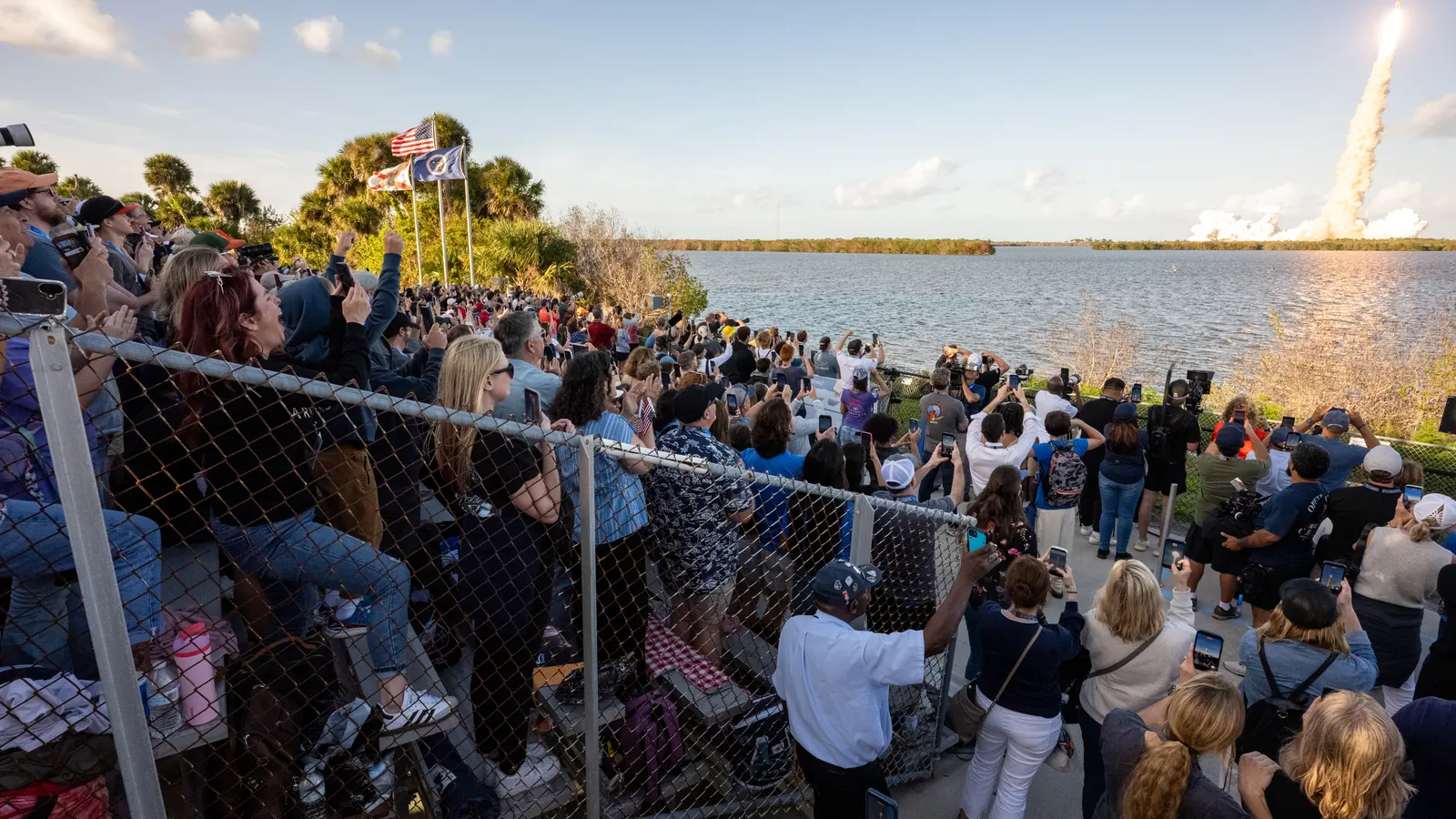
Rockets had made close to 240 attempts to reach orbit in 2026 by mid-October. In its October 5 launch preview, NASASpaceflight.com counted Starlink 15-25, a SpaceX Falcon 9 flight, as the 240th orbital launch attempt of the year. That flight has since slipped to October 12, so the tally on October 11 stood at about 239, or 0.84 launches a day. At that rate something lifts off for orbit every 28.5 hours. Trackers give slightly different answers to how many rocket launches there have been in 2026, because they don't all count the same flights or update on the same day.
The satellite catalog offers an independent check. Every launch that reaches orbit gets an international designator, such as 2026-230A, which records the year, the launch's number within that year and a letter for each object it left in orbit. In our October 11 snapshot of CelesTrak's list of active satellites, the highest 2026 launch number is 230, from Guowang 27, a launch for China's Guowang satellite network. Its first orbit data in our snapshot are dated October 10. So at least 230 launches have put something into orbit this year. Attempts run higher, because a rocket that fails on the way up never gets a designator.
How many rocket launches were there in 2025?
The record year is 2025. Astronomer Jonathan McDowell counted 329 orbital launch attempts from Earth that year in his 2025 launch tables. Of those, 321 reached orbit or came close to it, which leaves eight failures, about one launch in 41.
SpaceNews came in a little lower, at 324 orbital launch attempts, in an analysis that AIAA reposted on January 5, 2026, calling 2025 a record-breaking year. Its count leaves out suborbital flights, such as Starship's five test flights and three HASTE launches of Rocket Lab's Electron. Trackers draw that line in different places, so their totals for the same year can differ by a handful. On either count, 2025 averaged about 0.9 launches a day, a little faster than 2026 so far.
Those launches carried thousands of satellites. ESA's 2026 Space Environment Report counts more than 300 launches in 2025 carrying over 4,000 new payloads, and McDowell's payload records put the figure at 4,526.
Failures have stayed rare in 2026. KeepTrack's 2026 launch chronology, built from McDowell's catalog, listed 171 attempts and six failures through July 19. One was India's PSLV-C62 in January, which failed during third-stage flight. The chronology's pace over the year's first 200 days, about 0.85 attempts a day, is close to the rate in NASASpaceflight.com's later count. We didn't find a reliable failure tally for the months since July.
Which country launches the most rockets?
The United States leads, mostly because of SpaceX. Working from McDowell's data, Payload counted 170 SpaceX launches in 2025, 165 on Falcon 9 and five on Starship. China came second with 92 attempts, 35% more than in 2024. Between them, SpaceX and China made 262 of the 329 attempts, about four in five.
SpaceX is ahead again in 2026. Spaceflight Now reported its 100th orbital mission of the year in late August. NASASpaceflight.com counted Starlink 15-25 as the 112th Falcon 9 mission of 2026, which puts one rocket type behind nearly half of the world's attempts this year. Falcon 9 can fly that often because its first stage, the booster, lands and flies again. On August 25 one booster made a record 37th flight, Spaceflight Now reported.
Since then the pace has eased. SpaceX averaged about three orbital launches a week through late August, and in the seven weeks after that Falcon 9 added roughly a dozen more. NASASpaceflight.com's preview described "a slow winding down of Falcon 9 operations." Meanwhile Starship reached orbit for the first time on Flight 14 on September 28 and began deploying the next-generation Starlink V3 satellites. The preview said no more Falcon 9 Starlink missions are planned from Florida, and how long they'll continue from Vandenberg, in California, "remains to be seen."
Counting 2026's launches in the satellite catalog
Each object on CelesTrak's active list comes with a two-line element set, or TLE, a compact block of orbit numbers whose first line carries the international designator. We read the designators of all 16,701 objects in our October 11 snapshot, the same data behind our live satellite map, and grouped them by launch. Guowang 27's first object is catalog number 100973, six digits long because the catalog ran out of five-digit numbers in July.
The highest number, 230, is a minimum rather than a total. CelesTrak's active list holds objects that aren't known to be dead, so a launch whose satellites are classified, not yet published or already gone doesn't show up. Recent launches can be missing too. Numbers 224 and 228 have nothing on the list even though 229 and 230 do, so there may also be launches after 230 that haven't appeared yet. Against NASASpaceflight.com's figure of about 239 attempts, the gap is about nine, which failures and launches not yet listed could explain. As a cross-check, McDowell's launch records showed 220 successful launches in late September, as our census of active satellites noted.
| Launch year | Highest launch number | Numbers with an active object | Active objects | Starlink share | Starlinks per Starlink launch | Launches with Guowang or Qianfan satellites |
|---|---|---|---|---|---|---|
| 2024 | 254 | 213 | 2,433 | 76.2% | 20.8 | 4 |
| 2025 | 315 | 279 | 4,290 | 73.2% | 25.7 | 21 |
| 2026, to October 11 | 230 | 210 | 3,264 | 66.3% | 26.4 | 23 |
Of the 230 numbers for 2026, 210 still have at least one object on the active list. For 2025 it's 279 of 315, and for 2024 it's 213 of 254. The share drops as a year's launches age, from 91% for 2026 to 89% for 2025 and 84% for 2024, as satellites die and reenter and crew and cargo ships come home.
This year's launches have left 3,264 objects on the active list, and 2,163 of them, or 66.3%, are Starlinks. Of 2025's survivors 73.2% are Starlinks, and of 2024's 76.2%. The Starlink share is lower this year even though each launch with Starlinks aboard has put more of them on the list. Those launches averaged 26.4 Starlinks each in 2026, against 25.7 in 2025 and 20.8 in 2024. You can follow the whole fleet on our Starlink constellation page.
The largest batches came from launches that carried dozens of satellites at once. Launch 2026-067 has 96 objects still active, among them PEAKSAT, and 2026-156 has 78, including CAS500-4. The Transporter-18 rideshare, launch 2026-227, a SpaceX flight that carries satellites for many customers, added 71. At the other end, 52 of this year's launches have a single object on the list, and the 50 busiest launches account for half of all 3,264.
China's two new satellite constellations show the fastest change. In our data, 23 launches this year carried at least one Guowang or Qianfan satellite that's still on the list. That's already more than the 21 in all of 2025, and up from four in 2024. Like the launch numbers, these counts include only survivors, so they're minimums as well.
Our snapshots hint at the recent slowdown. The highest number rose from 223 on September 27 to 230 on October 11, about 0.5 launches a day, against 0.81 a day for the year's numbered launches as a whole. Catalog lag may explain part of the drop, since numbers 224 and 228 are still empty.
Launches to watch for the rest of 2026
WatchSat's launch schedule draws on Launch Library 2, a public launch database run by The Space Devs. In the version we loaded on October 10, four upcoming launches were marked go with a set time, and three of them are Falcon 9 flights. Starlink 15-25, the 240th attempt by NASASpaceflight.com's count, is due to lift off from Vandenberg on October 12 at 23:00 UTC. On October 13 at 10:33 UTC, another Falcon 9 is set to launch the CRS-35 Dragon cargo mission to the International Space Station from Cape Canaveral. A third should carry USSF-481 from Vandenberg on October 15 at 23:44 UTC.
The odd one out is Japan's MMX mission to the moons of Mars, due on an H3 rocket from Tanegashima on October 19 at 19:41 UTC. Most other entries in the feed carry a placeholder date at the end of a month, and launch dates slip often.
If launches keep 2026's average pace of 0.84 a day, the 81 days from October 12 to December 31 would add about 68 attempts, for a total near 307. Matching 2025's 329 would take about 90 more, or 1.1 a day. That's about a third faster than this year's average, at a time when Falcon 9's flight rate is falling. NASASpaceflight.com's count and McDowell's may not treat every flight the same way, so the comparison is approximate. New Starlinks, including the batch from Starlink 15-25, show up on our Starlink train page once their first orbits are published.
Sources
- NASASpaceflight.com, Launch Preview: Flights from South Korea, China, USA planned for this week, October 5, 2026
- Jonathan McDowell, planet4589.org, 2025 launch tables; launch and payload statistics, as cited in our post of September 27, 2026
- AIAA, reposting SpaceNews, SpaceX and China Power Record-Breaking Year for Orbital Launches, January 5, 2026
- Payload, 2025 orbital launch attempts by country
- ESA, ESA Space Environment Report 2026, 2026
- Spaceflight Now, SpaceX launches 100th orbital mission of 2026, August 21, 2026, and SpaceX to launch Starlink mission on a Falcon booster's record-breaking 37th flight, August 24, 2026
- SpaceX, Starship Flight 14, September 28, 2026
- KeepTrack, 2026 Space Launch Chronology, current to July 19, 2026
- CelesTrak, active satellite element sets, snapshots of September 27 and October 11, 2026
- The Space Devs, Launch Library 2, upcoming launches as loaded on October 10, 2026
Follow by RSS. Share this post: Bluesky · X · Reddit · Email
More from the blog
-
How long do satellites last? Lifespan by orbit and type
How long do satellites last? Most active ones are Starlinks, built for five years. New GPS satellites get 15, and Landsat 5, built for three, lasted 28 years.
-
When will the ISS be retired? Deorbit plan and what's next
NASA plans to retire the ISS after September 30, 2030, when operations end. A SpaceX-built vehicle then steers it into the South Pacific in about 2031.
-
Where is China's Tiangong space station? Orbit and crew
China's Tiangong space station orbits about 386 km up on a 41.5° tilt, so it stays between 41.5° N and S. Who's aboard, its size, and where you can see it.
-
What are the types of orbits? LEO, MEO, GEO and HEO
The main types of orbits are LEO, MEO, GEO and HEO. Of 16,701 objects on CelesTrak's active list on October 11, 2026, 95 percent were in low Earth orbit.
-
What are the Van Allen belts? Altitude, risks and satellites
The Van Allen belts are two zones of trapped particles, about 1,600 to 40,200 km up by NASA figures. Of 16,701 active satellites, 95% stay below 2,000 km.
Home · Live satellite map · Satellite directory · Starlink · OneWeb · Navigation satellites · Space stations · Other active satellites · Track the ISS · ISS visible passes · Starlink train · Rocket launches · Aurora forecast · Humans in space · Solar System · Deep Space · Embed widgets · Blog · Guide: spot the ISS · Guide: what is a TLE? · Guide: how many satellites? · Guide: satellite trackers compared · Discovery: Elias 2-24 b · About · FAQ · Data & methodology · Credits · Editorial policy · Accessibility · Contact · Privacy · Terms
© 2026 WatchSat · Not affiliated with any space agency or satellite operator.