WatchSat › Blog › Leonid meteor shower 2026: peak time, Moon and next storm
Leonid meteor shower 2026: peak time, Moon and next storm
The Leonid meteor shower 2026 peaks around 23:45 UTC on November 17, at a ZHR of about 15, under a half-lit Moon that sets by about midnight.
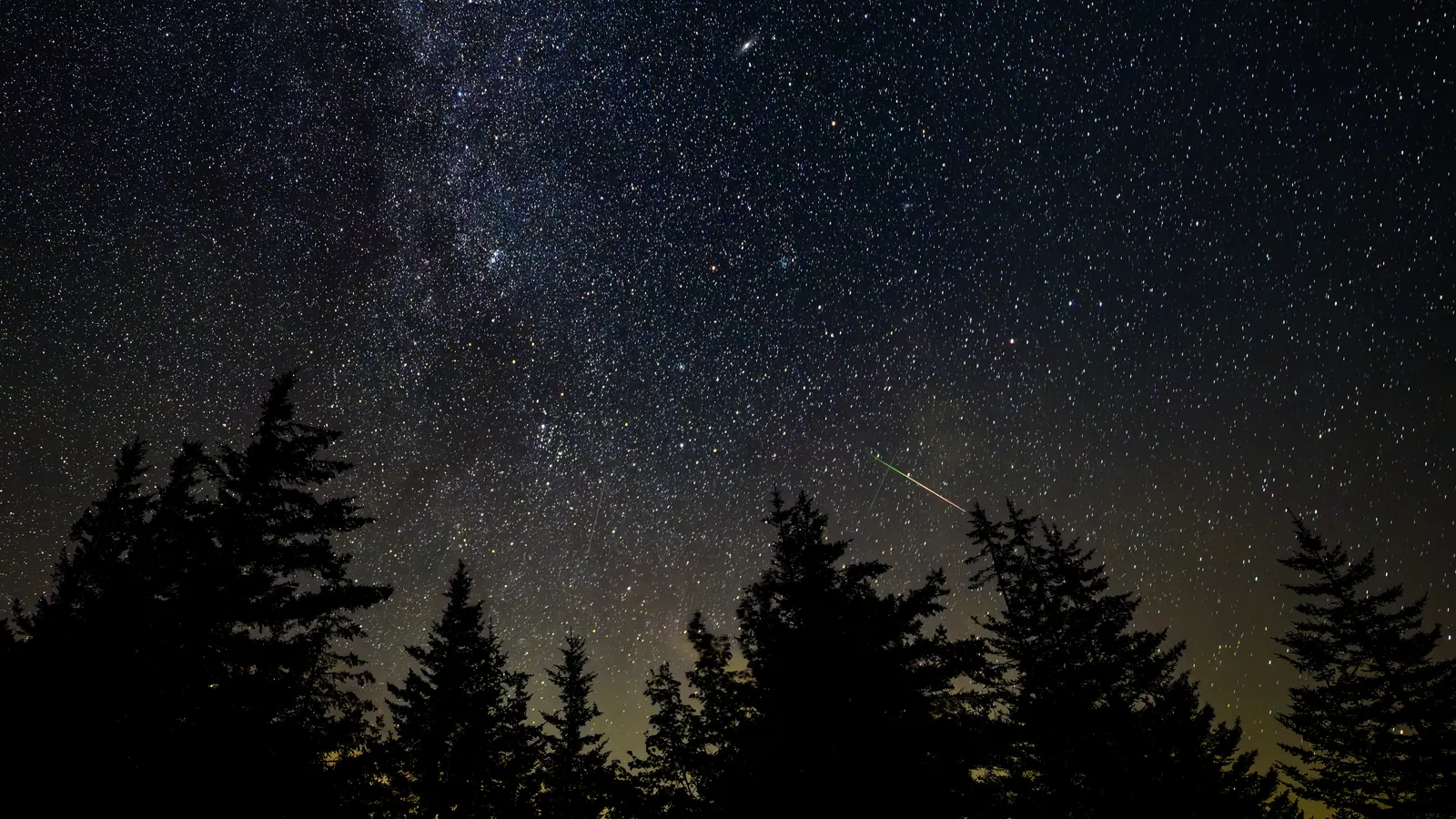
The Leonid meteor shower peaks around the night of November 17, 2026. Ondatravel, quoting the International Meteor Organization's 2026 calendar, puts the maximum at 23:45 UTC on November 17, which is 6:45 p.m. EST in New York. The American Meteor Society (AMS) gives the Leonids a modest zenithal hourly rate of 15. A roughly half-lit first quarter Moon sets between about 11 p.m. and midnight, so the hours before dawn are dark.
The Leonids are best known for their storms. In 1833 and 1966, people in North America saw meteors fall at rates estimated in the tens of thousands an hour or more, and smaller storms followed in 1999, 2001 and 2002. NASA says a Leonid storm can come every 33 years or so, in step with the orbit of the shower's parent comet, 55P/Tempel-Tuttle. None of the forecasts we found predicts a storm for 2026.
When is the Leonid meteor shower in 2026?
NASA's Leonid page and the AMS meteor shower calendar both list the shower as active from November 6 to November 30, 2026, and both name November 16–17 as the peak night. Other forecasts point a day later. Ondatravel quotes the IMO's 2026 calendar for a maximum at 23:45 UTC on November 17, and EarthSky gives 0 UTC on November 18, a quarter of an hour later. EarthSky advises watching from late on November 17 until dawn on November 18. Space.com's 2026 shower guide follows NASA's date and suggests late on November 16 until dawn on November 17.
At 23:45 UTC it's 6:45 p.m. EST in New York and 3:45 p.m. PST in Los Angeles, hours before the radiant rises. The radiant is the point the meteors seem to fly out of. In central Europe the peak comes at 00:45 CET on November 18, after the radiant is up. On both sides of the Atlantic, the night of November 17–18 is the one closest to the IMO's maximum. NASA and the AMS name the night before, and the shower runs for more than three weeks, so the morning of November 17 is worth a try too.
Rates in an ordinary year are low. The AMS lists a zenithal hourly rate, or ZHR, of 15. Star Walk says up to 15 an hour and the Farmers' Almanac 10 to 15 under dark skies, while the IMO's notes on the 2018 Leonids gave a usual ZHR of 10 to 20. NASA's page is the most cautious, listing fewer than 3 meteors an hour observed under dark skies. A ZHR describes an ideal sky, and our Geminid guide explains why real counts come in lower. Star Walk and Ondatravel, the latter in wording that follows the IMO calendar, both say no significant outburst is predicted this year.
Will the Moon spoil the 2026 Leonids?
Only for the first half of the night. Ondatravel and EarthSky both put first quarter on November 17, so the Moon is roughly half lit on the peak night. The AMS calendar lists it as 45% full. Star Walk gives 53% and the German site Sterngucker 54%. The Moon is waxing, so the figure depends on the hour each source picked.
Moonset varies with location. Star Walk puts it around 11 p.m., Ondatravel's Leonid page gives about 22:58 for Warsaw, and Sterngucker 23:30 for Berlin. Once it's down, the sky stays moonless until dawn.
The radiant sits in the constellation Leo. The AMS lists it at right ascension 10h08m and declination +21.8 degrees, and Ondatravel places it just over 10 degrees north of the star Regulus. EarthSky says Leo rises just before midnight in mid-November and the radiant is highest at dawn, and Space.com calls viewing generally favourable after midnight. Watch from moonset until the first light of dawn.
Leonids hit the atmosphere fast. NASA's fact box and the AMS give 69.7 km/s, and NASA's main text 71 km/s (44 miles per second). NASA's page also quotes an AMS fireball coordinator calling them the fastest meteors of the major annual showers.
The 2026 Leonid night in WatchSat's sky calculations
We checked the peak and the Moon ourselves with astronomy-engine, the open-source library that places the Sun, Moon and planets in WatchSat's sky view and our 3D solar system. Our methodology page explains how the sky view's positions are checked against it, and the credits page lists it with our other data sources.
We timed the peak by solar longitude, the Sun's position along its yearly path. For the maximum we used 235.27 degrees (J2000), the Sun's longitude at Ondatravel's 23:45 UTC in a simpler calculation of our own. None of the sources we read states that figure. In astronomy-engine the Sun reaches it at 23:52 UTC on November 17, seven minutes later. At that moment the Moon is 55% lit. It passed first quarter at 11:48 UTC, about 12 hours before the peak. New Moon falls on November 9 and full Moon on November 24, so the nights after the peak get brighter.
For a sample night, we picked a site at 40 degrees north on the prime meridian, where local solar time matches UTC. It's roughly the latitude of New York, Madrid and Beijing. On November 17 the radiant rises there at about 23:00 and the Moon sets at 23:47. Our calculated maximum follows five minutes later, with the radiant still low in the east, and the Sun doesn't rise until 06:48 on November 18. Between moonset and sunrise there are about seven hours with the radiant climbing, less the twilight before dawn. Elsewhere near that latitude, moonset and the radiant's rise come at similar local solar times, but the maximum falls at the same instant everywhere, around 23:50 UTC.
Satellites are the other moving lights you'll see in those hours. A satellite glides steadily across the sky for minutes, as our guide to spotting the ISS describes, while a Leonid moving at about 70 km/s is gone almost as soon as you notice it. For the Orionid peak in October we counted sunlit satellites over New York through a whole night and found the middle hours almost empty, with the count climbing again before dawn. We haven't run that count for November. Our live satellite map shows what's overhead at any moment, the ISS pass predictions tell you whether the station crosses your sky on the peak mornings, and the Starlink train tracker flags fresh batches that cross in a line. Satellites leave trails in long exposures too, and our post on satellite streaks in telescope images explains how they get there.
Comet Tempel-Tuttle and the 33-year Leonid storms
The Leonids are debris from comet 55P/Tempel-Tuttle. In a 2006 NASA article, the agency's Meteoroid Environment Office said that every time the comet visits the inner solar system, once every 33 years, it lays down a new stream of dust, pebbles and rock. JPL's Small-Body Database, as relayed by TheSkyLive, gives the orbital period as 33.2418 years, and Wikipedia's entry on the comet says 33.318. Its next perihelion, the closest point to the Sun, comes in May 2031, on May 20 by Wikipedia's figure or May 27 by TheSkyLive's.
NASA's Leonid page says a storm can bring hundreds to thousands of meteors an hour, depending on where you are. Forecasters tie storms to individual trails of debris. NASA's Leonid campaign site traces the 1966 storm to material the comet shed in 1899. Its 1998–2002 forecasts had Earth passing in 2002 through dust released in 1767, best seen from Europe, and in 1866, best seen from the Americas.
| Year | What was reported | Source |
|---|---|---|
| 1833 | About 240,000 meteors seen under clear skies across the eastern United States | Space.com |
| 1966 | About 40 a second, or 144,000 an hour, at the peak on November 17, and about 150,000 an hour for roughly 20 minutes from one observer in Arizona | Christian Science Monitor, NASA |
| 1999, 2001, 2002 | Storms of thousands an hour (Space.com). NASA's forecast page listed a ZHR of 1,300 for the 2001 peak over the US | Space.com, NASA |
| 2026 | ZHR about 15, no significant outburst predicted | AMS, Star Walk, Ondatravel |
Space.com and the Transient Sky site credit the 1833 storm with starting modern meteor science. Counts from that night vary. Space.com's 240,000 is a total, while Transient Sky gives about 70,000 an hour. NASA counts 2002 as the most recent storm, and the IMO lists 1999, 2001 and 2002 as the latest storm years.
The IMO's Leonid page says the next storm isn't expected before 2033–34. A preprint posted to arXiv in August 2026, not yet peer reviewed, models the stream's dust trails and finds 2031 quiet, with no coherent section of trail reaching Earth. It predicts the strongest activity of 2031 to 2035 on November 18, 2034, as a night with two comparable maxima rather than one storm. Its authors say the model reproduces the peak times of the 2001 and 2002 storms to within 1 and 40 minutes.
Older forecasts differ. The Christian Science Monitor pointed to 2033 back in 2015. The Denver Astronomical Society expects good displays around the comet's 2031 and 2064 returns, at times over 100 an hour, but no storm until Earth meets dense debris in 2099. A compilation of dust-trail forecasts by Lyytinen lists three encounters in 2033 and 2034 from a 1999 paper and warns that further modelling could shift the predicted maxima considerably.
Sources
- Sterngucker, Leoniden, updated September 2026
- arXiv, A calibrated dust-trail model of the Leonid meteoroid stream and forecasts of the 2031-2035 encounters, preprint, August 2026
- NASA Science, Leonids, 2026 edition, undated
- American Meteor Society, Meteor Shower Calendar 2026-2027, undated
- International Meteor Organization, The 2026 meteor shower calendar is here, undated
- Ondatravel, Leonids (meteor shower calendar) and Leonids, undated
- EarthSky, Everything you need to know: Leonid meteor shower, 2026 text, undated
- Space.com, Meteor showers 2026: When, where and how to see the best 'shooting stars' of the year, 2026 guide, undated
- Star Walk, Leonids 2026: How To Watch This Classic November Meteor Shower, 2026 text, undated
- Farmers' Almanac, Leonid Meteor Shower 2026: Peak Date, Viewing Tips, and Forecast, undated
- International Meteor Organization, Leonids, undated, and Observing the 2018 Leonids, 2018
- Christian Science Monitor, The Leonids are coming! Here's how to watch them, November 10, 2015
- Transient Sky, The meteor storms of November, part II: the Leonids, November 16, 2008
- NASA, Return of the Leonids, November 2006
- NASA Leonid Multi-Instrument Aircraft Campaign, history of the Leonid storms and Leonid forecasts for 1998 to 2002, page titles not available, undated
- Space.com, The Leonid Meteor Shower Revealed: Shooting Star Show's Brilliant History, undated
- TheSkyLive, Comet 55P/Tempel-Tuttle, data from JPL's Small-Body Database, undated
- Wikipedia, 55P/Tempel-Tuttle, undated
- Denver Astronomical Society, Meteor Showers: Leonids (LEO), undated
- castfvg.it, Lyytinen's compilation of Leonid dust-trail forecasts, page title not available, undated
- Astronomy Engine, astronomy-engine on GitHub, the ephemeris library behind WatchSat's calculations, run October 12, 2026
Follow by RSS. Share this post: Bluesky · X · Reddit · Email
More from the blog
-
What is Kessler syndrome? How a space debris cascade works
Kessler syndrome is a runaway chain of collisions in orbit, first described in 1978. ESA's 2026 report projects low-orbit collisions climbing fast.
-
What is the Kp index? How to read an aurora forecast
The Kp index rates geomagnetic activity from 0 to 9 every three hours. Kp 5 is a G1 storm, and each step brings the aurora about 2 degrees nearer the equator.
-
When is Mars closest to Earth? 2027 date and distance
Mars is closest to Earth on February 20, 2027 (UTC), 101.41 million km away, hours after opposition. By our count it's the farthest such approach of 2001-2100.
-
What causes the northern lights? Solar wind and colors
Particles from the Sun, steered to the poles by Earth's magnetic field, make oxygen and nitrogen glow mostly 100 to 200 km up. The Sun peaked in October 2024.
-
What is OneWeb? Owner, satellite count and orbits
OneWeb is Eutelsat's broadband network in low Earth orbit. On October 11, 2026, our catalog held 651 OneWeb satellites, about 1,200 km up in 12 planes.
Home · Live satellite map · Satellite directory · Starlink · OneWeb · Navigation satellites · Space stations · Other active satellites · Track the ISS · ISS visible passes · Starlink train · Rocket launches · Aurora forecast · Humans in space · Solar System · Deep Space · Embed widgets · Blog · Guide: spot the ISS · Guide: what is a TLE? · Guide: how many satellites? · Guide: satellite trackers compared · Discovery: Elias 2-24 b · About · FAQ · Data & methodology · Credits · Editorial policy · Accessibility · Contact · Privacy · Terms
© 2026 WatchSat · Not affiliated with any space agency or satellite operator.