WatchSat › Blog › What is the Kp index? How to read an aurora forecast
What is the Kp index? How to read an aurora forecast
The Kp index rates geomagnetic activity from 0 to 9 every three hours. Kp 5 is a G1 storm, and each step brings the aurora about 2 degrees nearer the equator.
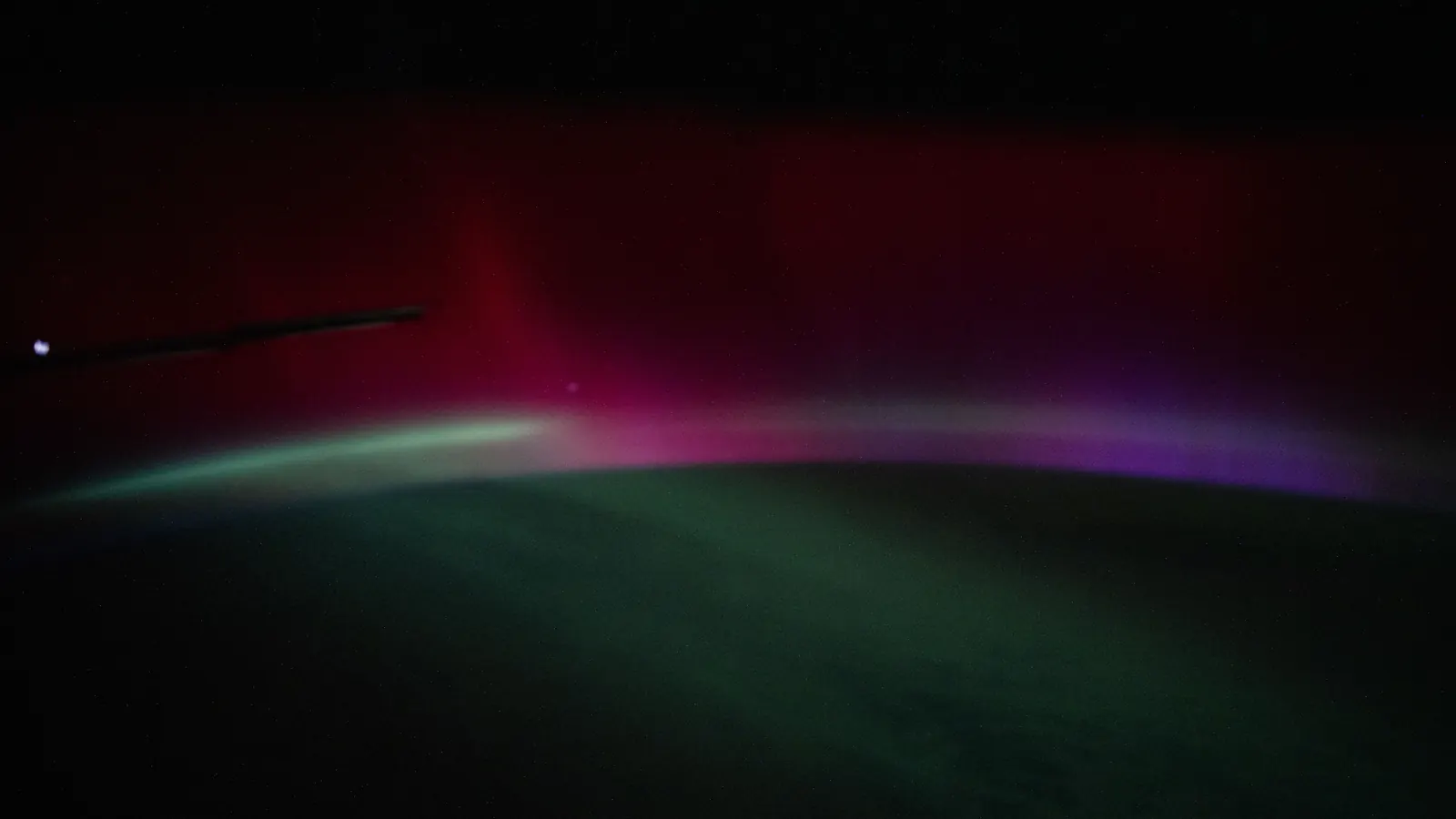
The Kp index is a number from 0 to 9 that rates how disturbed Earth's magnetic field is during each three-hour block of the day. Germany's GFZ Helmholtz Centre computes the official value from 13 magnetic observatories, and NOAA's Space Weather Prediction Center (SWPC) publishes a faster estimate from 8 of them. Kp 5 is where NOAA's geomagnetic storm scale starts, at G1, and as a rule of thumb each step up moves the aurora about 2 degrees of geomagnetic latitude toward the equator. The scale tops out at 9, a level the British Geological Survey reported on May 10 and 11, 2024.
Our aurora forecast page runs on Kp, which has two limits. It's measured on the ground after a disturbance arrives, and a three-hour value can lag a fast-moving storm.
What is the Kp index, and who calculates it?
Every Kp value starts as a set of local K indices. Each observatory measures how far the horizontal magnetic field strays from a quiet-day curve in each three-hour slot of the UTC day and converts that range to a number from 0 to 9. NOAA's geomagnetic data archive calls the scale quasi-logarithmic, and its conversion to ap, a linear version, shows how steep it gets. Kp 4 equals an ap of 27, and Kp 9 equals 400.
GFZ dates the K index to 1938, when it was introduced at the Niemegk observatory near Potsdam. Julius Bartels introduced the planetary version, named for the German planetarische Kennziffer, or planetary index. GFZ's Kp page dates that to 1949, while Wikipedia's K-index article says 1939.
Kp is the mean of the 13 observatories' standardised K values, GFZ says. NOAA's archive places them between 44 and 60 degrees geomagnetic latitude, while an older NGDC file says 46 to 63. In that file's list, 11 are in Europe and North America, from Lerwick in Britain to Sitka in Alaska, and Eyrewell in New Zealand and Canberra in Australia cover the south.
The standardised values come in thirds, giving 28 steps from 0o to 9o. A minus means a third below the whole number and a plus a third above, so on NOAA's Kp and ap table 5- is 4 2/3, 5o is 5 and 5+ is 5 1/3. SWPC's feed writes them as decimals, which is why our aurora page shows values like 4.67.
Not every observatory reports in real time. SWPC builds its estimated Kp from the 8 it can get quickly, at Sitka, Meanook, Ottawa, Fredericksburg, Hartland, Wingst, Niemegk and Canberra. GFZ's value is the definitive one, and its nowcast tables flag values built from fewer than 13 observatories.
What Kp do you need to see the aurora where you live?
NOAA's storm levels translate straight into Kp. SWPC's table maps G1 to Kp 5, G2 to Kp 6, G3 to Kp 7, and G4 to Kp 8 up to 9-, leaving only 9o for G5. Our report on this month's G3 storm shows the scale in use, and our post on how solar storms affect satellites covers the orbital side.
Over an 11-year solar cycle, NOAA's scale page puts the average at about 1,700 three-hour periods at G1, on about 900 days, and about 4 at G5, on about 4 days. By our arithmetic, the G1 figure works out to some 155 periods a year. Australia's Bureau of Meteorology counted 22 G5-level storms in eight cycles, about 90 years, or roughly 3 per cycle. It says G4 and G5 storms favour the declining years after solar maximum, though a G5 can come at any point.
For the aurora itself, SWPC's aurora viewing tips work from the auroral oval, the ring of light around each magnetic pole. At Kp 0 its equatorward edge lies near 66 degrees geomagnetic latitude, and it moves about 2 degrees toward the equator per Kp step, which by our arithmetic puts it near 56 degrees at Kp 5 and 48 at Kp 9. SWPC and NOAA's National Centers for Environmental Information both treat the rule as an approximate average.
Geomagnetic latitude is measured from the geomagnetic poles, which are tilted away from the geographic ones. In the model our aurora page uses, the north geomagnetic pole sits 9.35 degrees from the geographic pole, at 80.65 degrees north and 72.68 degrees west, close to the meridian through Boston and New York. Winnipeg, at 49.9 degrees north, comes out almost level geomagnetically with Edinburgh, which is about six degrees farther north.
For US viewers, SWPC's tips say the aurora stays far north and dim at Kp 0 to 2 and spreads and brightens at 3 to 5. At Kp 6 or 7 it may be visible from the northern edge of the United States, and at 8 or 9 it may be overhead in the northern states.
You don't need it overhead. SWPC's aurora page says a bright display can be seen from up to 1,000 km (about 620 miles) away, roughly 9 degrees of latitude, while an older SWPC tips page puts the easy-viewing range at 4 or 5 degrees. A paper evaluating auroral forecasts against satellite observations reports that the forecast's poleward edge is less reliable from Kp 3 up.
Kp thresholds for 11 cities on our aurora page
Our aurora forecast reads SWPC's planetary K-index and three-day Kp forecast through an edge function that caches them for 15 minutes. It shows the latest Kp, its G level and the highest predicted Kp for three UTC days, starting with today. SWPC is credited on our credits and data sources page, and our FAQ covers our other data sources.
Share your location and the page converts it to geomagnetic latitude with that centred-dipole model, then compares it with a viewline that starts at 66.5 degrees at Kp 0 and moves 2.04 degrees toward the equator per Kp step. Poleward of the line, the page says the aurora may be overhead. Within 6 degrees equatorward it's possible low on the horizon, and farther away it's unlikely.
Our line runs 0.14 to 0.5 degrees poleward of SWPC's rule, a shade stricter. Both lines are more generous than SWPC's own US guidance above, which keeps an overhead aurora in the northern states for Kp 8 or 9. The 6-degree horizon band sits between the older page's 4 to 5 degrees and SWPC's 1,000 km. The table shows where 11 cities cross into each zone, assuming a dark, clear sky.
| City | Geographic latitude | Geomagnetic latitude | Horizon band from | Overhead from |
|---|---|---|---|---|
| Reykjavik | 64.1° N | 68.9° | any Kp | any Kp |
| Fairbanks | 64.8° N | 65.6° | any Kp | Kp 0.4 |
| Edinburgh | 56.0° N | 58.1° | Kp 1.2 | Kp 4.1 |
| Winnipeg | 49.9° N | 58.2° | Kp 1.1 | Kp 4.1 |
| London | 51.5° N | 53.4° | Kp 3.5 | Kp 6.4 |
| Minneapolis | 45.0° N | 53.6° | Kp 3.4 | Kp 6.3 |
| Seattle | 47.6° N | 53.1° | Kp 3.6 | Kp 6.6 |
| Boston | 42.4° N | 51.7° | Kp 4.3 | Kp 7.3 |
| New York | 40.7° N | 50.1° | Kp 5.1 | Kp 8.1 |
| Hobart | 42.9° S | 49.7° | Kp 5.3 | Kp 8.2 |
| Christchurch | 43.5° S | 46.8° | Kp 6.7 | not reached |
Minneapolis lies 6.5 degrees south of London but sits slightly higher geomagnetically. In the south the pole is at 80.65 degrees south and 107.32 degrees east, so Hobart, nearer that pole's meridian, comes out 2.9 degrees higher than Christchurch, which is farther south. At Kp 9 our viewline stops at 48.1 degrees, and Christchurch never gets the overhead verdict.
As a check, OrbitalRadar's Boston aurora forecast puts Boston at about 51.7 degrees, matching our model, and says the aurora typically reaches the city around Kp 7. Our page would call it overhead from Kp 7+, or 7.33. A centred dipole simplifies Earth's field, so treat the table as rough thresholds.
Why a high Kp can still mean no aurora
Kp describes three hours at a time, and a lot can happen inside one block. GFZ's Hp30 and Hp60 indices use the same 13 observatories at 30-minute and 60-minute resolution. They keep the thirds but have no ceiling, running on past 9o to 9+, 10- and beyond, as Belgium's Solar-Terrestrial Centre of Excellence explained in June 2024.
The ceiling matters in the biggest storms. NOAA issued its first G4 watch since January 2005 on May 9, 2024, according to an Axios report carried by Slashdot, and the storm became the first G5 since October 2003. The British Geological Survey logged Kp 9 on May 10 and 11. Kp can't go higher than 9, so the linear indices carry the detail. Wikipedia's account of the storm gives a daily Ap of 271.
The bigger gap is lead time. SWPC's 30-minute aurora forecast runs the OVATION model on solar wind speed and magnetic field measured at L1, between Earth and the Sun, a spot our guide to Lagrange points explains. That buys 30 to 90 minutes of warning. If the L1 data drop out, the model falls back on a Kp-based estimate with no lead time.
Aurora-chasing guides such as AuroraForecast.is watch two of those inputs. A southward, or negative, Bz, the north-south part of that field, lets solar wind particles couple into Earth's magnetosphere more easily, they say, and faster wind generally brings more energetic aurora. We found no agency figure for how far south Bz has to point.
For planning a night, SWPC's experimental aurora viewline uses the highest forecast Kp between 6 p.m. and 6 a.m. US Central Time, taken from the daily 3-Day Geomagnetic Forecast and its 24 three-hourly Kp values. A Space Weather study found that, half a day out, adding past Kp values to solar wind data barely helped, and that scarce data from big storms weakens predictions when activity runs high.
On January 18, 2026, an X1.9 flare from region 4341 launched a coronal mass ejection. SWPC says G4 levels were first reached at 19:38 UTC on January 19, as its shock arrived, which by our arithmetic was 20:38 in Berlin but 14:38, in daylight, in New York. Gigazine reported an S4 radiation storm alongside it, the largest since October 2003. On SWPC's table G4 covers Kp 8 up to 9-, though we didn't find the exact peak. You'll also need a dark, clear sky, which the aurora page leaves to you. Our ISS visible-pass predictions do test for darkness, from the Sun's altitude where you are, as our methodology page explains, and the live satellite map shows what will cross that sky.
Sources
- Gigazine, severe solar storm report, January 20, 2026
- NOAA Space Weather Prediction Center, G4 storm notice for January 19, 2026, January 2026
- GFZ Helmholtz Centre, Kp nowcast table, 2025
- Solar-Terrestrial Centre of Excellence, STCE Newsletter, June 21, 2024
- British Geological Survey, Update 2024-05-13, May 13, 2024
- Slashdot (Axios), G5 Severe Geomagnetic Storm Watch Issued For First Time Since 2003, May 10, 2024
- NOAA Space Weather Prediction Center, Planetary K-index, NOAA Space Weather Scales, Tips for Viewing the Aurora, Tips for viewing aurora (old) and aurora page, undated
- NOAA Space Weather Prediction Center, Aurora - 30 Minute Forecast, Aurora Viewline (tonight and tomorrow night) and 3-Day Geomagnetic Forecast, undated
- NOAA National Centers for Environmental Information, How Science Predicts the Aurora, undated
- NOAA National Geophysical Data Center, K, Kp, and ap Indices, Geomagnetic kp and ap Indices and kp ap format file, undated
- GFZ Helmholtz Centre, About Kp index, What is the Kp index and Hpo indices of Global Geomagnetic Activity, undated
- Bureau of Meteorology Space Weather Services, Significant space weather events: occurrence statistics, undated
- Wikipedia, May 2024 solar storms and K-index, accessed October 12, 2026
- Space Weather (GEO-LEO e-docs), Nowcasting and Predicting the Kp Index Using Historical Values and Real-Time Observations, undated
- CORE, Evaluating Auroral Forecasts Against Satellite Observations Under Different Levels of Geomagnetic Activity, undated
- OrbitalRadar, Aurora forecast: Boston, undated
- AuroraForecast.is, Why You Should Ignore the Kp When Hunting For The Northern Lights?, undated
Follow by RSS. Share this post: Bluesky · X · Reddit · Email
More from the blog
-
How far away is the Moon? Distance, perigee and supermoons
How far away is the Moon? 384,400 km (238,855 miles) on average. In 2026 it ranges from 356,641 to 406,407 km, closest on December 24.
-
What is Kessler syndrome? How a space debris cascade works
Kessler syndrome is a runaway chain of collisions in orbit, first described in 1978. ESA's 2026 report projects low-orbit collisions climbing fast.
-
Leonid meteor shower 2026: peak time, Moon and next storm
The Leonid meteor shower 2026 peaks around 23:45 UTC on November 17, at a ZHR of about 15, under a half-lit Moon that sets by about midnight.
-
When is Mars closest to Earth? 2027 date and distance
Mars is closest to Earth on February 20, 2027 (UTC), 101.41 million km away, hours after opposition. By our count it's the farthest such approach of 2001-2100.
-
What causes the northern lights? Solar wind and colors
Particles from the Sun, steered to the poles by Earth's magnetic field, make oxygen and nitrogen glow mostly 100 to 200 km up. The Sun peaked in October 2024.
Home · Live satellite map · Satellite directory · Starlink · OneWeb · Navigation satellites · Space stations · Other active satellites · Track the ISS · ISS visible passes · Starlink train · Rocket launches · Aurora forecast · Humans in space · Solar System · Deep Space · Embed widgets · Blog · Guide: spot the ISS · Guide: what is a TLE? · Guide: how many satellites? · Guide: satellite trackers compared · Discovery: Elias 2-24 b · About · FAQ · Data & methodology · Credits · Editorial policy · Accessibility · Contact · Privacy · Terms
© 2026 WatchSat · Not affiliated with any space agency or satellite operator.