WatchSat › Blog › What causes the northern lights? Solar wind and colors
What causes the northern lights? Solar wind and colors
Particles from the Sun, steered to the poles by Earth's magnetic field, make oxygen and nitrogen glow mostly 100 to 200 km up. The Sun peaked in October 2024.
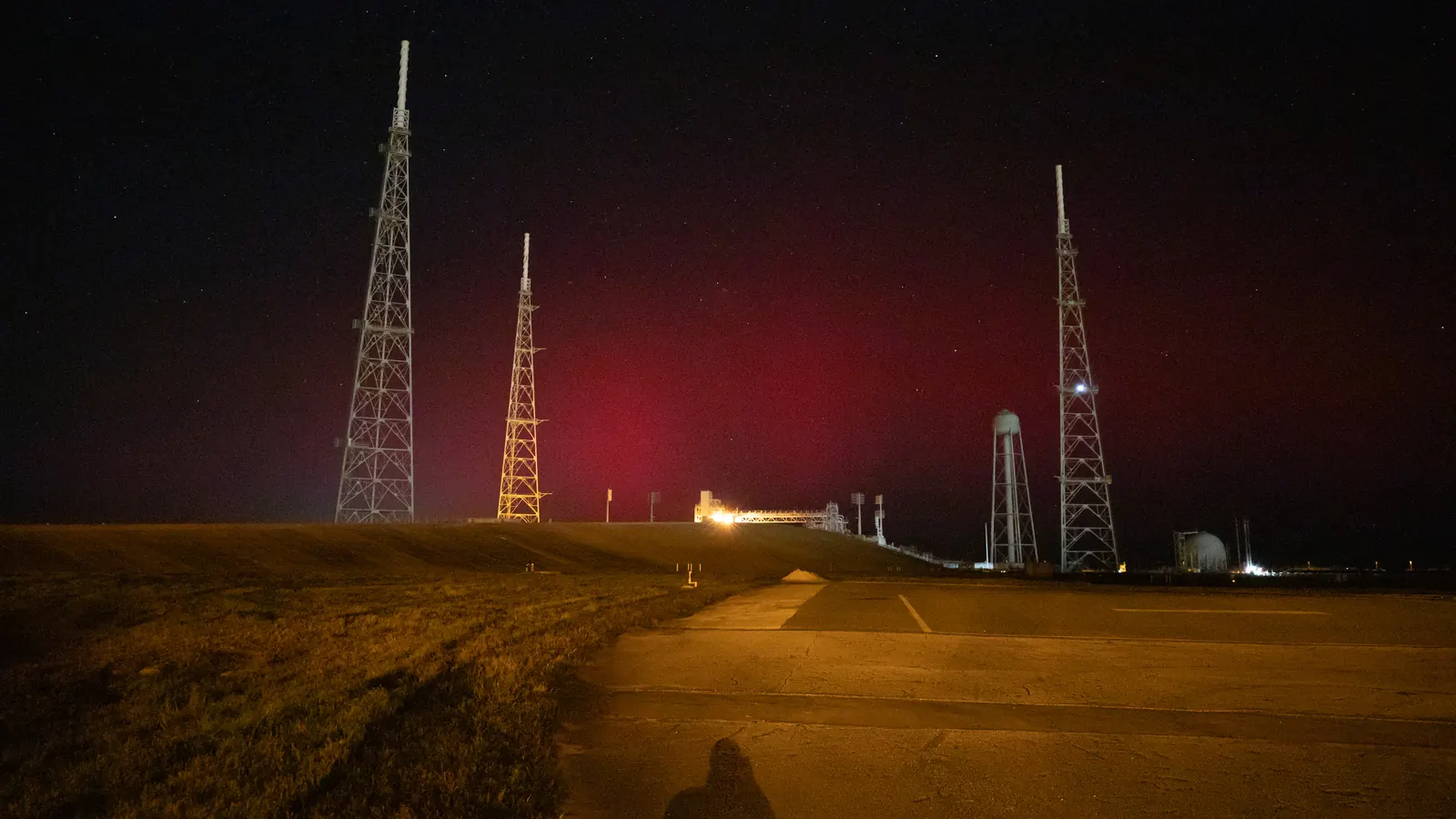
The northern lights are caused by the solar wind, the charged particles streaming from the Sun. Energy it loads into Earth's magnetic field sends electrons down the field lines toward the poles, where they crash into oxygen and nitrogen high in the atmosphere and make those gases glow. NASA puts the familiar green light at roughly 100 to 200 km (60 to 120 miles) up. How often the sky lights up depends on how active the Sun is. On October 12, 2026, the Sun is two years past the peak of Solar Cycle 25, which the Royal Observatory of Belgium dates to October 2024, when the smoothed sunspot number reached 160.9.
The same process lights the sky around the south magnetic pole, where the display is called the aurora australis. Our aurora forecast turns NOAA's live readings of geomagnetic activity into a verdict for wherever you're standing.
How solar wind becomes the northern lights
The Sun gives off a constant outflow of charged particles, which NASA's aurora explainer calls the solar wind. At Earth it meets the planet's magnetic shield, and NASA says the encounter often deposits energy there until some of it is released. The electrons behind the aurora come from the magnetotail, the part of Earth's field drawn out downwind of the planet. Studying a single event with several spacecraft, Baker and colleagues found magnetic reconnection, where field lines break and rejoin, about 18 Earth radii down the tail, roughly 7 minutes before the aurora brightened.
The electrons then spiral along magnetic field lines toward the poles, and NASA's Astronomy Picture of the Day describes Earth's field channeling them into the atmosphere there. Up high they collide with oxygen and nitrogen. Each hit lifts an electron in the atom to a higher energy level, and when it drops back, the atom gives off the difference as light.
The glow forms a ring around each magnetic pole, the auroral oval. Because the ring is centered on the magnetic pole rather than the geographic one, your chance of seeing it depends on geomagnetic latitude, as a study of the oval explains. During storms the whole oval grows and both edges move toward the equator, as research from the 1960s and a later study of storm-time expansion describe. The southern oval has been photographed from orbit over Antarctica. Our report on the October 10 storm opens with an aurora photographed from the International Space Station in January, and our ISS tracker shows where the station is now.
Why are the northern lights green, red and purple?
Color depends mostly on height. NASA's picture-of-the-day text notes that red forms highest, where the air is thinnest, and green lower down. NASA's explainer puts red oxygen light above 200 km (120 miles), with green oxygen and blue nitrogen light at about 100 to 200 km. Atmospheric Optics, a popular site on sky optics, draws narrower bands. The green starts around the height often used as the edge of space.
| Color | Gas | Height, per NASA | Height, per Atmospheric Optics |
|---|---|---|---|
| Green | Oxygen | 100 to 200 km | 100 to 150 km |
| Red | Oxygen | Above 200 km | 150 to 250 km, occasionally above 600 km |
| Blue | Nitrogen | 100 to 200 km | Not given |
Oxygen makes both main colors, and timing decides which one you get. The excited state behind green light lasts about 0.7 seconds before the atom gives up a photon, while the one behind red light lasts about 110 seconds, according to a review of Japanese auroral records. Lower down, another collision usually carries the energy off before a red photon can escape. Only high up, where collisions are rare, does oxygen get time to glow red. Where the colors mix, NASA says, the sky can turn purple, pink or even white. Auroras also give off ultraviolet light, which satellite cameras record and the eye can't see.
A phone often shows more color than the eye does. At night the eye relies on rods, which are sensitive but can't tell colors apart, so a faint aurora can look gray-green or vanish, a widely reprinted explainer notes. Phones hold the shutter open longer at higher ISO and often brighten the result in software. According to computational imaging scientist Bill Freeman, quoted by Acton Exchange, that processing is an important contributor to the vivid colors.
In 2016, members of the Alberta Aurora Chasers Facebook group posted photos of a thin, bright band they called a proton arc. Scientists ruled that out because proton aurora is diffuse and invisible to the eye, NPR reported. A 2018 study led by Bea Gallardo-Lacourt concluded that the band, nicknamed STEVE, isn't an aurora at all. Ground cameras and ESA's Swarm mission linked it to a fast flow of ions, though the match is only partial, Astrobites explains. All three Swarm satellites are still working and listed in our directory of active satellites. Their element sets put them in orbits tilted 87.3 to 87.7 degrees, so every lap you follow on the live satellite map crosses both auroral ovals.
Is 2026 still a good year to see the northern lights?
By the evidence so far, yes, though the Sun is past its peak. NASA and NOAA announced on October 15, 2024, that the Sun had reached the solar maximum period of Solar Cycle 25. NOAA's Elsayed Talaat cautioned that "this announcement doesn't mean that this is the peak of solar activity we'll see this solar cycle," Astronomy.com reported.
Using the smoothed monthly sunspot number, the Royal Observatory of Belgium's SIDC has since dated the peak to October 2024. That peak of 160.9 compares with the 115 that the cycle's prediction panel forecast in 2019 and the 180.3 reached by Solar Cycle 23.
Sunspot area and the Sun's 10.7 cm radio flux have been falling since, SIDC says, while geomagnetic indices such as Ap, which measure how disturbed Earth's field is, have been rising. By its count, 2 of the cycle's 10 strongest X-class flares so far came between October 2025 and February 2026. Space.com expects the decline to continue through 2026 and notes that the strongest solar events often come in the declining phase. It also reported that an X5.1 flare in November 2025 set off a severe geomagnetic storm, a claim we haven't found a second source for.
Two storms from 2024 show what a big night looks like. On May 10 and 11, NOAA rated the storm G5, or extreme, with Kp reaching 9, according to Wikipedia's summary of NOAA data. The Weather Network noted it was the first G5 since October 2003. On October 8, 2024, sunspot region AR 3848 fired an X1.8 flare and a coronal mass ejection, a cloud of magnetized gas, toward Earth, SpaceWeatherLive reported. It arrived at 15:17 UTC on October 10, 2024, and by 16:57 UTC the storm had reached G4, or severe, Space.com reported, relaying a NOAA forecast that aurora might be seen as far south as Alabama and northern California. Storms like these also add drag to low satellites, as our post on solar storms and satellites explains.
NOAA's aurora viewing tips say the best display usually comes between 10 p.m. and 2 a.m. local time and that spring and fall, around the equinoxes, are the best seasons. This year's September equinox came at 00:05 UTC on September 23, by Astronomy Engine, the library behind our sky pages. Edward Sabine noticed the equinox bump in 1856, and in 1973 Christopher Russell and Robert McPherron explained it, Wikipedia notes. Near the equinoxes, Earth's field is tilted so it links up more readily with a southward-pointing field carried in the solar wind. The effect is statistical. A 2020 paper found it drives small and moderate storms but not the largest ones.
Geomagnetic latitude in WatchSat's aurora forecast
The aurora page reads NOAA's planetary K-index and its three-day forecast, refreshed at the edge every 15 minutes, and our credits page lists the source. Kp runs from 0 to 9. Share a location and the page converts it to geomagnetic latitude, measured from Earth's magnetic axis instead of its spin axis. We use a centered-dipole model of Earth's field, with the geomagnetic north pole at 80.65° N, 72.68° W, from the IGRF reference model for about 2025. Notes in our code put its error at about 1 to 2 degrees, which they call ample for judging whether you can see the aurora.
The shift can be big. By our model, London, at 51.5° N, sits at 53.4° geomagnetic. Miami, at 25.8° N, comes out at 35.0°, about 9 degrees higher, because it lies close to the geomagnetic pole's line of longitude. Tromsø, at 69.7° N in northern Norway, moves the other way, to 67.4°.
The page then compares your geomagnetic latitude with a viewline, the oval's equatorward edge, where aurora would be overhead. It sits at 66.5° when Kp is 0 and moves 2.04 degrees toward the equator for each step of Kp, reaching 48.1° at Kp 9. Our code calls it a straight-line fit that matches a standard table of oval positions to within 0.2 degrees. Since the glow sits 100 km or more up, it can show low on the horizon from farther away, so the page says "on the horizon" for anyone up to 6 degrees equatorward of the line. You'll still need a dark, clear sky.
Under that model, Tromsø is in the overhead zone even at Kp 0. London moves to "on the horizon" once Kp passes about 3.5 and to "overhead" above about 6.4. Miami stays "unlikely" at any Kp, because even at Kp 9 the horizon line only reaches 42.1°.
Sources
- STCE / Royal Observatory of Belgium (SIDC), Solar Cycle 25 reached its maximum in October 2024, 2026
- Space.com, Will 2026 bring strong auroras? What the sun's recent activity tells us, 2026
- NASA Scientific Visualization Studio, NASA, NOAA Announce That the Sun Has Reached the Solar Maximum Period, October 15, 2024
- Astronomy.com, The Sun has reached solar maximum, NASA and NOAA scientists say, October 2024
- Space.com, Severe solar storm could supercharge auroras across US, impact power grids, NOAA warns, October 10, 2024
- SpaceWeatherLive, X1.8 solar flare, severe geomagnetic storm watch, October 9, 2024
- The Weather Network, Extreme geomagnetic storm may spark widespread auroras over Canada on Friday, May 2024
- Space Weather and Space Climate, paper on the Russell–McPherron effect and storm occurrence, 2020
- PubMed Central, study of auroral oval expansion during storms, 2019
- NPR, Scientists Are Puzzled By Mysterious Lights In The Sky. They Call Them STEVE, August 23, 2018
- Astrobites, Let's Call It STEVE, 2018
- Baker et al., NASA IMAGE mission, multi-spacecraft study of reconnection and auroral onset, 2002
- NASA, Astronomy Picture of the Day: Aurora and Orion, January 26, 1997
- NASA Technical Reports Server, auroral oval study over Alaska, 1966
- Space.com, Has the sun already passed solar maximum?, undated
- Wikipedia, May 2024 solar storms, undated
- arXiv, A Review for Japanese auroral records on the three extreme space weather events around the International Geophysical Year (1957-1958), undated
- NASA Science, aurora explainer, undated
- NOAA Space Weather Prediction Center, Tips on Viewing the Aurora, undated
- NSF Public Access Repository, paper on the auroral oval and geomagnetic latitude, undated
- Wikipedia, Russell–McPherron effect, undated
- Atmospheric Optics, Glowing Gases - Aurorae, undated
- Swinburne University of Technology, Aurora australis (southern lights), undated
- Yorkshire Evening Post (Fast Company story), Why can you see Northern Lights better on your phone than with your eye?, undated
- Acton Exchange, Eyes on the (solar) storm, undated
- WatchSat calculations: NOAA SWPC planetary K-index and K-index forecast feeds; Astronomy Engine 2.1.19; CelesTrak, active satellites element sets, snapshot of October 11, 2026
Follow by RSS. Share this post: Bluesky · X · Reddit · Email
More from the blog
-
Leonid meteor shower 2026: peak time, Moon and next storm
The Leonid meteor shower 2026 peaks around 23:45 UTC on November 17, at a ZHR of about 15, under a half-lit Moon that sets by about midnight.
-
When is Mars closest to Earth? 2027 date and distance
Mars is closest to Earth on February 20, 2027 (UTC), 101.41 million km away, hours after opposition. By our count it's the farthest such approach of 2001-2100.
-
What is OneWeb? Owner, satellite count and orbits
OneWeb is Eutelsat's broadband network in low Earth orbit. On October 11, 2026, our catalog held 651 OneWeb satellites, about 1,200 km up in 12 planes.
-
What is SpaceX Starship? Size, engines and flight record
SpaceX Starship is a two-stage rocket, 124.4 m tall, built to be fully reused. Its 14th flight reached orbit on September 28, 2026.

-
Where is Voyager 2 now? Distance, signal time and power
Where is Voyager 2 now? On October 12, 2026, it's 21.56 billion km (13.40 billion miles) from Earth, and its signals take almost 20 hours to arrive.
Home · Live satellite map · Satellite directory · Starlink · OneWeb · Navigation satellites · Space stations · Other active satellites · Track the ISS · ISS visible passes · Starlink train · Rocket launches · Aurora forecast · Humans in space · Solar System · Deep Space · Embed widgets · Blog · Guide: spot the ISS · Guide: what is a TLE? · Guide: how many satellites? · Guide: satellite trackers compared · Discovery: Elias 2-24 b · About · FAQ · Data & methodology · Credits · Editorial policy · Accessibility · Contact · Privacy · Terms
© 2026 WatchSat · Not affiliated with any space agency or satellite operator.