WatchSat › Blog › October 10 geomagnetic storm reached G3: aurora outlook
October 10 geomagnetic storm reached G3: aurora outlook
A coronal mass ejection drove a G3 (strong) geomagnetic storm on October 10, 2026. What NOAA measured, who saw aurora and what comes next.
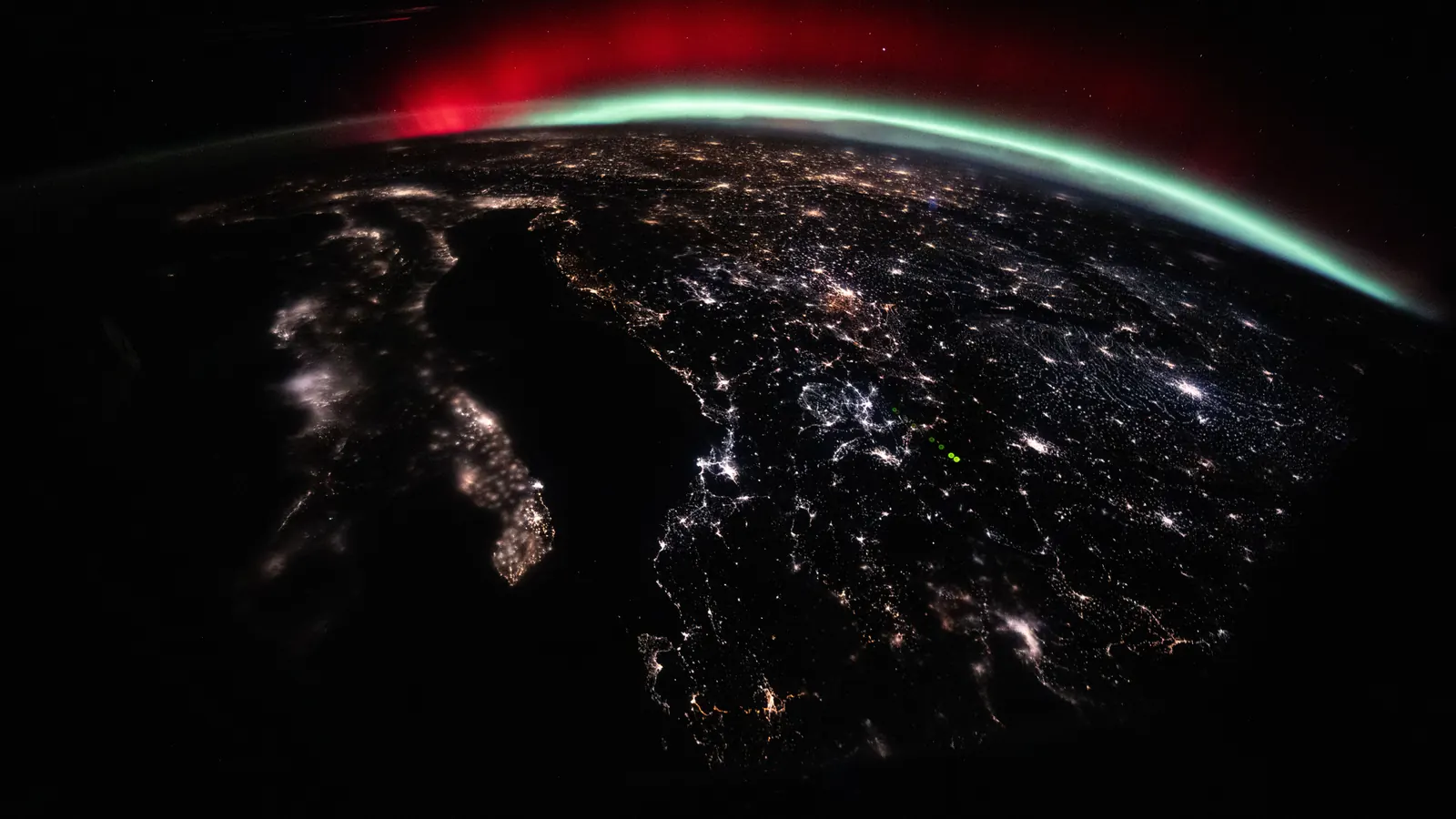
A coronal mass ejection reached Earth on Saturday, October 10, and pushed geomagnetic activity to G3, a strong storm on NOAA's five-step scale. NOAA's Space Weather Prediction Center logged the G3 level at 17:58 UTC, and the planetary K-index, or Kp, sat at 7 for the three hours from 15:00 to 18:00 UTC. It was the highest Kp of the week. NOAA's own three-day forecast, issued at 12:30 UTC that morning, had topped out at G2.
NASA astronaut Chris Williams took the aurora photo above from the International Space Station on January 19, 2026, looking north over Italy toward Germany. We didn't find any station photos from this week's storm.
What caused the October 10 geomagnetic storm?
The week started with Active Region 4549, a sunspot group that Spaceweather.com describes as having a beta-gamma-delta magnetic field, the tangled kind that stores enough energy for big flares. On October 6 it fired an M1.4 flare that peaked at 06:10 UTC, and NOAA issued a G2 watch for October 9, when the CME that came with that flare was due. Kp on October 9 never got above 4, below the Kp 5 needed for a G1 storm.
On October 8 a much bigger M6.7 flare peaked at 15:48 UTC and caused an R2, or moderate, blackout of high-frequency radio on the sunlit side of Earth. NOAA then said two CMEs that left the Sun on October 7 and 8 would arrive on October 11, with the faster one expected to merge with the slower one on the way, and it moved its G2 watch to that day.
A CME turned up ahead of that schedule. NOAA saw its signature in the solar wind from 14:34 UTC on October 10, and the magnetometer at Niemegk, Germany, recorded a 56 nT sudden impulse at 15:16 UTC as it struck. Spaceweather.com tied an M6.4 flare at 15:10 UTC that afternoon to Region 4549, the week's second R2 blackout. The K-index alerts then came quickly: K6 (G2) at 17:17 UTC, K7 (G3) at 17:58 UTC, and K7 again at 19:26 UTC. NOAA's three-hour estimates for 18:00 to 21:00 and 21:00 to 24:00 UTC were both 6.67, which NOAA still counts as G3.
Talk of a G4, or severe, storm for October 10 and 11 spread online. NOAA didn't issue a G4 watch, warning or alert for this storm. We went through its alert feed back to September 11, and the highest product in it is the K7 alert above. On NOAA's scale a G4 storm needs Kp 8.
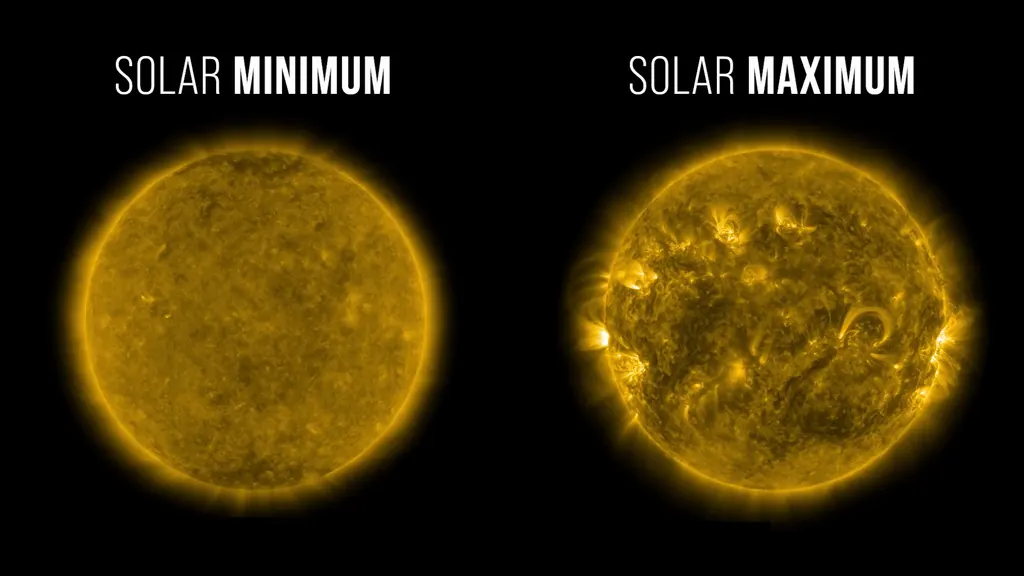
In NOAA's record of Solar Cycle 25, the smoothed sunspot number peaked at 160.9 in October 2024, the month NASA and NOAA announced that the Sun had reached its maximum period. The monthly number for September 2026 was 60.3, and Spaceweather.com put the daily count at 93 on October 10.
Who saw the northern lights?
The strongest stretch, between about 17:00 and 19:30 UTC, fell in the early afternoon on the US East Coast and in the evening in Europe. NOAA's G3-level estimates ran to midnight UTC, which is 8 p.m. in New York, where full darkness came at about 7:54 p.m. NOAA says that during G3 storms, aurora "has been seen as low as Illinois and Oregon (typically 50° geomagnetic lat.)."
Spaceweather.com published a report from photographer Karsten Berger in Levi, in Finnish Lapland, who said the colors were visible to the naked eye on October 10. The night before, ripples from the CME that mostly missed brought aurora to the sky over Bluff, New Zealand. When we finished this post, at about 23:30 UTC on October 10 (7:30 p.m. EDT), we hadn't found a reliable report of aurora from the US or the UK, and Spaceweather.com expected G2 conditions as night fell over North America.
How WatchSat's aurora forecast reads a storm like this
Our aurora forecast page takes NOAA's latest Kp and turns it into the edge of the auroral oval, then compares that with your geomagnetic latitude, which is latitude measured against Earth's magnetic axis instead of its spin axis. The page puts the overhead edge at 66.5 degrees minus 2.04 degrees for each point of Kp. At Kp 7 that's 52.2 degrees, and it allows a view low on the northern horizon down to about 46.2 degrees. NOAA's 50-degree figure for G3 falls between those two lines.
Storms also matter to satellites, because they heat and puff up the upper atmosphere and add drag in low orbit. NOAA's description of G3 says drag "may increase on low-Earth-orbit satellites." Spaceweather.com tracks how fast a typical Starlink at 480 km sinks. Its figure for October 10, posted before the storm peaked, was 45.1 meters a day, against a 2026 high of 127.6 meters a day on January 20.
The 26 Starlinks that Starship Flight 14 left in orbit were near 316 km when the storm hit, far below most of the Starlink constellation. They're the satellites we'll watch most closely in the next element sets, starting with Starlink-40083.
What to watch next
- NOAA's outlook at 23:22 UTC on October 10 had a G2 storm for October 11, with Kp at 5.67, the bottom of the G2 range, in the first three hours of the day UTC, and no storm for October 12.
- The UK Met Office expected a second glancing blow from a CME on October 11 and a fast stream of solar wind from a coronal hole on October 12 or 13. It said aurora sightings were possible across Scotland on clear nights from October 10 to 13, with low confidence in the timing.
- The Moon was new on October 10, so the next few nights are dark.
- NOAA's 27-day outlook, issued October 5, has Kp 5 on October 21 and 22 UTC, the dates of the Orionid meteor shower peak. Outlooks that far ahead often change.
The aurora forecast updates from NOAA's feed through the night. Share a location and it tells you whether the oval reaches you and which horizon to watch.
Sources
- NOAA Space Weather Prediction Center: alerts, watches and warnings feed, read October 10, 2026; planetary K-index and K-index forecast, read October 10, 2026; GOES X-ray flare list, read October 10, 2026; NOAA scales now and forecast, read October 10, 2026; 3-day forecast, October 10, 2026; 27-day outlook, October 5, 2026; observed solar cycle indices; NOAA space weather scales
- NOAA SWPC news: G2 geomagnetic storm watch for 09 Oct, October 6, 2026; Moderate (G2) geomagnetic storms likely 11 Oct 2026, October 9, 2026; Moderate (G2) geomagnetic storming expected 10 Oct 2026, October 10, 2026; Strong (G3) geomagnetic storms expected 10 Oct 2026, October 10, 2026
- Met Office, space weather forecast, October 10, 2026
- Spaceweather.com, news and Starlink drag index, October 10, 2026
- NASA Scientific Visualization Studio, NASA, NOAA announce that the Sun has reached the solar maximum period, October 15, 2024
- NASA, aurora over Europe from the International Space Station, January 19, 2026
Follow by RSS. Share this post: Bluesky · X · Reddit · Email
More from the blog
-
Where is the Hubble Space Telescope now? Orbit and reentry
The Hubble Space Telescope orbits about 470 km up and is sinking roughly 10 km a year. STScI puts its most likely reentry in 2033 unless it gets a boost.
-
Where is the James Webb Space Telescope? Distance and orbit
The James Webb Space Telescope was 1.36 million km from Earth on October 8, 2026, looping around L2. Its distance swings from 1.2 to 1.75 million km.

-
ISS crew swap: Crew-13 sets U.S. record, Crew-12 lands
Crew-13 reached the ISS 7 hours 55 minutes after launch on October 1, a U.S. record. Crew-12 splashed down October 8, and CRS-35 is due October 13.

-
Orionid meteor shower 2026: peak, Moon and satellites
The Orionids peak on the night of October 21-22, 2026 under a bright gibbous Moon. When the Moon sets, and why satellites crowd the hour before dawn.
-
Starship Flight 14 reached orbit: tracking its 26 Starlinks
Starship reached orbit for the first time on September 28, 2026 and left 26 Starlink V3 satellites behind. Their NORAD IDs, and how high they've climbed.

Home · Live satellite map · Satellite directory · Starlink · OneWeb · Navigation satellites · Space stations · Other active satellites · Track the ISS · ISS visible passes · Starlink train · Rocket launches · Aurora forecast · Humans in space · Solar System · Deep Space · Embed widgets · Blog · Guide: spot the ISS · Guide: what is a TLE? · Guide: how many satellites? · Guide: satellite trackers compared · Discovery: Elias 2-24 b · About · FAQ · Data & methodology · Credits · Editorial policy · Accessibility · Contact · Privacy · Terms
© 2026 WatchSat · Not affiliated with any space agency or satellite operator.