WatchSat › Blog › Where does space begin? The Kármán line, 100 km or 80 km
Where does space begin? The Kármán line, 100 km or 80 km
Where does space begin? FAI's Kármán line is 100 km (62 miles), the US uses 50 miles (80 km), and no law sets it. Nothing in our Oct 11 data was below 164.7 km.
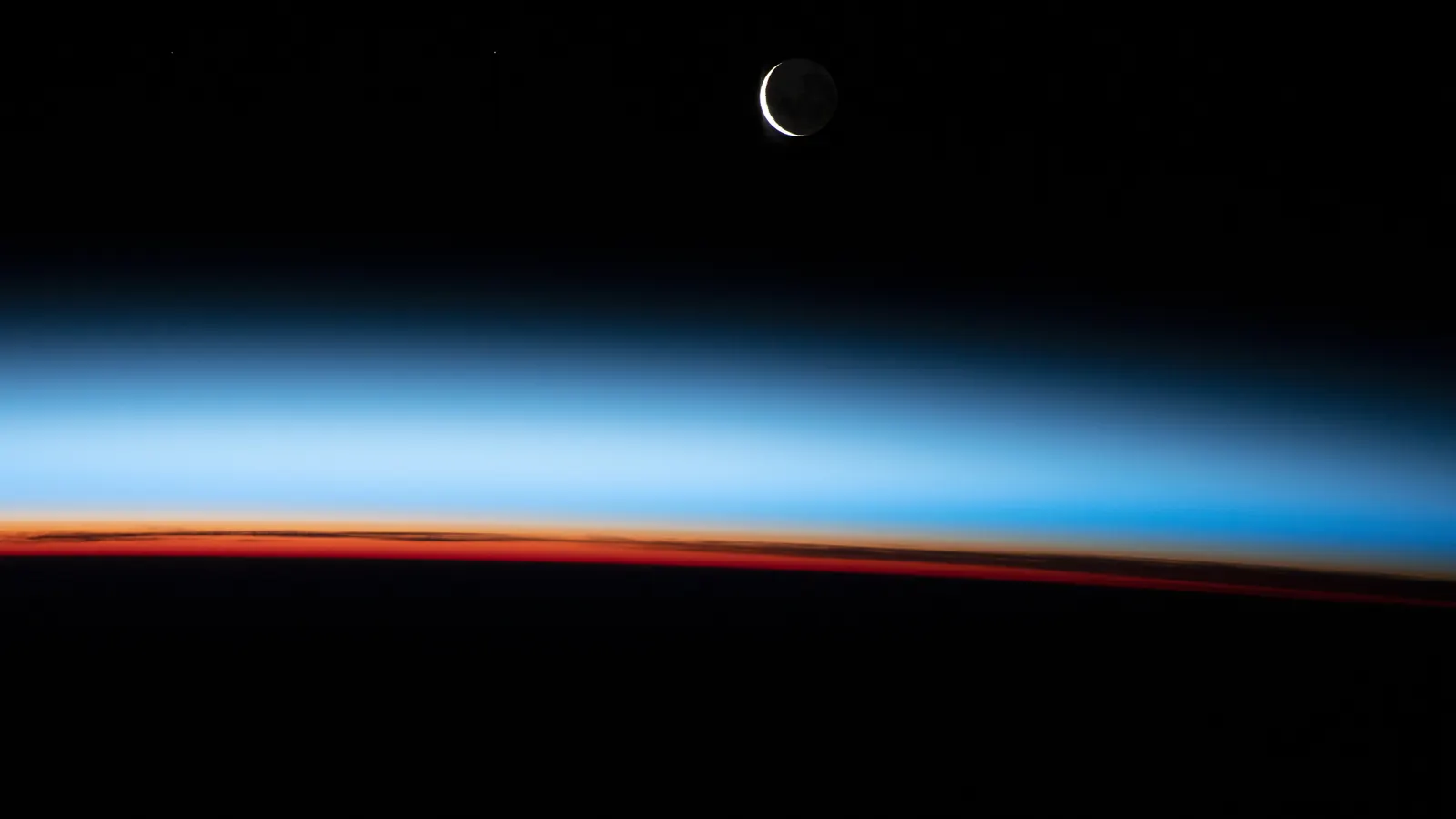
By the most widely used convention, space begins 100 km (62 miles) above the Earth's surface, at the Kármán line that the Fédération Aéronautique Internationale (FAI) uses for its spaceflight records. In the United States, the Air Force, the Federal Aviation Administration (FAA) and NASA have long drawn the line lower, at 50 miles, or about 80 km. Neither line marks a physical edge, because the air thins gradually over hundreds of kilometres. Where space begins is a matter of record books and agency rules, and no international law settles it.
Satellites stay well above both lines. In the October 11 copy of the orbit data behind our live satellite map, no orbit dipped lower than 164.7 km. Like CelesTrak's catalog, we measure heights from Earth's equatorial radius of 6,378 km.
What is the Kármán line?
The line is named after Theodore von Kármán and rests on an argument about wings. Wings hold an aircraft up with lift, the upward push they get from air flowing past them. As the air thins with height, the aircraft has to fly faster to get enough of it. At some altitude the speed it needs reaches orbital speed, and above that a vehicle is held up by its motion around the Earth rather than by its wings.
Kármán's rough calculation put that height at about 84 km (52 miles), according to Encyclopaedia Britannica, though he never formally published it. The lawyer Andrew G. Haley proposed using it as the boundary and named it for Kármán. FAI settled on 100 km, and its Sporting Code counts activity above that height as astronautics. Britannica says historians dispute whether FAI followed Kármán's reasoning or simply chose a round number.
In 2018 Jonathan McDowell of the Harvard-Smithsonian Center for Astrophysics argued in the journal Acta Astronautica that 80 km is the better choice. Part of his case rests on the mesopause, the level where the atmosphere's temperature bottoms out. It sits at roughly 80 km, close to the American 50-mile line.
FAI has looked at moving the line itself. An undated statement on FAI's website says recent analyses present "a compelling scientific case" for lowering it to 80 km, and proposes a joint workshop. On March 20, 2024, FAI's astronautic records commission, ICARE, discussed a "modernized definition". Its technical expert, Nicolas Bérend, went the other way. In presentations to the commission, his method, based on lift and orbital speed, put the boundary at about 105 to 112 km, depending on how much lift the wings are assumed to give. Those are a technical expert's proposals, not an FAI rule, and the commission's 2024 minutes still treat the line as 100 km.
Astronaut wings, space tourists and the law
America's 50-mile line, 80.47 km, comes from practice rather than physics. The Air Force, the FAA and NASA have used it to decide who earns astronaut wings, Popular Science explains. The FAA ended its commercial astronaut wings program on December 10, 2021, and said it would instead list online anyone who flies above 50 statute miles on an FAA-licensed or permitted launch.
Richard Branson rode Virgin Galactic's VSS Unity to about 86 km (53 miles) on July 11, 2021, Scientific American reported. That's above the US line but below FAI's. Blue Origin's founder, Jeff Bezos, flew on New Shepard on July 20 that year, and the company says New Shepard, which flew 38 times, carried 98 people above the Kármán line. Under FAI's rule Bezos reached space and Branson didn't, while under the American rule both did.
As of October 2026, neither company is flying passengers. Blue Origin paused New Shepard on January 30, 2026, for at least two years, to shift resources to lunar work. Engadget, citing SpaceNews, reported in 2026 that the first commercial flight of Virgin Galactic's new Delta-class ship had slipped to February 2027 at the earliest.
No treaty draws the line either. The UN space committee's legal subcommittee has considered the "definition and delimitation of outer space" since 1967. A UN document on the question says there's no agreement on where air space ends and outer space begins. In 2021 the Library of Congress's law blog noted that the Kármán line "is not agreed upon in international law."
Where does Earth's atmosphere end?
There's no sharp edge. The US Standard Atmosphere of 1976 is a reference model of average conditions, and by our calculation from it, air pressure at 80 km is about 1 pascal. That's roughly one hundred-thousandth of the pressure at sea level. Pressure measures the weight of the air overhead, so more than 99.999% of the atmosphere's mass lies below 80 km.
Above that, the layers have only rough boundaries. NASA's guide to the atmosphere's layers puts the thermosphere at about 80 to 700 km (50 to 440 miles) up. It gives the exosphere, the outermost layer, as about 700 to 10,000 km (440 to 6,200 miles). Other sources draw them differently. UCAR's Center for Science Education says the exosphere's lower edge moves between about 500 and 1,000 km as the Sun's activity changes. By one definition, it adds, the outer edge reaches about 190,000 km, roughly halfway to the Moon.
The International Space Station flies in the thermosphere, and its crew is part of our live count of who's in space. In orbit data dated October 10, its average height was 420.2 km, 4.2 times the height of the Kármán line. That puts it in space by either convention but still inside what NASA counts as atmosphere, which is why it needs the regular boosts covered in our post on the ISS's speed and altitude. On a 30 cm globe, the Kármán line would sit 2.35 mm above the surface and the station about 1 cm up.
The lowest satellites in our October 11 data
We checked the 16,701 objects in our October 11 copy of CelesTrak's active satellite list and the eight earlier copies we've saved since September 15. For each object we worked out the perigee, the lowest point of its orbit. The figures come from two-line element sets, or TLEs, the compact orbit format explained in our guide to TLEs.
In the October 11 copy, none had a perigee below 100 km, or even 150 km. The lowest satellite on the list was STARLINK-4464, at 164.7 km, 1.65 times the height of the Kármán line. Only four objects had perigees below 200 km, and 19 below 250 km. Across all nine copies, the lowest perigee we caught was 134.2 km, for STARLINK-4386 in elements dated October 5.
Objects that low don't stay long. STARLINK-4464 averaged 282.6 km up in elements dated September 14 and was sinking about 1.3 km a day. In elements dated 23:06 UTC on October 10 it averaged 168.5 km, after dropping 15.1 km a day over the previous 2.7 days. These heights are estimates. Element sets for objects this low are the least reliable in the catalog, because drag keeps reshaping the orbit after each set is fitted to tracking data.
Our copies are days apart, so we never catch the final plunge, only objects leaving the list. Of 84 objects listed at some point since September 15 but missing on October 11, 75 had a last perigee below 300 km, with a median of 198 km. Starlinks made up 53 of those 75. Spread over the 26.7 days between the typical element dates of our first and last copies, the 75 work out to about 2.8 a day. Leaving the list isn't proof of reentry, and we haven't checked official decay records, but all 75 were low when we last saw them. Our reentry explainer covers what happens next.
How low a satellite can orbit comes down to whether it can push back. Of the 60 objects averaging under 300 km on October 11, 54 sank during our period, at a median of 1.5 km a day. Six held their height for 26 days. QIANKUN-1 stayed at 263.2 km, SHIYAN-25 at about 271.5 km, and four satellites named COSMOS 2591 to 2594 at about 284 km. Holding steady while nearly everything around them fell suggests thrusters at work, as our post on how satellites stay in orbit describes.
JAXA's SLATS satellite, also called Tsubame, held 167.4 km for seven days using gas thrusters and an ion engine. Guinness World Records recognized that as a record in December 2019, SmallSat News reported. STARLINK-4464 was at about the same height on October 10, with nothing holding it up.
At its last measured rate, STARLINK-4464 would sink below 141.5 km in under two days. No object in our copies showed a lower average height before it dropped off the list, so it may already have come down. If it's missing from our next copy, it has most likely crossed both candidate edges of space on the way down.
Sources
- SpaceNews, Blue Origin launches Bezos on first crewed New Shepard flight, July 2021
- Fédération Aéronautique Internationale, FAI Sporting Code, General Section, 2022, and Statement about the Karman Line, undated
- FAI International Astronautic Records Commission (ICARE), 2024 plenary meeting minutes, meeting of March 20, 2024, with Nicolas Bérend, Some elements for the discussion about a modernized definition of Karman Line, 2024, and The Kármán line definition, v1.2, listed on FAI's ICARE documents page in August 2025
- Jonathan C. McDowell, The edge of space: Revisiting the Karman Line, Acta Astronautica, 2018 (author's PDF)
- Encyclopaedia Britannica, Kármán line, undated
- Popular Science, explainer on the Kármán line, undated
- Federal Aviation Administration, FAA Ends Commercial Space Astronaut Wings Program, Will Recognize Individuals Reaching Space on Website, December 10, 2021
- Scientific American, Virgin Galactic launches Richard Branson to space in 1st fully crewed flight of VSS Unity, July 2021
- Blue Origin, New Shepard to pause flights, January 30, 2026
- Engadget, Virgin Galactic postpones its new spaceship's first commercial flight to 2027, 2026
- UN Committee on the Peaceful Uses of Outer Space, document on the definition and delimitation of outer space, undated
- Library of Congress Law Library, Billionaires Are Going to Space, or Are They?, August 2021
- NASA Science, Earth's Atmosphere: A Multi-layered Cake, undated; UCAR Center for Science Education, The Exosphere, undated
- NOAA, NASA and US Air Force, U.S. Standard Atmosphere, 1976 (reference model; pressures are our calculation from its published layer formulas)
- SmallSat News, Japan's Tsubame smallsat gains Guinness World Records recognition, December 31, 2019
- CelesTrak, active satellite element sets, nine WatchSat copies from September 15 to October 11, 2026
Follow by RSS. Share this post: Bluesky · X · Reddit · Email
More from the blog
-
What are China's Qianfan and Guowang constellations?
China's Qianfan and Guowang satellite constellations had 477 satellites on CelesTrak's active list on October 11, 2026, toward plans of about 15,000 and 13,000.

-
What are the different types of satellites? Uses and counts
The types of satellites, by job. Communications are 80.2% of the 16,701 on CelesTrak's active list, Starlink alone 66.6%, while about 10% can't be identified.
-
Where is Europa Clipper now? Distance and the Earth flyby
Europa Clipper was 59.0 million km from Earth on October 11, 2026, and closer to the Sun than Earth is. It swings past Earth on December 3, bound for Jupiter.

-
Where is New Horizons now? Distance, speed and what's next
New Horizons was 65.77 AU from the Sun on October 8, 2026, and its signals took 9 hours 6 minutes to reach Earth. It's still inside the heliosphere.
-
Can satellites connect directly to your phone? How it works
Satellites can connect directly to your phone for texts. Starlink says it has launched 650 direct-to-cell satellites. How it works and who offers it.
Home · Live satellite map · Satellite directory · Starlink · OneWeb · Navigation satellites · Space stations · Other active satellites · Track the ISS · ISS visible passes · Starlink train · Rocket launches · Aurora forecast · Humans in space · Solar System · Deep Space · Embed widgets · Blog · Guide: spot the ISS · Guide: what is a TLE? · Guide: how many satellites? · Guide: satellite trackers compared · Discovery: Elias 2-24 b · About · FAQ · Data & methodology · Credits · Editorial policy · Accessibility · Contact · Privacy · Terms
© 2026 WatchSat · Not affiliated with any space agency or satellite operator.