WatchSat › Blog › What is OneWeb? Owner, satellite count and orbits
What is OneWeb? Owner, satellite count and orbits
OneWeb is Eutelsat's broadband network in low Earth orbit. On October 11, 2026, our catalog held 651 OneWeb satellites, about 1,200 km up in 12 planes.
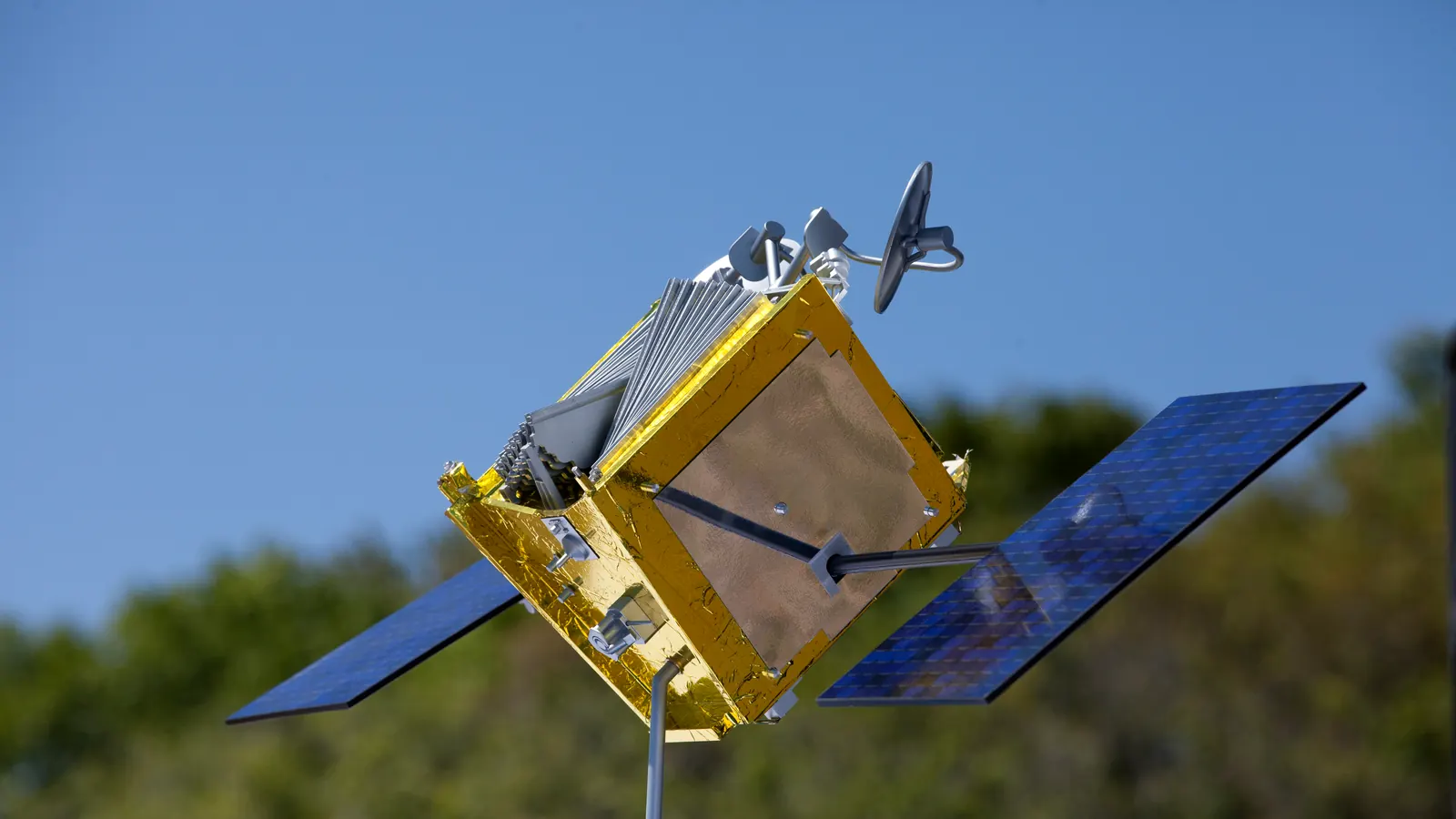
OneWeb is a network of internet satellites in low Earth orbit, owned since September 28, 2023, by the Paris-based operator Eutelsat. Our October 11, 2026 snapshot of CelesTrak's active-satellite list holds 651 OneWeb satellites. All but three of them circle Earth at about 1,200 km (746 miles), on orbits that pass close to both poles. Our OneWeb constellation page shows where each of today's satellites is right now.
OneWeb's capacity reaches users through distribution partners. In March 2022 Eutelsat signed a OneWeb distribution deal covering ships, aircraft, businesses, telecom operators and governments, and Kymeta and Speedcast signed reseller deals the same month. In September 2026 Eutelsat named Eclipse Global Connectivity its first European partner for government aircraft, supplying airtime, terminals and software for French military and government aircraft. Eutelsat's low-orbit (OneWeb) revenue rose 69.5% to €297 million in the year to June 30, 2026, about 25% of the group's total, ISPreview reported.
Who owns OneWeb?
Greg Wyler, who had worked at Google and O3b Networks, founded the company in 2012 under the name WorldVu, according to Wikipedia. Its first six satellites went up in February 2019. OneWeb filed for Chapter 11 bankruptcy protection in the US in March 2020 after its main investor, SoftBank, pulled its funding.
In July 2020 the UK government and Bharti Global formed a consortium to buy it, each putting in about US$500 million, Space Intel Report wrote. Judge Robert D. Drain of the US Bankruptcy Court approved the sale on October 2, 2020, Satellite Today reported. US regulators cleared it later that month, and OneWeb left bankruptcy in November.
Eutelsat announced a merger in 2022 and completed the all-share deal on September 28, 2023, as Satellite Today and Advanced Television reported. Eutelsat Group is based and listed in Paris, and OneWeb runs from London as its subsidiary Eutelsat OneWeb. At the time, Eutelsat's chief executive pitched the group as the only operator with both a low-orbit fleet and satellites in geostationary orbit, the high ring over the equator. Bharti came out of the deal as the group's largest shareholder, with 21.2%, according to tele.net.in.
Eutelsat raised fresh money in 2025, and governments supplied most of the first round. After the UK government joined in July 2025, the planned total reached €1.5 billion. The first step was a €828 million share sale reserved for named investors at €4.00 a share, completed on November 21, 2025. The French state put in €551 million, CMA CGM €100 million, the UK government €90 million, the fund FSP €57 million and Bharti €30 million. Eutelsat's November 2025 filing lists the French state as the largest shareholder, ahead of Bharti and the UK. A rights issue of about €670 million was planned to make up the rest. We haven't confirmed that it closed, or how it moved those stakes.
How many satellites does OneWeb have?
Spaceflight Now puts the planned first generation at 648 satellites. A 2017 design OneWeb presented at a UN forum was bigger, with 720 satellites in 18 orbital planes of 40, at 1,200 km and tilted 87.9 degrees to the equator. Airbus describes the network that got built as more than 600 satellites in 12 synchronised planes. Each first-generation satellite weighs about 150 kg (330 pounds).
We found no exact count of working satellites from Eutelsat. In September 2026 ISPreview wrote that 654 first-generation satellites are in space, with about 600 providing coverage and the rest held as spares. Reuters, in a report carried by The Star on September 10, 2026, said only "more than 600".
OneWeb's first launches were on Soyuz rockets from Baikonur, Vostochny and Kourou. In March 2022 Roscosmos demanded a promise of no military use and the sale of the UK government's stake. OneWeb refused, and the launch of a Soyuz carrying 36 satellites was called off at Baikonur, as Seradata and Asia News Network both recount. Seradata's headline put the cost of the cancelled launches at US$229 million. OneWeb didn't expect to get those 36 back and built replacements.
It turned to SpaceX and to NSIL, the commercial arm of India's space agency, ISRO. OneWeb's first launch on ISRO's LVM3 rocket, in October 2022, carried 36 of its satellites. The table tracks the count, with the March 9 total from the World Teleport Association.
| Date | Event | OneWeb satellites in orbit |
|---|---|---|
| February 2019 | First six launched on Soyuz | 6 |
| October 2, 2020 | Court approves sale to UK government and Bharti | 74 |
| March 9, 2023 | Falcon 9 launches 40 | 582 |
| March 26, 2023 | Second LVM3 launch, 36 satellites | 618 |
| May 20, 2023 | Falcon 9 launch | 634 |
| October 20, 2024 | Falcon 9 launches the last 20 first-generation satellites | 654 |
| October 11, 2026 | Named ONEWEB in WatchSat's copy of CelesTrak's active list | 651 |
Spaceflight Now said the second Indian launch gave OneWeb enough satellites for global service. The last batch left Vandenberg on October 19 local time, SpaceX's 100th orbital launch of 2024. The 654 total is our addition of Spaceflight Now's numbers, and it matches ISPreview's.
OneWeb's 12 orbital planes in our satellite data
WatchSat's live satellite map draws every satellite in CelesTrak's active list, whose orbits WatchSat stores as two-line element sets (our guide to TLEs explains the format). Our snapshot, taken on October 11, 2026, holds 16,701 objects. We counted every satellite named ONEWEB and got 651, three short of ISPreview's 654. The list doesn't separate working satellites from spares, so it can't settle how many carry traffic.
We took each satellite's average height from its orbital period. Of the 651, 648 sit between 1,150 and 1,250 km, with a median of 1,202 km, and three are lower. The fleet's median inclination, the tilt of the orbit against the equator, is 87.90 degrees, the 2017 design figure, with a range of 86.7 to 88.9 degrees. Their ground tracks reach within about 2 degrees of latitude of each pole. Each satellite takes about 109 minutes to go round once, at 7.25 km/s. Our methodology page explains how the site turns these element sets into positions.
To find the planes, we sorted the 648 by right ascension of the ascending node, the direction in space where an orbit crosses the equator heading north. They fall into 12 groups about 15.2 degrees apart, matching Airbus's 12 planes, with 50 to 61 satellites in each and two outliers. The planes fill only about half the circle, from roughly 203 to 13 degrees. A near-polar orbit crosses the equator twice, heading north on one side of Earth and south on the other, so 12 planes spread over half a circle put an equator crossing about every 15 degrees all the way round.
By launch year, the list has 6 satellites from 2019, 102 from 2020, 282 from 2021, 109 from 2022, 132 from 2023 and 20 from 2024, from 20 separate launches. All six from the first launch, in February 2019, are still on the list. Satnews gives the first generation's design life as five to seven years, so the oldest are at or past the end of it.
The same list holds 11,129 Starlink satellites, about 17 times as many. Half of those Starlinks fly below 465.5 km, so OneWeb's typical satellite sits about two and a half times higher, and none of the list's Starlinks is above 600 km. Our posts on how Starlink works and Amazon's Leo satellites cover two rivals, and our guide to satellite numbers has the full count.
OneWeb's replacement satellites and the 2030 target
Eutelsat is buying replacements from Airbus, starting with 100 next-generation satellites ordered in December 2024. Advanced Television reported a plan for 340 more on August 6, 2025, and the contract followed on January 13, 2026, taking the order to 440, according to Satnews and Eutelsat's release. They're built on a new production line in Toulouse, with deliveries due to start towards the end of 2026. In September 2026 Eutelsat ordered 229 more, bringing the total to 669. Reuters valued that order at about €1 billion, and Airbus has begun initial work under an "authorization to proceed".
The generation names are muddled. Advanced Television calls the 229 "OneWeb 1.5", and Eutelsat talks of moving customers from Generation 1 and 1.5 to Gen 2. We haven't found a clear statement of which new satellites belong to which generation.
On October 2, 2026, Satellite Today reported that Airbus had finished the first 32 of them. Eutelsat's release says they're being prepared to ship for a SpaceX launch, and it gives no date. Eutelsat has also booked two Ariane 64 launches from French Guiana with Arianespace, in 2027 and 2028.
At World Space Business Week in Paris in September 2026, chief executive Jean-François Fallacher said he expects more than 1,300 OneWeb satellites in orbit by 2030, some replacing old ones and some adding capacity, according to both Advanced Television and Satnews. The company has ordered 264 satellites from Aerospacelab as well, for delivery by 2032. Once those and 66 satellites for IRIS², the European Union's secure-connectivity constellation, are flying, Eutelsat plans to move customers off the older generations. IRIS² will give it access to more than twice OneWeb's current capacity, the company says, with the commercial Ku-band part working by mid-2032.
The first 32 should be the next OneWeb satellites in orbit, on a date not yet set. Look for the flight on our launch schedule. Once CelesTrak lists them, they'll appear in our satellite directory.
On our arithmetic, the 651 satellites in our list plus 669 on order from Airbus make 1,320. Passing 1,300 by 2030 from those two alone needs nearly every Airbus satellite in orbit and almost none of today's fleet retired, even though the 2019 satellites will be about 11 years old by then. We found no figure for how many Aerospacelab satellites Eutelsat expects to fly before 2030, and both Ariane 64 dates could slip.
Sources
- Eutelsat, Eutelsat's OneWeb Renewal Moves Toward Launch as First New Satellites Ship, October 2, 2026
- Satellite Today, Airbus Completes 32 OneWeb Refresh Satellites Ahead of Launch, October 2, 2026
- Satnews, Eutelsat targets 1,300 OneWeb satellites in orbit by 2030 ahead of IRIS² transition, September 15, 2026
- Advanced Television, Eutelsat CEO: "1,300 OneWeb satellites in orbit by 2030", September 15, 2026
- The Star (Reuters), Starlink rival Eutelsat plans OneWeb expansion after 1 billion euro satellite order, September 10, 2026
- Satnews, Eutelsat names Eclipse as first European OneWeb government aviation distribution partner for French defense fleets, September 9, 2026
- Airbus, Eutelsat orders 229 additional OneWeb satellites from Airbus, September 2026
- ISPreview, Eutelsat buys further 229 OneWeb LEO broadband satellites from Airbus, September 2026
- Advanced Television, Eutelsat procures another 229 OneWeb LEO satellites from Airbus, September 2026
- Runway Girl Network, Eutelsat inks key agreements for OneWeb replenishment, IRIS² buildout, September 2026
- ISPreview, OneWeb broadband satellites help lift LEO revenues 69.5 percent at Eutelsat, August 2026
- Satnews, Eutelsat awards Airbus contract for 340 additional OneWeb LEO satellites, January 13, 2026
- Eutelsat, Eutelsat procures a further 340 OneWeb Low Earth Orbit satellites from Airbus, January 2026
- Eutelsat, Amendment to the 2024-25 Universal Registration Document, November 25, 2025
- Eutelsat, Eutelsat launches a 828 million euro reserved capital increase, November 18, 2025
- Advanced Television, Eutelsat to add 340 OneWeb satellites, August 6, 2025
- Eutelsat, The United Kingdom to participate in contemplated capital increase, taking the total amount to 1.5 billion euros, July 2025
- Spaceflight Now, SpaceX launches final Gen. 1 OneWeb satellites on 100th orbital flight of 2024, October 19, 2024
- Satellite Today, Eutelsat Completes OneWeb Deal, September 28, 2023
- Advanced Television, Eutelsat, OneWeb complete merger, September 28, 2023
- tele.net.in, Eutelsat completes all share combination with OneWeb, September 2023
- Spaceflight Now, Indian launch gives OneWeb enough satellites for global internet service, March 26, 2023
- World Teleport Association, SpaceX Launch Takes OneWeb Constellation to 582 Satellites, March 2023
- Spaceflight Now, OneWeb celebrates successful launch on Indian rocket, October 22, 2022
- Satellite Today, Eutelsat, Kymeta, and Speedcast Sign OneWeb Distribution Deals, March 24, 2022
- Seradata, Cancelled Soyuz launches cost OneWeb $229 million, undated
- Asia News Network, India seeks greater share of satellite launch market, undated
- Satellite Today, U.S. Bankruptcy Court Approves OneWeb Sale to UK Government, Bharti, October 5, 2020
- Space Intel Report, Bankruptcy court gives initial OK for UK government, Bharti purchase of OneWeb, 2020
- OneWeb, presentation to the UN/Austria High Level Forum, 2017
- Wikipedia, Eutelsat OneWeb, as of October 2026
- CelesTrak, active satellites element sets, snapshot of October 11, 2026
Follow by RSS. Share this post: Bluesky · X · Reddit · Email
More from the blog
-
When is Mars closest to Earth? 2027 date and distance
Mars is closest to Earth on February 20, 2027 (UTC), 101.41 million km away, hours after opposition. By our count it's the farthest such approach of 2001-2100.
-
What causes the northern lights? Solar wind and colors
Particles from the Sun, steered to the poles by Earth's magnetic field, make oxygen and nitrogen glow mostly 100 to 200 km up. The Sun peaked in October 2024.
-
What is SpaceX Starship? Size, engines and flight record
SpaceX Starship is a two-stage rocket, 124.4 m tall, built to be fully reused. Its 14th flight reached orbit on September 28, 2026.

-
Where is Voyager 2 now? Distance, signal time and power
Where is Voyager 2 now? On October 12, 2026, it's 21.56 billion km (13.40 billion miles) from Earth, and its signals take almost 20 hours to arrive.
-
How many Amazon Kuiper satellites are in orbit? Leo's fleet
Amazon reported 396 Kuiper satellites launched by July 2026. On October 11, CelesTrak's active list held 391 Amazon Leo satellites, 375 near 630 km up.

Home · Live satellite map · Satellite directory · Starlink · OneWeb · Navigation satellites · Space stations · Other active satellites · Track the ISS · ISS visible passes · Starlink train · Rocket launches · Aurora forecast · Humans in space · Solar System · Deep Space · Embed widgets · Blog · Guide: spot the ISS · Guide: what is a TLE? · Guide: how many satellites? · Guide: satellite trackers compared · Discovery: Elias 2-24 b · About · FAQ · Data & methodology · Credits · Editorial policy · Accessibility · Contact · Privacy · Terms
© 2026 WatchSat · Not affiliated with any space agency or satellite operator.