WatchSat › Blog › What are Lagrange points? L1 to L5 and what orbits there
What are Lagrange points? L1 to L5 and what orbits there
Lagrange points are five places where a small object can keep pace with two large ones. For the Sun and Earth, L1 and L2 lie about 1.5 million km from Earth.
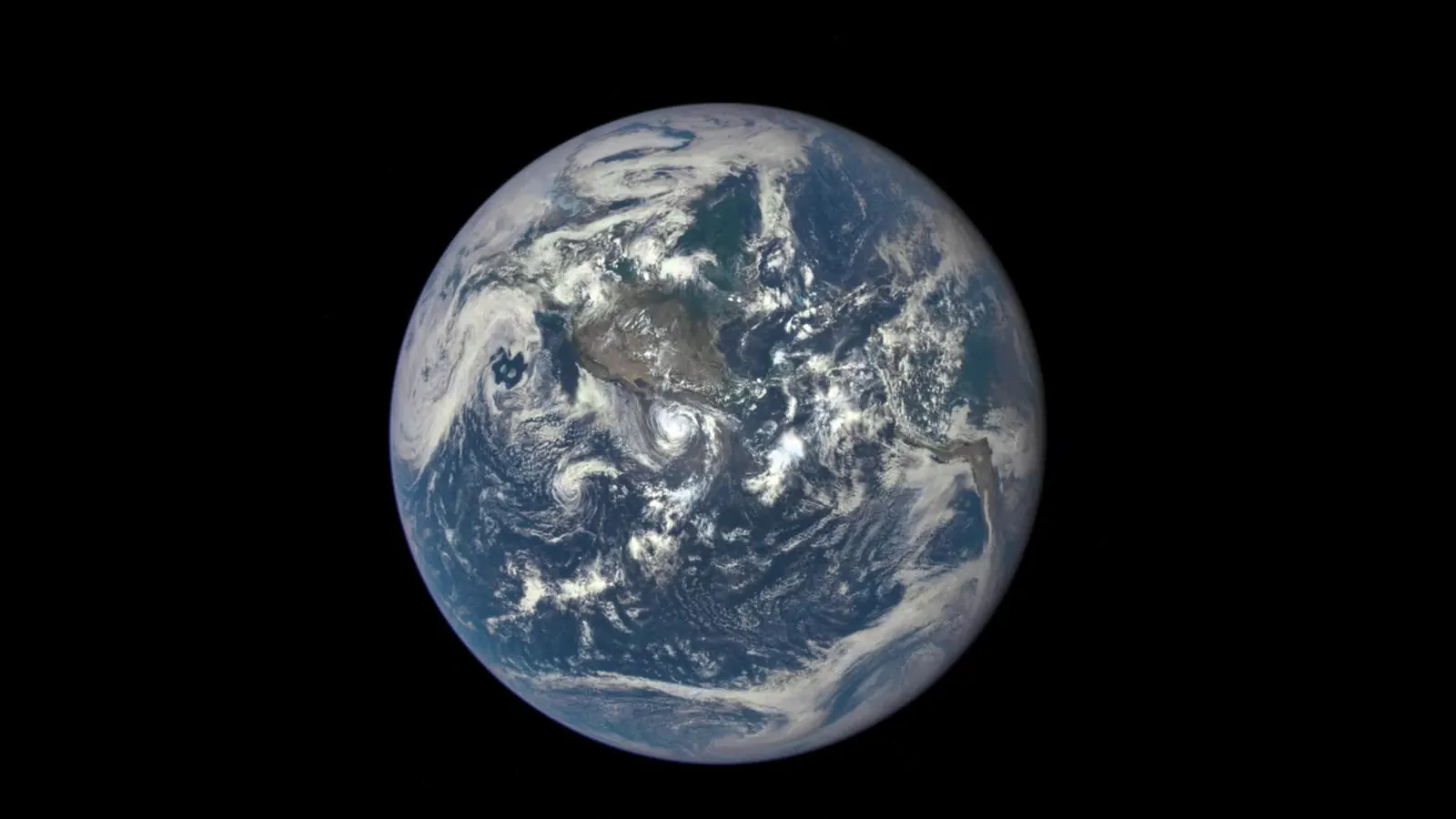
Lagrange points are the five places near two large orbiting bodies, such as the Sun and Earth, where a much smaller object can keep its position relative to both. For the Sun and Earth, L1 and L2 lie about 1.5 million km (932,000 miles) from Earth, L1 toward the Sun and L2 away from it. Diagrams that explain what Lagrange points are tend to show five fixed dots, but the points shift as Earth moves, and spacecraft loop around them instead of sitting on them.
An object orbiting closer to the Sun than Earth would normally go round faster. At L1, Earth's gravity cancels part of the Sun's pull, so the object keeps pace with Earth instead. At L2, beyond Earth, Earth's pull adds to the Sun's, which lets an object on a wider orbit keep up. L3 lies on the far side of the Sun. L4 and L5 lead and trail Earth by 60 degrees, each at the corner of an equilateral triangle with the Sun and Earth.
Leonhard Euler found the three points on the line through the two bodies in the 1760s. Joseph-Louis Lagrange added the triangle points in 1772, in a prize-winning essay for the Paris Academy of Sciences, and showed there are exactly five.
How many Lagrange points are there, and which are stable?
Every pair of bodies orbiting each other has five, including Earth and the Moon. By our calculation their L1 lies 58,019 km from the Moon on the Earth side, and their L2 64,515 km beyond it.
NASA calls L1, L2 and L3 unstable. Nudge an object off one and it keeps drifting away, and the pages for NASA's WMAP mission say that drift takes hold at L1 and L2 within about 23 days. A spacecraft orbiting near them needs regular course corrections, and one that drifts off won't come back without fuel. L3 is hidden behind the Sun from Earth, and NASA sees little use for it.
The other two, L4 and L5, are stable. Objects nudged off them stay nearby, but only when one body far outweighs the other, with more than 24.96 times the smaller one's mass. The Sun has about 333,000 times Earth's mass and 1,047 times Jupiter's, and Earth has 81.3 times the Moon's, so all three pairs clear that bar. Natural bodies that collect around these two points are called Trojans.
Earth has two known Trojans, both near L4, and as of October 2026 we found no report of a third. NASA's WISE spacecraft found 2010 TK7 in October 2010, and 2020 XL5 was first imaged on December 12, 2020. A 2022 study in Nature Communications put 2020 XL5 at about 1.18 km across and called it the second transient, or temporary, Earth Trojan. Its authors expect it to stay for at least 4,000 years. Seen from the ground, Earth's L4 and L5 lie 60 degrees from the Sun, so searches have to work in twilight, which is one reason so few are known.
Halo and Lissajous orbits around L1 and L2
Because L1 and L2 are unstable, spacecraft fly loops around them and fire their thrusters now and then to stay on course. A NASA technical paper on L1 orbits says these station-keeping burns "are necessary to prevent orbital decay and eventual escape from the L1 region."
Each loop combines two motions. One is a swing within the plane of Earth's orbit, the other a swing above and below it. In a halo orbit the two swings take practically the same time, so the spacecraft retraces the same closed loop lap after lap. SOHO, launched in 1995, was placed on one that repeats about every 178 days. In a Lissajous orbit the two swings take different times, so the path doesn't quite close and each lap lands a little off the last. NASA's ACE, launched in 1997, followed a small one, and WIND, launched in 1994, a large one.
India's Aditya-L1 shows how big these loops are. ISRO put it into a halo orbit around L1 on January 6, 2024. One lap takes about 177.86 days, and the loop's target half-widths are 209,200 km, 663,200 km and 120,000 km along its three axes. ISRO chose that orbit for a five-year mission with minimal station-keeping.
Which spacecraft orbit L1 and L2?
L1 gives an uninterrupted view of the Sun, NASA says, so Sun-watching missions go there. One SpaceX launch on September 24, 2025, sent NASA's IMAP and NOAA's SWFO-L1 toward L1. IMAP reached its destination on January 10, 2026, and began science on February 1. SWFO-L1 made its final engine burn on January 23 and was renamed SOLAR-1. NOAA moved it into operations on June 10, 2026.
Spacecraft orbiting L1 give warning of the solar storms that add drag to satellites in low orbit. By our arithmetic, solar wind moving at 400 km per second takes 62.5 minutes to cover the 1.5 million km to Earth. A coronal mass ejection, a cloud of magnetized gas thrown off by the Sun, covers it in 25 minutes at 1,000 km per second. A November 2025 paper gives a similar warning time, from just under 1.5 hours down to about 25 minutes.
L2 suits telescopes because a spacecraft orbiting there stays close enough to talk to Earth easily, NASA notes. The James Webb Space Telescope loops around it, and our guide to where Webb is explains why it was sent there. ESA's Euclid joined Webb around L2 in July 2023. ESA's Gaia has since left. After its supply of cold gas ran out, a last thruster firing on March 27, 2025, moved it away from L2 into a retirement orbit around the Sun.
NASA's Nancy Grace Roman Space Telescope is on its way to L2. It launched on a SpaceX Falcon Heavy on August 30, 2026, and made its first course correction the next day. NASA says Roman will enter its orbit about 100 days after launch. By our count that's around December 8, an estimate rather than a NASA date.
Webb, Lucy and the 1.5 million km in our data
Earth's Hill sphere gives a quick check on NASA's figure. It's roughly the region around Earth where Earth's gravity, rather than the Sun's, controls a small body's orbit, and L1 and L2 lie close to its edge. Its radius is the Sun-Earth distance multiplied by the cube root of Earth's mass divided by three times the Sun's mass. At 1 AU, Earth's average distance from the Sun, that gives 1,496,559 km, or 1,502,669 km with the Moon's mass added to Earth's.
The exact answer comes from the circular restricted three-body problem. In this textbook case the small object has no pull of its own and the two big bodies move in circles. With Earth and Moon counted together, it puts L1 at 1,497,621 km from Earth and L2 at 1,507,683 km, so the quick formula lands within 0.34 percent of both. Earth's distance from the Sun changes through the year, so the points move too. In 2026 L1 ranged between about 1.47 and 1.52 million km from Earth, and L2 between 1.48 and 1.53 million km.
For Webb, we put L2 on the line from the Sun through Earth, at the distance the exact solution gives for each date. Then we measured the distance to Webb's position in the JPL Horizons tables behind our deep space tracker. On October 8, 2026, Webb was 694,110 km (431,300 miles) from L2.
Repeating that every half day from March 2022 to September 2031, with JPL's planned orbit for dates after October 8, we found Webb stays about 400,000 to 825,000 km from L2. The Space Telescope Science Institute (STScI) gives 250,000 to 832,000 km. The high ends nearly match. Our low end is well above STScI's, though, and we haven't found out why. STScI may measure from a different L2 reference point, or it may be quoting the orbit Webb was designed for. Until we know, treat our 400,000 km figure as a product of our method rather than a correction to STScI's. On JPL's planned orbit, Webb's next high, about 815,000 km, comes around October 28, and the next low, about 400,000 km, around December 13.
None of these spacecraft are in our October 11 copy of CelesTrak's active list, the 16,701 objects behind our live satellite map. The list is built from element sets, compact descriptions of orbits around Earth, so it leaves out anything circling a Lagrange point. The satellite on it that ranges farthest, NASA's TESS, gets 370,833 km from Earth's centre, about a quarter of the way to L1.
Jupiter has Lagrange points of its own, and NASA's Lucy is bound for the Trojans gathered around two of them. To place Lucy, we took Jupiter's position from the astronomy-engine library. Jupiter's L4 point leads the planet by 60 degrees along its orbit, at the same distance from the Sun. On October 11, Lucy was 5.11 AU (764 million km) from the Sun and 91.6 degrees ahead of Jupiter. That put it 428 million km (2.86 AU) from the exact L4 point. On our 3D solar system map, its marker sits well ahead of Jupiter's.
Lucy's first Trojan flyby, of Eurybates and its moon Queta, is set for August 12, 2027, according to NASA. Even then, by our numbers, Lucy will be 300.8 million km (2.0 AU) from the exact L4 point. Eurybates itself lies about 21 degrees ahead of the point, because the Trojan swarm spreads wide around it. NASA has the L4 flybys running to November 2028, and Lucy comes closest to the point itself in December 2028, at about 51.9 million km. Then it heads for L5 and the pair Patroclus and Menoetius, due on March 3, 2033.
Sources
- NASA Goddard Space Flight Center, WMAP mission, The Lagrange Points and Observatory: L2 orbit, undated
- arXiv, history of the collinear and triangular solutions of the three-body problem, January 2019, and a second history of the Euler and Lagrange solutions, October 2025
- T. Santana-Ros et al., study of the second Earth Trojan asteroid, 2020 XL5, Nature Communications, February 1, 2022
- NASA Technical Reports Server, papers on libration-point orbits for SOHO, ACE and WIND, 20110008638 and 20150021066
- ISRO, Halo Orbit Insertion of Aditya-L1, January 6, 2024
- NASA, NASA, NOAA Launch Three Spacecraft to Map Sun's Influence Across Space, September 24, 2025
- NASA Science, NASA's IMAP Mission Reaches Its Destination, January 12, 2026
- NOAA Office of Satellite and Product Operations, SOLAR-1 Transition to Operations on June 10, 2026, June 10, 2026
- NOAA Space Weather Prediction Center, SOLAR-1 Is Now The New Designation for SWFO-L1, January 2026, and NOAA NCEI, SOLAR-1 overview, Space Weather Portal
- arXiv, Monitoring the Solar Wind Before It Reaches L1, November 2025
- ESA, Webb and Gaia welcome Euclid to L2, July 28, 2023, and Farewell Gaia! Spacecraft operations come to an end, March 27, 2025
- NASA, NASA's Dark Universe-Seeking Nancy Grace Roman Space Telescope Launches, August 30, 2026, and NASA Science, NASA's Roman Completes First Mid-Course Correction Burn, August 31, 2026
- STScI, JWST User Documentation, JWST Orbit
- NASA Science, Lucy mission page, as of October 2026
- NASA/JPL, Horizons System (Webb and Lucy), data refreshed October 8, 2026; Astronomy Engine 2.1.19; CelesTrak, active satellites element sets, snapshot of October 11, 2026
Follow by RSS. Share this post: Bluesky · X · Reddit · Email
More from the blog
-
How many Amazon Kuiper satellites are in orbit? Leo's fleet
Amazon reported 396 Kuiper satellites launched by July 2026. On October 11, CelesTrak's active list held 391 Amazon Leo satellites, 375 near 630 km up.
-
When is the Geminid meteor shower 2026? Peak times and Moon
The Geminid meteor shower peaks the night of December 13-14, 2026: NASA says 40 to 50 meteors an hour under dark skies, and the crescent Moon sets early.
-
When is the next total solar eclipse? August 2, 2027
The next total solar eclipse is on August 2, 2027. Totality crosses Spain, North Africa and Arabia, lasting up to 6 min 23 s in Egypt's desert near Luxor.
-
How fast is the Parker Solar Probe? Top speed and orbit
At closest approach the Parker Solar Probe reaches about 430,000 mph (692,000 km/h) relative to the Sun. On Oct. 11, 2026, it was doing just 13.9 km/s.
-
What are China's Qianfan and Guowang constellations?
China's Qianfan and Guowang satellite constellations had 477 satellites on CelesTrak's active list on October 11, 2026, toward plans of about 15,000 and 13,000.
Home · Live satellite map · Satellite directory · Starlink · OneWeb · Navigation satellites · Space stations · Other active satellites · Track the ISS · ISS visible passes · Starlink train · Rocket launches · Aurora forecast · Humans in space · Solar System · Deep Space · Embed widgets · Blog · Guide: spot the ISS · Guide: what is a TLE? · Guide: how many satellites? · Guide: satellite trackers compared · Discovery: Elias 2-24 b · About · FAQ · Data & methodology · Credits · Editorial policy · Accessibility · Contact · Privacy · Terms
© 2026 WatchSat · Not affiliated with any space agency or satellite operator.