WatchSat › Blog › Where is the James Webb Space Telescope? Distance and orbit
Where is the James Webb Space Telescope? Distance and orbit
The James Webb Space Telescope was 1.36 million km from Earth on October 8, 2026, looping around L2. Its distance swings from 1.2 to 1.75 million km.
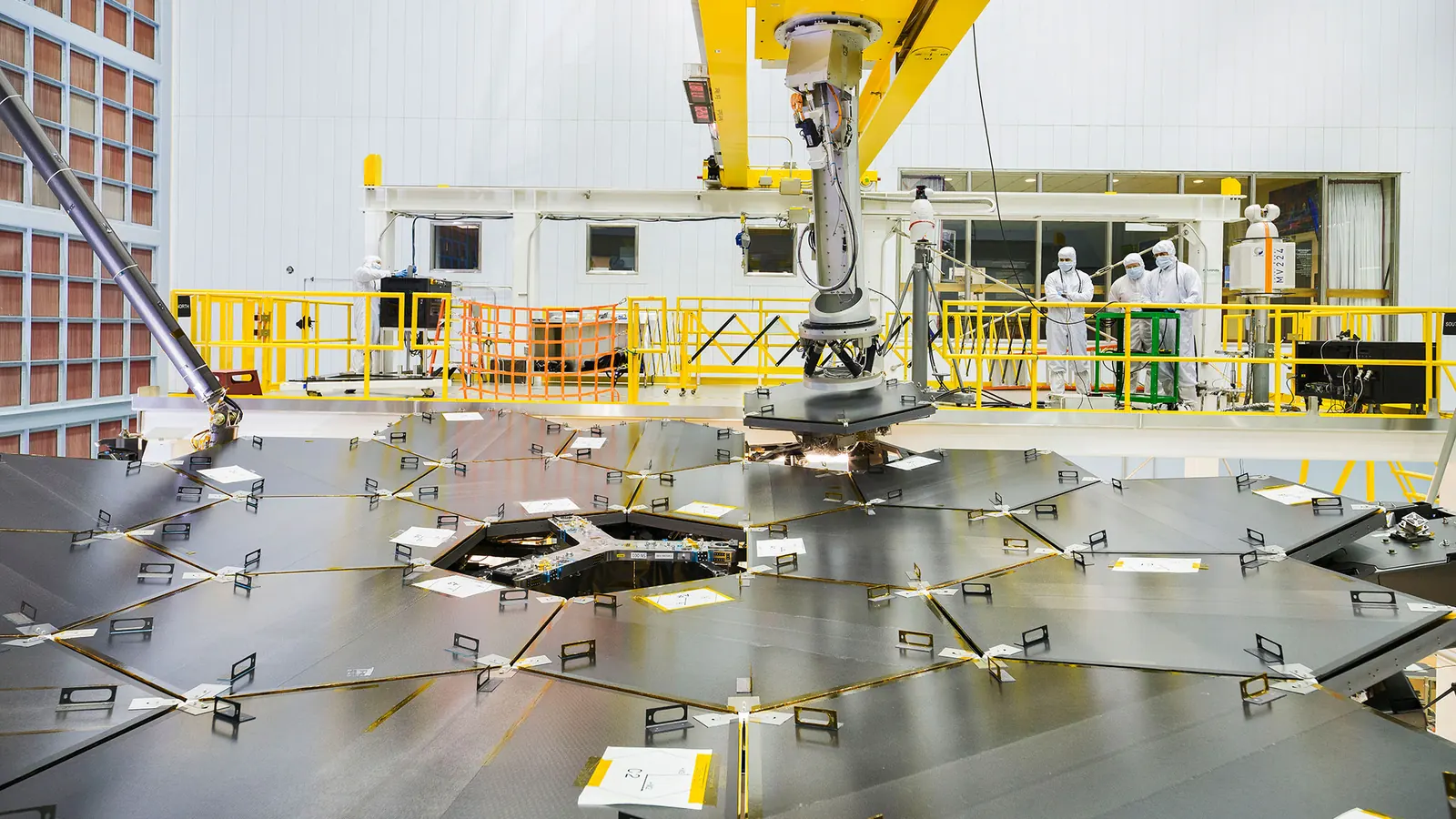
On October 8, 2026, the James Webb Space Telescope was 1,362,384 km (846,546 miles) from Earth, on the side facing away from the Sun. Its radio signals took about 4.5 seconds to reach the ground, and by October 11 it had moved out to about 1.39 million km. The figure you'll usually see is 1.5 million km, which is the distance to L2, the point Webb loops around. Webb's own distance changes by more than half a million kilometres over a few months, and since March 2022 it has been closer than 1.5 million km 42 percent of the time.
Webb orbits the Sun, keeping pace with Earth from slightly farther out. On October 8 Webb was 1.0075 astronomical units (AU) from the Sun and Earth was 0.9994 AU, where 1 AU is Earth's average distance from the Sun. Webb was moving at 30.26 km/s relative to the Sun. On top of that yearly path it traces a wide loop around L2, called a halo orbit, which takes about six months. The Space Telescope Science Institute (STScI) says the loop carries Webb between 250,000 and 832,000 km from the L2 point. Webb got there on an Ariane 5, launched from the Guiana Space Centre in Kourou on December 25, 2021. Thirty days later, on January 24, 2022, a 297-second burn that added about 1.6 m/s put it on that orbit.
How far is JWST from Earth?
Our deep space tracker takes Webb's position and velocity from JPL's Horizons system, the lab's public source for where planets and spacecraft are, and subtracts Earth's position at the same moment. Its tables were last refreshed on October 8. For the mission as a whole we used Horizons' long table, which has one entry every 10 days since launch day plus JPL's predictions for the planned orbit ahead. We filled that in at six-hour steps.
Since March 2022, Webb has been between about 1.2 million km (745,000 miles) and 1.75 million km (1.09 million miles) from Earth. The distance rises and falls on a cycle of about six months. It peaks near 1.75 million km in June or July and near 1.70 million km in December or January. The low points, around 1.2 million km, come in March and in September or October. The latest low was about 1.214 million km on September 14, 2026, and on October 8 Webb was moving outward at roughly 10,000 km a day. If the planned orbit holds, Webb should pass 1.5 million km around October 21 and stay near 1.70 million km from late November to late December.
| Date | Webb's distance from Earth |
|---|---|
| September 14, 2026 | about 1.214 million km (low point) |
| October 8, 2026 | 1.362 million km |
| November 1, 2026 | 1.597 million km (predicted) |
| December 1, 2026 | 1.700 million km (predicted) |
| March 10, 2027 | about 1.196 million km (next low, predicted) |
The halo orbit also swings Webb well off to one side. On October 8 it sat 27 degrees off the line pointing straight away from the Sun, about 627,000 km from that line. When ESA announced Webb's arrival at L2 on January 24, 2022, it put L2 1.5 million km from Earth. The telescope itself was about 1.39 million km away.
At the October 8 distance, a command and Webb's reply take about nine seconds round trip, a tiny delay next to Voyager 1's signals, which are nearing a full day each way. The telescope sends its science data home through NASA's Deep Space Network on a high-frequency Ka-band radio link at 28 megabits per second, according to NASA.
What is L2, and why is Webb there?
L2, the second Sun-Earth Lagrange point, lies on the line from the Sun through Earth, on Earth's far side. Out there the pull of the Sun and of Earth together lets an object go around the Sun in one year, the same as Earth, even though it's on a bigger circle. Working that balance out from the masses of the Sun, Earth and Moon, we get about 1.5 million km beyond Earth at 1 AU. Earth's orbit is slightly oval, so L2 moves too. By our calculation it sat about 1.48 million km out on January 4, 2026, when Earth was nearest the Sun, and about 1.53 million km out on July 6, when Earth was farthest. The shift helps explain why Webb's peaks in June and July run higher than the ones in December and January.
NASA describes the point as only metastable, meaning an object there doesn't stay put on its own. Left alone, Webb would drift off, so it fires small thrusters every three weeks or so to stay on its loop.
Webb is at L2 to stay cold. It sees mostly infrared light, which anything warm gives off, the telescope included. According to NASA, the telescope and its instruments have to be very cold so their own glow doesn't swamp the faint signals they're after. The sunshield that keeps them cold is 21.2 by 14.2 m and made of five layers of Kapton film. NASA says it only works if the Sun, Earth and Moon all stay on one side of it, and from L2 they do, all year. The halo orbit also keeps Webb out of Earth's and the Moon's shadows. Behind the shield the telescope cools on its own to below 50 kelvin (about minus 223 C, or minus 370 F). The mid-infrared instrument, MIRI, needs a cryocooler, a mechanical refrigerator, to get below 7 kelvin, which it reached on April 7, 2022.
Hubble, by contrast, works from low Earth orbit, about 470 km up. From there Earth fills a big part of the sky, and its direction swings all the way around once every 94-minute orbit. No shade could keep Earth and the Sun behind it at the same time.
Webb, Hubble and the satellite catalog
Webb doesn't appear on WatchSat's satellite pages. Those run on two-line element sets (TLEs) from CelesTrak, a format built to describe orbits around Earth, as our guide to TLEs explains. None of the 16,683 objects in our October 8 copy of CelesTrak's active list is Webb. We follow it with Horizons position tables instead, and on our 3D solar system map its marker sits right on top of Earth's at the scale of the planets.
The object in that list that ranges farthest from Earth is NASA's TESS satellite, whose stretched orbit reaches 364,455 km at its high point, measured above Earth's 6,378 km equatorial radius as CelesTrak's catalog does. On October 8 Webb was 3.67 times farther from Earth's centre than TESS ever gets.
Hubble's October 7 element set puts it 469.2 to 471.3 km up, on a 94.00-minute orbit, about 15 a day, tilted 28.47 degrees to the equator. Webb's distance on October 8 was 2,897 times Hubble's height, and Hubble's signals reach the ground in about 1.6 milliseconds. Follow Hubble's live position, or check the Hubble pass predictions for when it crosses your sky.
How long Webb will last
NASA designed Webb for at least five years of science, with a goal of 10. Science operations began with the first full-colour images, which NASA released on July 12, 2022, so Webb has now been at work for a little over four years. On that day Webb was near one of its farthest points, about 1.75 million km from Earth.
Propellant sets one hard limit, because every station-keeping burn, the small corrections that hold it on its loop, uses some. Four days after launch, NASA said Webb "should have enough propellant to allow support of science operations in orbit for significantly more than a 10-year science lifetime." ESA credited the accuracy of the Ariane 5, which beat its requirement, and of the first mid-course correction. In July 2022 Rigby and colleagues published a paper on how Webb performed during commissioning, the months of checkout before science began. It projected enough propellant for more than 20 years of science, though the estimate covers fuel alone.
Hardware wear is another limit. Between May 23 and 25, 2022, a micrometeoroid hit mirror segment C3, and NASA reported the following month that it was larger than the team's models had predicted. Since Webb's second observing cycle, STScI says, observations have been limited in a zone around the direction the telescope is travelling, where impacts carry more energy.
Shuttle crews serviced Hubble five times between 1993 and 2009, but nobody can do that for Webb. NASA's Webb FAQ says L2 is beyond the reach of any planned crewed vehicle. Early studies of robotic servicing, it adds, found the benefits didn't justify the added complexity, mass and cost.
Sources
- NASA Science, NASA Says Webb's Excess Fuel Likely to Extend its Lifetime Expectations, December 29, 2021
- ESA/Webb, Precise Ariane 5 Launch Likely to Extend Webb's Expected Lifetime, December 2021
- ESA/Webb, Webb Has Arrived at L2, January 24, 2022, and NASA Scientific Visualization Studio, Orbital Insertion Burn: Webb Arrives at L2
- J. Rigby et al., The Science Performance of JWST as Characterized in Commissioning, arXiv, July 2022
- NASA Science, Webb Orbit and Webb's Sunshield
- STScI, JWST User Documentation, JWST Orbit and JWST Micrometeoroid Avoidance Zone
- NASA, Webb Telescope's Coldest Instrument Reaches Operating Temperature, April 2022
- NASA Science, Webb: Engineered to Endure Micrometeoroid Impacts, June 8, 2022
- NASA, NASA Reveals Webb Telescope's First Images of Unseen Universe, July 12, 2022
- NASA Science, Talking with Webb using the Deep Space Network, August 15, 2023; Webb and the Deep Space Network, undated
- NASA, James Webb Space Telescope FAQ, and NASA Science, Hubble Servicing Missions Timeline
- NASA/JPL, Horizons System (Webb, ID -170), data refreshed October 8, 2026, and CelesTrak, active satellites element sets, snapshot of October 8, 2026
Follow by RSS. Share this post: Bluesky · X · Reddit · Email
More from the blog
-
What is a sun-synchronous orbit? Polar orbits and dawn-dusk
A sun-synchronous orbit turns 0.9856° a day with the Sun, so Landsat 9 crosses the equator southbound near 10:12 a.m. One in five active satellites flies one.
-
Where is the Hubble Space Telescope now? Orbit and reentry
The Hubble Space Telescope orbits about 470 km up and is sinking roughly 10 km a year. STScI puts its most likely reentry in 2033 unless it gets a boost.
-
October 10 geomagnetic storm reached G3: aurora outlook
A coronal mass ejection drove a G3 (strong) geomagnetic storm on October 10, 2026. What NOAA measured, who saw aurora and what comes next.
-
ISS crew swap: Crew-13 sets U.S. record, Crew-12 lands
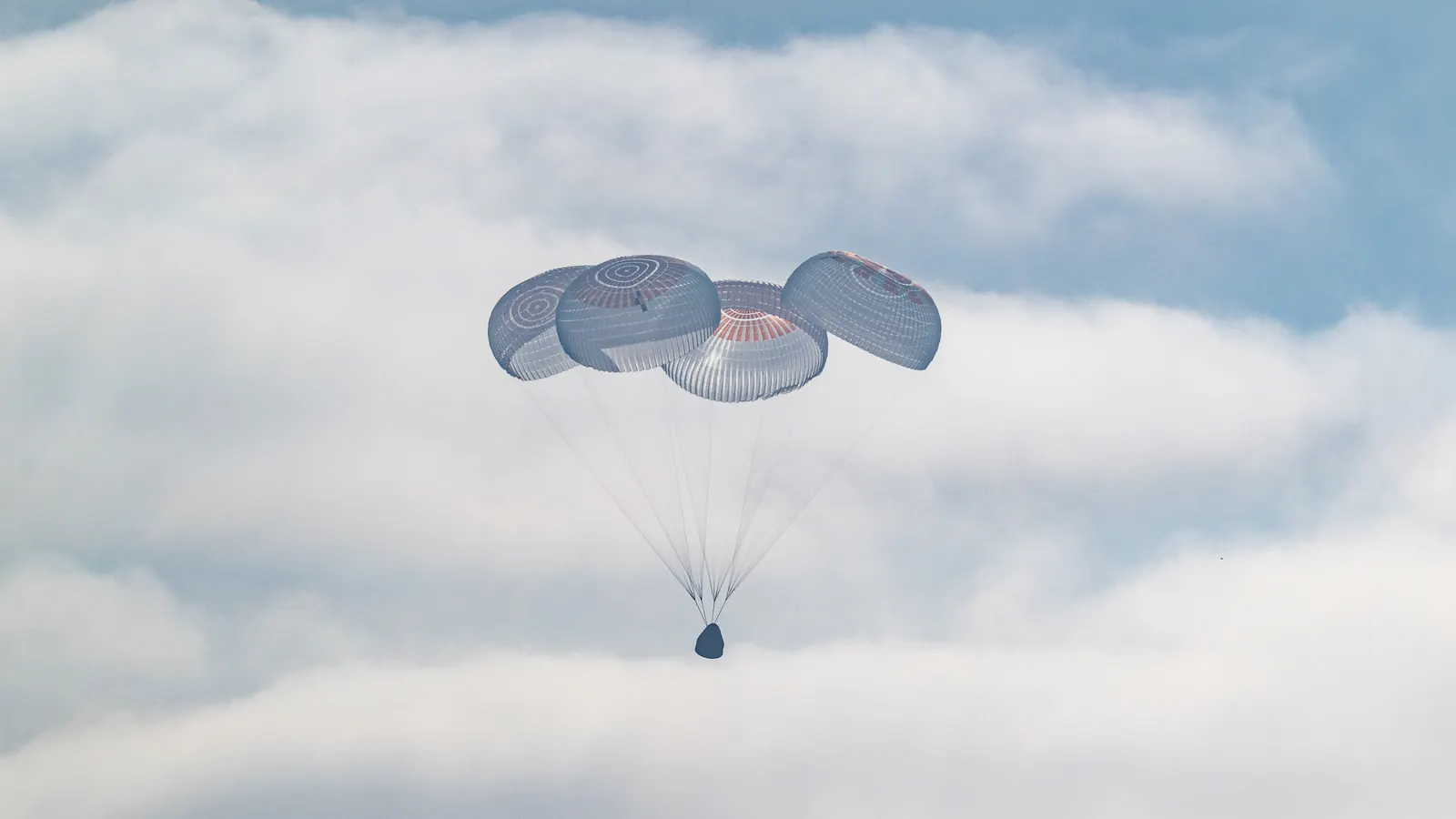
Crew-13 reached the ISS 7 hours 55 minutes after launch on October 1, a U.S. record. Crew-12 splashed down October 8, and CRS-35 is due October 13.
-
Orionid meteor shower 2026: peak, Moon and satellites
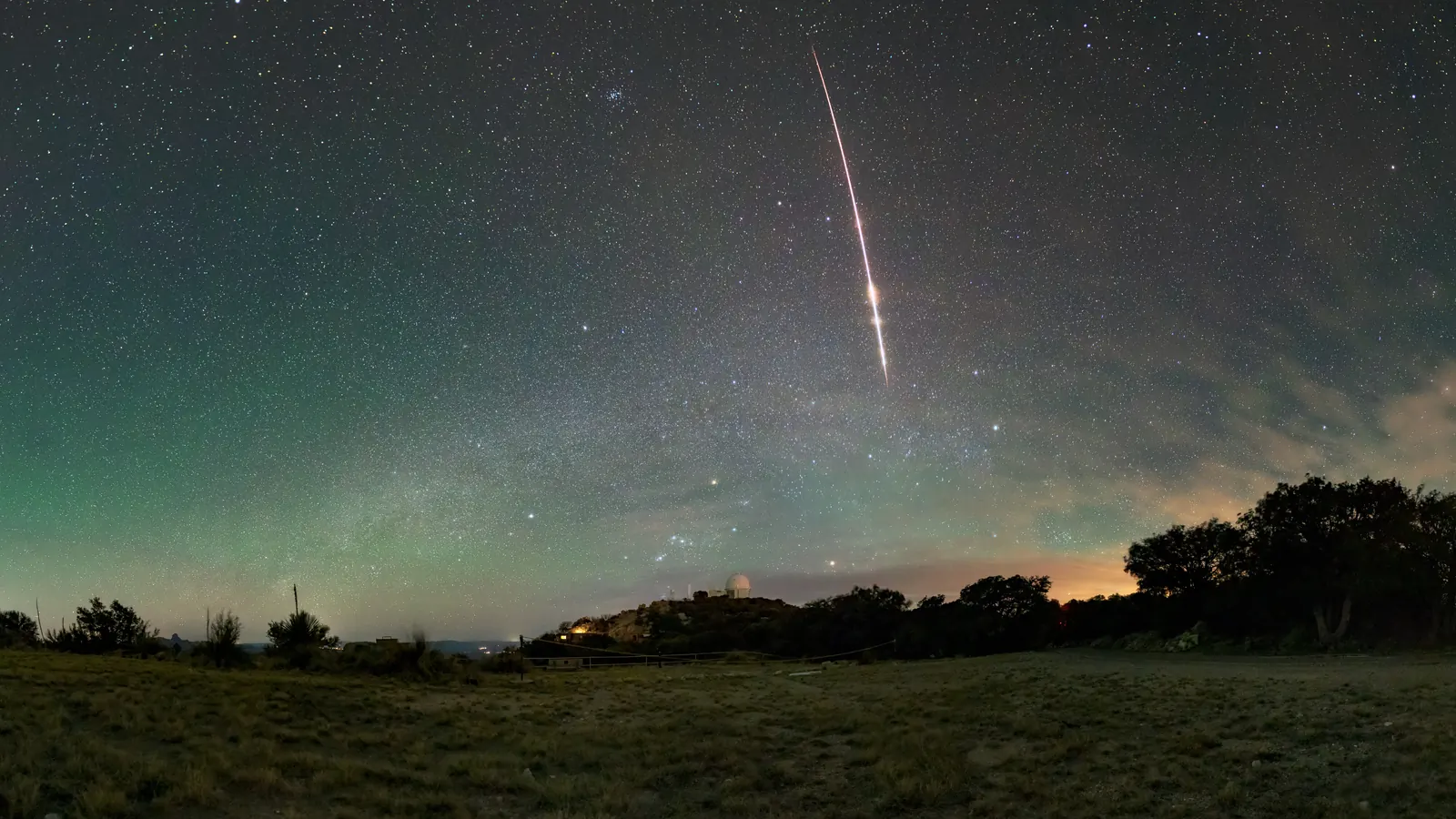
The Orionids peak on the night of October 21-22, 2026 under a bright gibbous Moon. When the Moon sets, and why satellites crowd the hour before dawn.
Home · Live satellite map · Satellite directory · Starlink · OneWeb · Navigation satellites · Space stations · Other active satellites · Track the ISS · ISS visible passes · Starlink train · Rocket launches · Aurora forecast · Humans in space · Solar System · Deep Space · Embed widgets · Blog · Guide: spot the ISS · Guide: what is a TLE? · Guide: how many satellites? · Guide: satellite trackers compared · Discovery: Elias 2-24 b · About · FAQ · Data & methodology · Credits · Editorial policy · Accessibility · Contact · Privacy · Terms
© 2026 WatchSat · Not affiliated with any space agency or satellite operator.