WatchSat › Blog › Where is the Hubble Space Telescope now? Orbit and reentry
Where is the Hubble Space Telescope now? Orbit and reentry
The Hubble Space Telescope orbits about 470 km up and is sinking roughly 10 km a year. STScI puts its most likely reentry in 2033 unless it gets a boost.
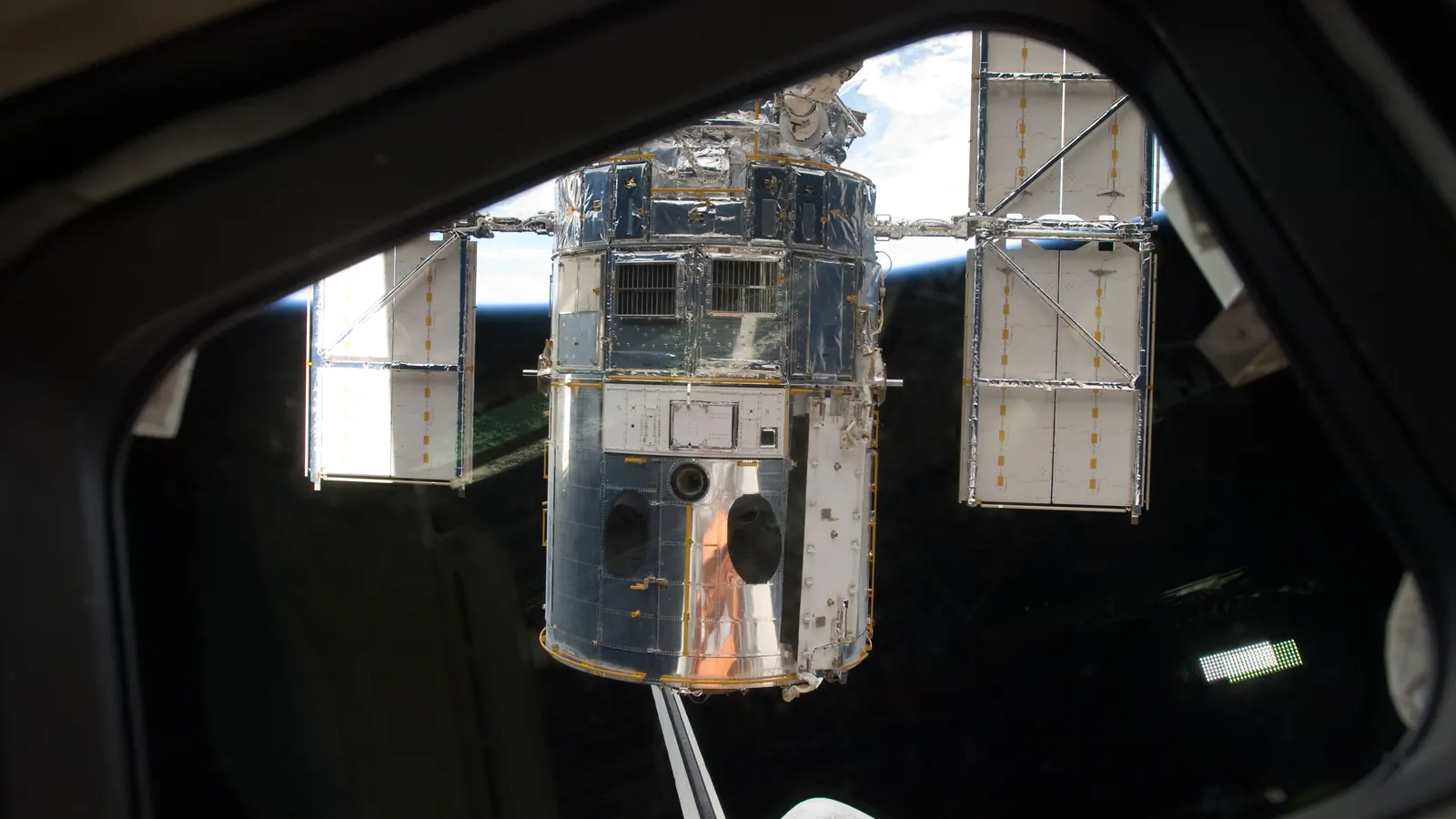
The Hubble Space Telescope is about 470 km (292 miles) above Earth, circling the planet once every 94 minutes at roughly 7.6 km a second. Its orbit is tilted 28.5 degrees to the equator, so it's always somewhere over the tropics or just beyond them, and Hubble's live position on WatchSat shows exactly where. It's also lower now than at any time since its 1990 launch. Hubble has no engine, and in our data it's losing about 10 km of height a year. The Space Telescope Science Institute (STScI), which runs its science for NASA, puts its most likely reentry in 2033 unless something lifts it.
How high is the Hubble Space Telescope?
Our October 8 snapshot of CelesTrak's active satellite list carries Hubble's element set for October 7, the block of numbers that describes its orbit at that moment. It gives an average altitude of 470.3 km, with a lowest point (perigee) of 469.2 km and a highest point (apogee) of 471.3 km. Those heights are measured above a sphere with Earth's equatorial radius of 6,378 km, the convention CelesTrak and most NASA figures use. Because Earth is slightly flattened, Hubble's true height above the ground ranges from about 467 to 476 km over one orbit. NASA's own Hubble pages still give older, higher figures, so expect a spread of numbers online.
At that height Hubble travels at about 7.63 km a second, roughly 27,500 km/h or 17,100 mph, in line with the 17,000 mph in NASA's Hubble FAQ. It makes 15.3 orbits a day. Earth turns underneath it, so each orbit's ground track, the path directly beneath it, lands about 24 degrees of longitude farther west than the last.
Hubble flies about 50 km above the International Space Station, which the same snapshot puts at 420 km. The station fires engines to hold its height and rose about 1 km over the weeks we tracked. According to ESA's Hubble site, Hubble's only boosts came from the space shuttle's thrusters during servicing visits. Five shuttle crews serviced it, the last in 2009. On WatchSat it's listed among the other active satellites under its catalog name, HST, with the NORAD catalog number 20580.
Hubble's slow fall in our orbital data
WatchSat saved eight copies of CelesTrak's catalog between September 15 and October 8, 2026. Two carried the same Hubble element set, leaving seven distinct ones, dated September 14 to October 7. For each, we took the mean motion, the number of orbits per day, and turned it into an average height with Kepler's third law, which ties the time an orbit takes to its size.
Hubble averaged 470.91 km in the September 14 elements and 470.29 km in the October 7 set, a loss of 630 metres in 23.5 days. It works out to about 27 metres a day, roughly 1.7 metres every orbit, or close to 10 km a year at the current pace. A straight-line fit through all seven points gives 26.5 metres a day, and the drag term in the October 7 elements, their own built-in estimate of the decay rate, points to 27.
Over the longer run the fall has been much bigger. In February 2026 The Register reported, citing a plot by astronomer Jonathan McDowell, that Hubble had dropped from above 600 km at launch to well below 500 km. It tied the faster recent descent to the Sun, which is near the peak of its activity cycle. An active Sun swells the upper atmosphere, so Hubble runs into more air. Drag also grows as Hubble sinks into denser layers, so today's rate can't simply be stretched into a reentry date.
Swift, a NASA observatory in a lower orbit, shows how much faster the fall gets farther down. In the same files it dropped from 328.6 km to 304.9 km, about 1,016 metres a day and 38 times Hubble's rate.
Who can see Hubble, and from where
Hubble passes straight overhead only between 28.5° N and 28.5° S, but you can see it from farther away, lower in the sky. Using the October 7 elements and a round Earth, we found that it clears the horizon for observers within about 50 degrees of the equator. For those within 42 degrees, it gets more than 10 degrees up. It peaks at about 33 degrees from Los Angeles and about 12 from New York, and from London it never rises at all.
According to NASA Goddard's Hubble tracking page, you can see the telescope with the naked eye as a fast-moving spot of light. It has to pass close enough overhead, the sky has to be dark and clear, and Hubble itself has to still be lit by the Sun. Those conditions come together only in the hours after sunset and before sunrise. We simulated a week of passes from October 11, counting one as visible when Hubble climbs at least 10 degrees, the Sun is more than 6 degrees below the horizon and the telescope is sunlit.
| City | Latitude | Visible passes, Oct 11 to 17 | Highest visible pass |
|---|---|---|---|
| Mexico City | 19.4° N | 7 | 87° |
| Miami | 25.8° N | 9 | 73° |
| Cairo | 30.0° N | 9 | 63° |
| Los Angeles | 34.1° N | 8 | 33° |
| Tokyo | 35.7° N | 6 | 26° |
| Sydney | 33.9° S | 2 | 17° |
| New York | 40.7° N | 3 | 12° |
| Chicago | 41.9° N | 0 | none |
| London | 51.5° N | 0 | never rises |
These counts are geometry only, with no cut for brightness, so treat them as an upper limit. They also shift from week to week, because Hubble's orbital plane swings west about 6.8 degrees a day, which changes which nights get passes in darkness. The Hubble pass predictions list times for your own location, and our guide to spotting the ISS explains how to find a moving satellite, Hubble included.
When will Hubble reenter the atmosphere?
There's no fixed date, because drag depends on how active the Sun is over the coming years. The Register's February headline said Hubble could reenter as early as 2028, a worst-case reading of McDowell's plot. STScI's April 2026 newsletter says current estimates point to a likely reentry in 2033. Its summary of the fall 2025 users committee meeting gave a median date of mid-2033, with less than a 10 percent chance of reentry before 2030. NASA's FAQ is looser, saying Hubble isn't expected to come down until the mid-2030s at the earliest.
In an April 22, 2026 presentation, STScI laid out three options. Hubble could be boosted to a storage orbit where it would last more than 100 years, or boosted as a temporary fix. A controlled reentry, the third choice, would be significantly more complex and expensive, STScI said. Left alone, Hubble would fall uncontrolled, and the deck put the casualty risk, the chance that surviving debris hurts someone, at 1 in 200. A boost would have to happen before February 2030, a year before the chance of reentry reaches 10 percent. To leave two to three years to build the hardware, STScI said, a decision was needed in 2026. According to the newsletter, planning and funding would have to start in fiscal 2027, which began on October 1.
The last shuttle crew, in 2009, carried up a docking ring, the Soft Capture Mechanism, so a future crewed or robotic vehicle could latch on for a boost or a controlled deorbit. NASA has looked at a rescue before. In September 2022 it signed an unfunded agreement with SpaceX to study a Crew Dragon boost, with Jared Isaacman, then running the private Polaris program, taking part. On June 4, 2024, NASA's astrophysics director, Mark Clampin, said NASA wouldn't pursue it for now, because the risk outweighed the benefit and Hubble's orbit would hold until the mid-2030s. Isaacman is now NASA's administrator. STScI's newsletter says NASA has considered a boost on condition that Hubble costs less to run afterwards.
A commercial attempt to boost another NASA telescope failed in August. Katalyst's LINK spacecraft launched in July 2026 to raise Swift's orbit, and on August 19 NASA and Katalyst called it off because LINK couldn't control its orientation. STScI had already said that approach wouldn't scale to Hubble. As of October 10 we hadn't found an announcement of an approved Hubble boost.
Congress gave Hubble $98.3 million in fiscal 2026, more than the $85.0 million the White House asked for. For fiscal 2027 the request is $72.7 million, while the House appropriations committee's bill carries $92.8 million, according to the American Astronomical Society.
A boost only pays off if the telescope keeps working. Hubble went into safe mode on May 24, 2024, over a faulty gyroscope, one of the sensors it uses to hold its aim. Since June 2024 it has pointed with one gyro, keeping a second in reserve. Project manager Patrick Crouse put the cost at about 12 percent of its efficiency, and Hubble can no longer track moving targets closer than Mars. STScI's status page lists two working gyros and three working fine guidance sensors, the instruments that lock onto guide stars. It gives about a 90 percent chance that at least one gyro still works in 2030.
The next thing to watch is the final fiscal 2027 budget Congress passes for NASA, since that's the year STScI says boost planning would have to begin. Meanwhile, at the current rate, each week of new elements puts Hubble about 190 metres lower.
Sources
- STScI, Building a roadmap for Hubble science into the 2030s, newsletter, April 2026; A roadmap for HST science through the 2030s, Space Telescope Users Committee presentation, April 22, 2026; Fall 2025 meeting of the Hubble Space Telescope Users Committee, newsletter, 2026; HST overview and status, live status page
- NASA, Hubble FAQs, undated; NASA, SpaceX to study Hubble telescope reboost possibility, September 2022; NASA to change how it points Hubble Space Telescope, June 4, 2024; Hubble symposium transcript, August 2026
- NASA Goddard, Tracking Hubble and Soft Capture and Rendezvous System, archive pages
- ESA/Hubble, A little boost, undated
- SpaceNews, Hubble goes to single-gyro operating mode as NASA passes on private servicing mission, June 2024
- Via Satellite, Katalyst LINK mission is unable to rescue NASA Swift observatory, August 19, 2026
- American Astronomical Society, FY26 President's budget request, June 2025; House FY27 CJS report: NASA, NSF and DOE details, May 2026
- The Register, Hubble could re-enter atmosphere as early as 2028, February 25, 2026
- CelesTrak, active satellites element sets, WatchSat snapshots of September 15 to October 8, 2026
Follow by RSS. Share this post: Bluesky · X · Reddit · Email
More from the blog
-
How much space debris is in orbit? 2026 counts and risks
How much space debris is in orbit? The US catalog lists about 34,000 objects, ESA counts about 47,000 tracked, and models estimate 1.5 million of 1 to 10 cm.
-
What is a sun-synchronous orbit? Polar orbits and dawn-dusk
A sun-synchronous orbit turns 0.9856° a day with the Sun, so Landsat 9 crosses the equator southbound near 10:12 a.m. One in five active satellites flies one.
-
Where is the James Webb Space Telescope? Distance and orbit
The James Webb Space Telescope was 1.36 million km from Earth on October 8, 2026, looping around L2. Its distance swings from 1.2 to 1.75 million km.
-
October 10 geomagnetic storm reached G3: aurora outlook
A coronal mass ejection drove a G3 (strong) geomagnetic storm on October 10, 2026. What NOAA measured, who saw aurora and what comes next.
-
ISS crew swap: Crew-13 sets U.S. record, Crew-12 lands
Crew-13 reached the ISS 7 hours 55 minutes after launch on October 1, a U.S. record. Crew-12 splashed down October 8, and CRS-35 is due October 13.
Home · Live satellite map · Satellite directory · Starlink · OneWeb · Navigation satellites · Space stations · Other active satellites · Track the ISS · ISS visible passes · Starlink train · Rocket launches · Aurora forecast · Humans in space · Solar System · Deep Space · Embed widgets · Blog · Guide: spot the ISS · Guide: what is a TLE? · Guide: how many satellites? · Guide: satellite trackers compared · Discovery: Elias 2-24 b · About · FAQ · Data & methodology · Credits · Editorial policy · Accessibility · Contact · Privacy · Terms
© 2026 WatchSat · Not affiliated with any space agency or satellite operator.