WatchSat › Blog › Voyager 1 will reach one light-day from Earth on Nov. 18
Voyager 1 will reach one light-day from Earth on Nov. 18
At 10:16 UTC on November 18, 2026, Voyager 1 will be one light-day from Earth. How far that is, how long its signals take, and why it stays past the line.
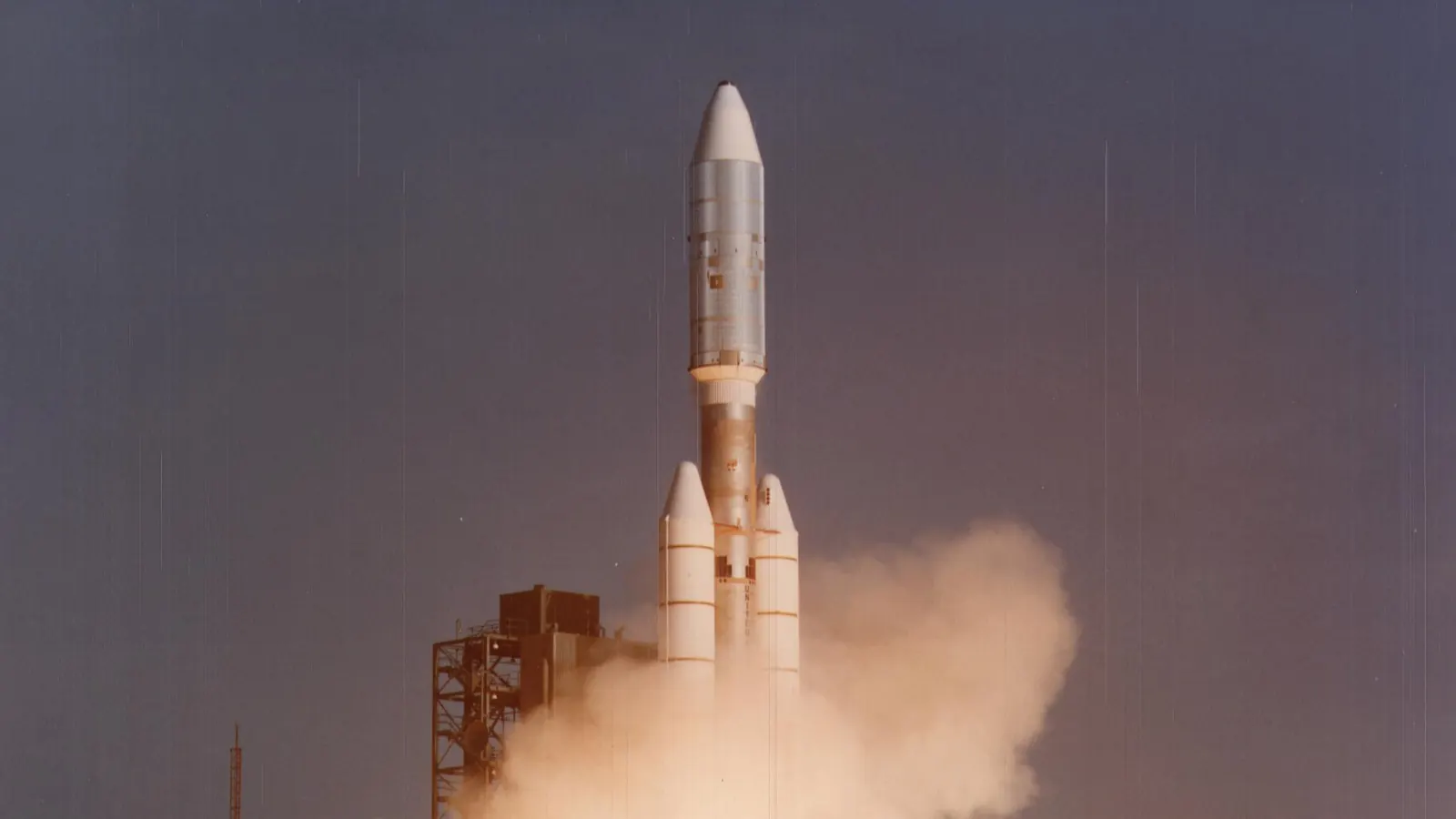
At 10:16 UTC on Wednesday, November 18, 2026 (2:16 a.m. on the US West Coast), NASA's Voyager 1 will be one light-day from Earth. That's 25,902,068,371 kilometres, the distance light covers in 24 hours, and no object built by people has ever been so far away. A radio command sent that morning will take a full day to reach the spacecraft, and its reply another full day to get back.
Voyager 1 left Cape Canaveral on September 5, 1977. By NASA's count, it will have taken 49 years, 2 months and 11 days to put one light-day between itself and home.
How far is Voyager 1 from Earth?
Light travels 299,792.458 kilometres every second. Multiply that by the 86,400 seconds in a day and you get about 25.9 billion kilometres, or 173.1 astronomical units (AU), where one AU is the average distance from Earth to the Sun. Neptune, the outermost planet, orbits about 30 AU out.
On September 27, NASA's live tracker put Voyager 1 at 172.1 AU from Earth, with a one-way signal time of 23 hours and 51 minutes. It's moving outward at close to 17 kilometres per second, about 3.6 AU a year, on a path that climbs roughly 35 degrees above the plane of the planets toward the constellation Ophiuchus.
We checked NASA's date
WatchSat's deep-space view plots Voyager 1 from JPL Horizons, NASA's official source for spacecraft positions, which we refresh every week. Using the latest state vector (September 21) and Earth's own orbit, our calculation puts the crossing between 10:16 and 10:17 UTC on November 18, bracketing NASA's published time of 10:16:07. It's a useful cross-check, because it means the positions on WatchSat are the same ones NASA works from.
Does Voyager 1 stay past one light-day?
NASA's announcement doesn't say, and the answer isn't obvious. Voyager 1 moves away from the Sun at a steady rate, but its distance from Earth rises and falls by more than 1.5 AU over a year, as Earth swings toward the spacecraft on one side of its orbit and away from it on the other. November 18 falls on an outward swing.
Chart data: distance on the first day of each quarter
| Date | Light-days | AU from Earth |
|---|---|---|
| Jan 1, 2025 | 0.9612 | 166.43 |
| Apr 1, 2025 | 0.9601 | 166.24 |
| Jul 1, 2025 | 0.9627 | 166.69 |
| Oct 1, 2025 | 0.9741 | 168.66 |
| Jan 1, 2026 | 0.9818 | 169.99 |
| Apr 1, 2026 | 0.9807 | 169.80 |
| Jul 1, 2026 | 0.9833 | 170.25 |
| Oct 1, 2026 | 0.9946 | 172.21 |
| Jan 1, 2027 | 1.0024 | 173.55 |
| Apr 1, 2027 | 1.0013 | 173.36 |
| Jul 1, 2027 | 1.0038 | 173.81 |
| Oct 1, 2027 | 1.0151 | 175.76 |
| Jan 1, 2028 | 1.0229 | 177.12 |
| Apr 1, 2028 | 1.0218 | 176.92 |
| Jul 1, 2028 | 1.0245 | 177.38 |
| Oct 1, 2028 | 1.0358 | 179.34 |
After the crossing the distance keeps rising for a while, then sags as Earth swings back toward the spacecraft. It bottoms out around April 24, 2027 at 1.001 light-days, still about 27 million kilometres beyond the line, and after that the outward drift wins for good. Once Voyager 1 crosses on November 18, it never comes back inside one light-day.
A two-day round trip
Only one antenna on Earth has a transmitter strong enough to send commands to the Voyagers: DSS-43, the 70-metre dish of NASA's Deep Space Network near Canberra, Australia. Voyager 1 sends its science home at 160 bits per second, slower than a 1980s dial-up modem, and receives commands at 16 bits per second. At one light-day, a command goes out and word that it worked comes back 48 hours later.
Distance makes repairs slow. When Voyager 1 started sending gibberish in November 2023, engineers traced the fault to about 3 percent of the memory in its flight data computer, corrupted by what they believe is a single failed chip. They split the affected code into pieces and moved them to other parts of the memory, and by April 2024 the spacecraft was talking sense again. Later that year they switched it to thrusters with less clogged fuel lines, and in March 2025 they revived a set of roll thrusters that hadn't worked since 2004.
Voyager 1's power and instruments in 2026
Voyager 1 runs on heat from decaying plutonium, and its power supply loses about 4 watts a year, so the team has been switching instruments off to keep it alive. The cosmic ray subsystem went dark on February 25, 2025. The low-energy charged particle instrument followed on April 17, 2026, after an unexpected power dip during a routine maneuver. Two instruments still work, the magnetometer and the plasma wave subsystem, and they're what let Voyager 1 keep measuring the space between the stars.
NASA says both Voyagers could stay within range of the Deep Space Network until about 2036, if their power holds out. Voyager 2, launched 16 days before its twin on a slower route, is on course to reach one light-day in November 2035.
Voyager 1 timeline
- September 5, 1977: launch from Cape Canaveral, 16 days after Voyager 2.
- March 5, 1979: closest approach to Jupiter.
- November 12, 1980: closest approach to Saturn, after a close pass of its moon Titan.
- February 14, 1990: the "Pale Blue Dot" photograph of Earth, taken from about 6 billion kilometres.
- February 17, 1998: passes Pioneer 10 to become the most distant object ever built.
- August 25, 2012: crosses the heliopause into interstellar space.
- November 18, 2026: one light-day from Earth.
Follow Voyager 1 on WatchSat
The deep-space view shows Voyager 1's live distance and signal time, from the same JPL data behind the chart above. The solar system view puts it among the planets, with NASA's photographs of the spacecraft and the pictures it sent home. On November 18 both will tick past one light-day within a minute of NASA's own tracker. Our credits page lists the data and images behind both.
Sources
- NASA, Where Are Voyager 1 and Voyager 2 Now? (live distance, instrument status, the November 18 projection)
- NASA, Voyager 1: What Is a Light-Day?, August 19, 2026
- NASA, Voyager 1 mission page and spacecraft page
- NASA, Voyager 1 instrument shut off to keep the spacecraft operating, April 17, 2026
- NASA JPL, Voyager 1 resumes sending engineering updates, April 22, 2024, and Voyager 1 revives backup thrusters, May 14, 2025
- NASA, Voyager frequently asked questions
- JPL Solar System Dynamics, Horizons (state vectors used for WatchSat's calculation)
Follow by RSS. Share this post: Bluesky · X · Reddit · Email
More from the blog
-
Orionid meteor shower 2026: peak, Moon and satellites
The Orionids peak on the night of October 21-22, 2026 under a bright gibbous Moon. When the Moon sets, and why satellites crowd the hour before dawn.
-
Starship Flight 14 reached orbit: tracking its 26 Starlinks
Starship reached orbit for the first time on September 28, 2026 and left 26 Starlink V3 satellites behind. Their NORAD IDs, and how high they've climbed.
-
MMX, Japan's Phobos sample-return mission, launches Oct. 20
JAXA's MMX is set to launch at 4:41:03 a.m. Japan time on October 20, 2026 (19:41:03 UTC on October 19) for Phobos, with a sample due back in 2031.
-
The satellite catalog ran out of five-digit NORAD IDs
On July 11, 2026 the satellite catalog issued its first six-digit NORAD ID, 100000. Why it stopped at 69,999, how Alpha-5 TLEs work and what broke.
-
Two-thirds of active satellites are now Starlinks
Of 16,621 active satellites in the public catalog, 11,132 are Starlinks. How many satellites are in orbit in 2026, who runs them and where they fly.
Home · Live satellite map · Satellite directory · Starlink · OneWeb · Navigation satellites · Space stations · Other active satellites · Track the ISS · ISS visible passes · Starlink train · Rocket launches · Aurora forecast · Humans in space · Solar System · Deep Space · Embed widgets · Blog · Guide: spot the ISS · Guide: what is a TLE? · Guide: how many satellites? · Guide: satellite trackers compared · Discovery: Elias 2-24 b · About · FAQ · Data & methodology · Credits · Editorial policy · Accessibility · Contact · Privacy · Terms
© 2026 WatchSat · Not affiliated with any space agency or satellite operator.