WatchSat › Blog › What is a sun-synchronous orbit? Polar orbits and dawn-dusk
What is a sun-synchronous orbit? Polar orbits and dawn-dusk
A sun-synchronous orbit turns 0.9856° a day with the Sun, so Landsat 9 crosses the equator southbound near 10:12 a.m. One in five active satellites flies one.
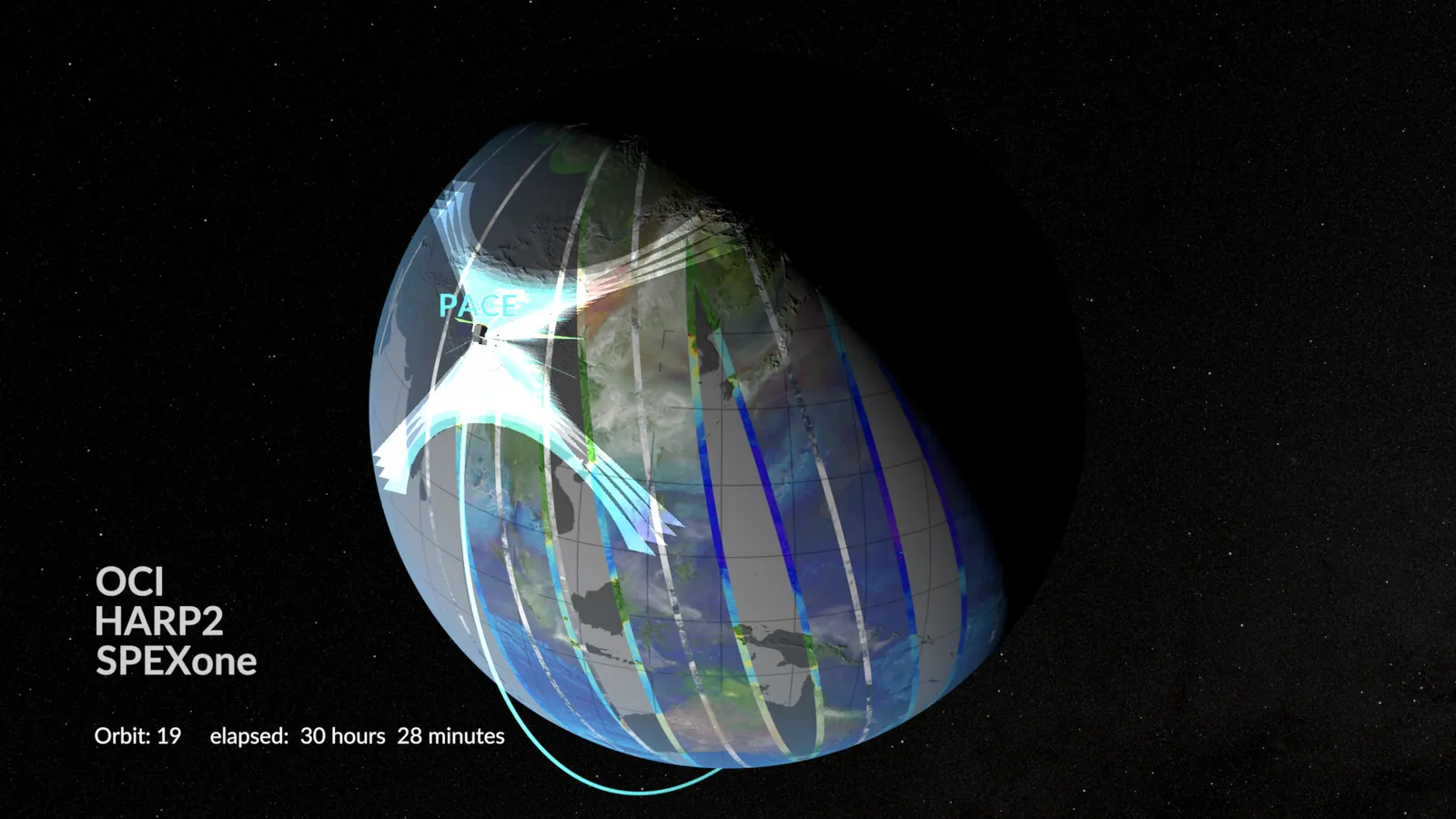
A sun-synchronous orbit is a near-polar orbit whose plane, the imaginary flat sheet the orbit lies in, swings eastward by about 0.9856 degrees a day to keep pace with Earth's motion around the Sun. As a result the satellite crosses each latitude at the same local solar time on every pass, meaning the same hour by the Sun, whatever the time zone says. Landsat 9 flies one 705 km up, at an inclination, or tilt to the equator, of 98.2 degrees. It crosses the equator heading south at about 10:12 a.m. local time, according to NASA's mission page. The swing comes from Earth's bulging middle tugging on an orbit tilted just past the poles, and about one in five active satellites now flies in that lane.
How Earth's bulge keeps the orbit in step with the Sun
Earth is slightly wider at the equator than from pole to pole, and the extra mass around the middle pulls unevenly on any satellite whose orbit is tilted to the equator. The pull makes the orbit's plane slowly swivel around Earth's axis. Engineers call this nodal precession, because it moves the orbit's nodes, the two points where it crosses the equator. It's also known as the J2 effect, after J2, the term in the mathematical description of Earth's gravity that accounts for the flattening.
The direction depends on the tilt. An orbit that runs the same way Earth spins, with an inclination under 90 degrees, drifts west. Tip it past 90 degrees so it runs slightly against the spin, and the drift turns east. At the right mix of height and tilt, the eastward drift equals the Sun's apparent progress around the sky, 360 degrees in a 365.24-day year, or 0.9856 degrees a day. The plane then keeps the same angle to the Sun all year, which NASA Earth Observatory's catalog of satellite orbits describes as a fixed local time at every equator crossing.
The right tilt depends on altitude. We worked it out for circular orbits, counting only Earth's flattening.
| Altitude | Inclination | One orbit takes |
|---|---|---|
| 400 km | 97.03° | 92.6 min |
| 500 km | 97.40° | 94.6 min |
| 600 km | 97.79° | 96.7 min |
| 705 km | 98.21° | 98.9 min |
| 800 km | 98.60° | 100.9 min |
| 1,000 km | 99.48° | 105.1 min |
The bulge's grip weakens with distance, so higher orbits need more tilt to drift fast enough. By our calculation the required inclination reaches 180 degrees, an orbit running backwards along the equator, at about 5,974 km. Since no orbit can tilt further, no circular orbit above that height can be sun-synchronous.
Satellites can drift out of their time slots, too. By our calculation the Terra satellite drifts 0.9602 degrees a day, slower than the Sun's 0.9856, so its southbound crossing, now at 8:37 a.m., keeps getting earlier.
Polar orbit vs sun-synchronous orbit
A polar orbit passes over or near both poles. ESA's guide to orbit types treats sun-synchronous orbit as a particular kind of polar orbit, tilted just far enough past 90 degrees to turn with the Sun. A true polar orbit, at exactly 90 degrees, gets no J2 drift at all. Its plane stays fixed against the stars while Earth carries it around the Sun, so its equator crossings slip by about two hours of local time a month.
Two communications networks on near-polar orbits show what happens when the drift doesn't match the Sun. By our calculation the planes of OneWeb's satellites, at 87.9 degrees and about 1,200 km, drift west 0.20 degrees a day, and Iridium's, at 86.4 degrees, drift 0.42. Measured against the Sun, their crossing times cycle through every hour of local time in about 304 days for OneWeb and 256 for Iridium.
Part of Starlink also flies a sun-synchronous orbit, though SpaceX uses it differently from an imaging mission. In our October 8 snapshot, SpaceX's polar shell, its batch of Starlink satellites on near-polar orbits, holds 1,525 of them. Starlink as a whole is now two-thirds of the active list. The polar Starlinks fly at a median 97.28 degrees and 466 km, and their inclinations sit a median 0.012 degrees from the sun-synchronous value for their height. Rather than clustering at one hour, their northbound crossings fall in 20 of the 24 hours of local time, whereas Landsat 8 and 9 share a single slot.
Why do Earth-observation satellites use sun-synchronous orbits?
Lighting is the main reason. With the crossing time fixed, the Sun's height over a given place changes only with the seasons, so pictures taken on the same date in different years are lit almost the same way. NOAA had that in mind in 2024, when it moved its NOAA-20 weather satellite along its orbit. Its operations notice said the crossing time would be held near 13:30, within 10 minutes, to preserve consistent lighting.
Landsat 9 is the textbook case. NASA gives its southbound crossing as nominally 10:12 a.m., give or take five minutes. It also says each Landsat repeats its ground track, the path it traces over the surface, every 16 days, while Landsat 8 and 9 together cover the planet every 8. Europe's Sentinel-2 satellites cross at 10:30 a.m. from 786 km, each on a 10-day cycle, or five days for a pair. ESA's Sentinel-2 orbit page calls 10:30 a trade-off between good sunlight and less cloud, set close to Landsat's time. Our Landsat 9 pass predictions show when it next crosses your sky.
The US weather satellites NOAA-20 and NOAA-21 take the early afternoon, and our calculation below puts NOAA-20's northbound crossing within a minute of NOAA's 13:30 target. All of these are mean local solar times, read off a sundial that runs as if the Sun crossed the sky at an even pace all year, so they don't match anyone's watch.
A dawn-dusk orbit is a sun-synchronous orbit that crosses the equator around 6 a.m. and 6 p.m. local time, so the satellite flies above the boundary between day and night. NISAR, the joint radar satellite of NASA and India's space agency, ISRO, uses one. NASA says the orbit keeps the spacecraft in almost constant sunlight, and its large solar arrays power the instruments. ESA gave its Biomass radar satellite a 6 a.m. northbound crossing to limit the effect of the ionosphere, the electrically charged upper layer of the atmosphere, on its radar. Europe's Sentinel-1 radar satellites cross northbound at 18:00.
Our own simple shadow model shows how close to constant that sunlight gets. For 2026, it keeps a 700 km orbit crossing northbound at 18:00 out of Earth's shadow entirely on 76% of days. Even near the June solstice, that orbit spends at most 18.8 minutes of each circuit in shadow. A Landsat-like orbit crossing at 10:12 a.m. passes through the shadow on every orbit, for 32.6 to 34.2 minutes of each 98.9-minute circuit.
How many satellites are in sun-synchronous orbit?
We took our October 8 snapshot of CelesTrak's active-satellite list, 16,683 objects, and read each one's orbital elements, the handful of numbers that fix an orbit's size, shape and tilt. The catalog doesn't flag sun-synchronous orbits, so we used our own filter: an inclination of 95.5 to 100.5 degrees, an altitude of 400 to 1,000 km and a nearly circular orbit.
By that test 3,516 objects, 21.1% of the list, sit in the sun-synchronous band. Of those, 1,482 are Starlinks from the polar shell; the shell's other 43 were below the band's 400 km floor. The other 2,034 make up 36.6% of the 5,551 satellites that aren't Starlinks, more than any other orbit class we sorted them into, and 1,007 of them launched in 2025 or 2026. Another 172 objects have sun-synchronous tilts but sit outside the altitude range.
From the same elements we computed when each satellite crosses the equator. Landsat 8 and 9 both come out at 10:12 a.m. southbound, matching NASA's figure, and all three Sentinel-2 satellites at 10:30. NOAA-20 crosses northbound at 13:31, with NOAA-21 at 13:25 and Suomi NPP at 13:38.
Across the whole band, mid-morning is the busiest hour. Of the 2,034 non-Starlinks, 589 cross southbound between 10 and 11 a.m., the hour Landsat and Sentinel-2 use. The weather satellites' early-afternoon slot is nearly empty by comparison, with just 16 crossing northbound between 1 and 2 p.m. Another 294 are within an hour of a dawn-dusk crossing.
Landsat 8 and Landsat 9 show how exact the geometry gets. In our elements both are tilted 98.22 degrees and fly 701.5 to 703.5 km up, measured from Earth's 6,378 km equatorial radius. When we run their orbits forward in time, they stay 179.4 to 179.9 degrees apart in the same plane, so one trails the other by about 49 minutes, or half an orbit. Their elements give a J2 drift of 0.988 degrees a day against the Sun's 0.9856, a difference of about 0.3% that's inside our method's margin of error.
Rideshare launches, which carry satellites for many customers on one rocket, fill much of the band. Satellites from nine SpaceX Transporter flights, Transporter-10 through 18, account for 695 of the 2,034 non-Starlinks, or 34.2%. Earlier Transporter flights can't be picked out by name in the list, so the real share is higher.
SpaceX launched Transporter-18 from Vandenberg on October 1 with 130 payloads, 41 of them aboard four transfer vehicles, carrier spacecraft that release their passengers later. None of its objects were in our October 5 snapshot. By October 8 there were 71, at 97.44 degrees and about 514 km, crossing southbound at about 10:15 a.m., and our non-Starlink count had jumped from 1,963 to 2,034. With 67 of the 71 still listed only as numbered Transporter-18 objects and 130 payloads on board, the total in our filter should keep climbing as the catalog catches up.
Sources
- NASA, Landsat 9 mission page and Landsat 9 fast facts, accessed October 11, 2026
- NASA Earth Observatory, Catalog of Earth Satellite Orbits, accessed October 11, 2026
- NASA, About the NISAR satellite, accessed October 11, 2026
- ESA, Types of orbits, Biomass: the satellite, Aeolus satellite and Sentinel-2 orbit, accessed October 11, 2026
- International Charter Space and Major Disasters, Sentinel-2, accessed October 11, 2026
- Copernicus SentiWiki, S1 mission, accessed October 11, 2026
- NOAA Office of Satellite and Product Operations, NOAA-20 operations notice, March 13, 2024
- SpaceX, Transporter-18 mission, October 1, 2026
- a.i. solutions, FreeFlyer University Guide, J2 perturbation, accessed October 11, 2026
- CelesTrak, active satellites element sets, snapshots of October 5 and 8, 2026
Follow by RSS. Share this post: Bluesky · X · Reddit · Email
More from the blog
-
How do solar storms affect satellites? Drag, GPS, Starlink
Solar storms affect satellites by heating the upper air, which adds drag in low orbit, and by skewing GPS. A mild 2022 storm downed 38 of 49 new Starlinks.

-
How much space debris is in orbit? 2026 counts and risks
How much space debris is in orbit? The US catalog lists about 34,000 objects, ESA counts about 47,000 tracked, and models estimate 1.5 million of 1 to 10 cm.
-
Where is the Hubble Space Telescope now? Orbit and reentry
The Hubble Space Telescope orbits about 470 km up and is sinking roughly 10 km a year. STScI puts its most likely reentry in 2033 unless it gets a boost.
-
Where is the James Webb Space Telescope? Distance and orbit
The James Webb Space Telescope was 1.36 million km from Earth on October 8, 2026, looping around L2. Its distance swings from 1.2 to 1.75 million km.

-
October 10 geomagnetic storm reached G3: aurora outlook
A coronal mass ejection drove a G3 (strong) geomagnetic storm on October 10, 2026. What NOAA measured, who saw aurora and what comes next.

Home · Live satellite map · Satellite directory · Starlink · OneWeb · Navigation satellites · Space stations · Other active satellites · Track the ISS · ISS visible passes · Starlink train · Rocket launches · Aurora forecast · Humans in space · Solar System · Deep Space · Embed widgets · Blog · Guide: spot the ISS · Guide: what is a TLE? · Guide: how many satellites? · Guide: satellite trackers compared · Discovery: Elias 2-24 b · About · FAQ · Data & methodology · Credits · Editorial policy · Accessibility · Contact · Privacy · Terms
© 2026 WatchSat · Not affiliated with any space agency or satellite operator.