WatchSat › Blog › Where is New Horizons now? Distance, speed and what's next
Where is New Horizons now? Distance, speed and what's next
New Horizons was 65.77 AU from the Sun on October 8, 2026, and its signals took 9 hours 6 minutes to reach Earth. It's still inside the heliosphere.
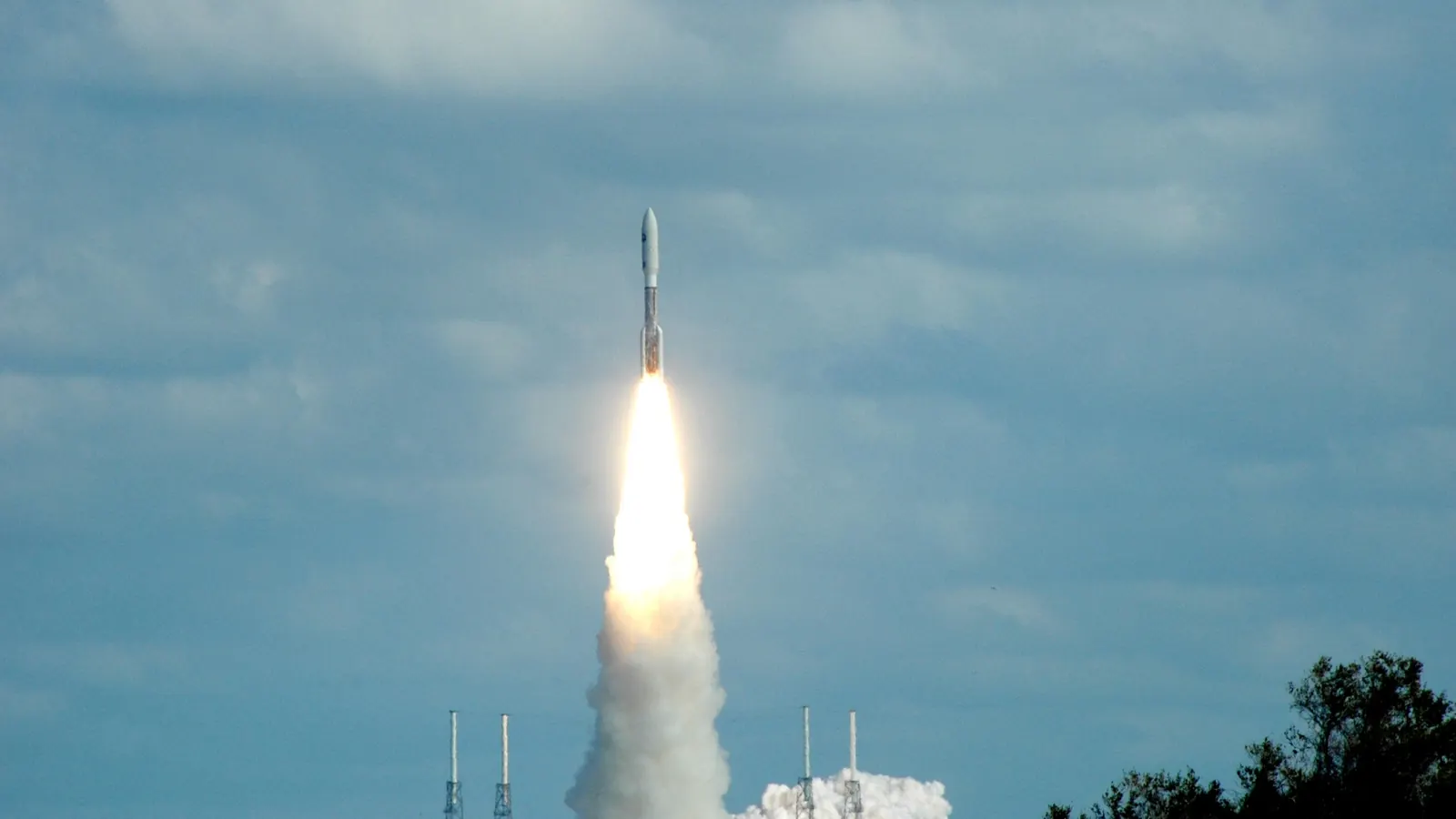
New Horizons was 65.77 astronomical units (AU) from the Sun on October 8, 2026, or about 9.84 billion km (6.11 billion miles). An AU is the average distance between Earth and the Sun. The probe's radio signals took about 9 hours 6 minutes to reach Earth that day. Any answer to "where is New Horizons now?" ages fast, because the probe gets 1.17 million km farther from the Sun every day. It's still inside the heliosphere, the bubble of solar wind that surrounds the Sun. Both Voyagers crossed its edge at roughly 120 AU.
NASA launched New Horizons on January 19, 2006. It swung past Jupiter on February 28, 2007, and on July 14, 2015, became the first spacecraft to explore Pluto up close. On January 1, 2019, it flew past Arrokoth, which NASA calls the most distant object ever explored up close. Our deep-space tracker shows its live distance, and the 3D solar system map shows Pluto and the planets on their real orbits.
New Horizons in our JPL Horizons data
WatchSat places New Horizons using JPL Horizons, the Jet Propulsion Laboratory's positioning service. We start from a state vector for October 8, which is the probe's position and velocity at one moment. Our methodology page explains how the site carries that forward between refreshes, and the credits page lists Horizons among our sources.
As a check, we ran the same calculation for June 23, 2026, the day New Horizons woke from hibernation. It put the probe 5.95 billion miles from Earth, with a one-way light time of 8 hours 51.9 minutes. NASA's announcement gave about 5.9 billion miles and 8 hours 52 minutes.
On October 8 the probe was moving at 13.58 km/s relative to the Sun, or 30,375 mph. Over the previous 12 months it got 2.86 AU farther out, about 427 million km or 265 million miles. NASA's mission page gives a rounder, higher figure of 300 million miles a year. The Sun's pull is still slowing it slightly. When it passed 60 AU in October 2024 it was moving at 13.66 km/s.
Earth's orbit carries our planet up to 1 AU toward or away from the probe, so the light time wobbles. On January 9, 2027, when the Sun passes within 2.0 degrees of New Horizons in our sky, a signal will need 9.35 hours. By July 12, with Earth between them, it drops only to 9.28 hours, because the probe will have moved about 1.4 AU farther out in the meantime.
In the sky, New Horizons is in Sagittarius. On October 8 it was at right ascension 19 h 15 m and declination minus 20.3 degrees, the sky's versions of longitude and latitude, about 1.5 degrees from the star Pi Sagittarii. The probe itself is the size of a piano and far too faint to see from here, so a star chart only gets you to the spot.
The table compares all five outbound probes in our October 8 data.
| Spacecraft | Distance from the Sun | Light time from Earth | Speed vs. the Sun | Distance gained per year |
|---|---|---|---|---|
| Voyager 1 | 171.99 AU | 23.89 h | 16.92 km/s | 3.56 AU |
| Voyager 2 | 144.15 AU | 19.97 h | 15.26 km/s | 3.17 AU |
| Pioneer 10 | 141.98 AU | 19.62 h | 11.85 km/s | 2.49 AU |
| Pioneer 11 | 118.00 AU | 16.36 h | 11.14 km/s | 2.33 AU |
| New Horizons | 65.77 AU | 9.11 h | 13.58 km/s | 2.86 AU |
New Horizons is the nearest of the five, and it's slower than both Voyagers, so it isn't gaining on either. Both Pioneers fell silent decades ago, and their rows are extrapolated from their last tracking.
Why is New Horizons slower than Voyager 1?
NASA's history office calls New Horizons the "fastest spacecraft to leave Earth," a record it set at launch. Voyager 1 is the faster of the two today, at 16.92 km/s against New Horizons' 13.58. Parker Solar Probe outruns both only on its dives close to the Sun and is slower at the far end of its orbit, as our post on Parker Solar Probe's speed explains.
The difference comes from gravity assists. In a gravity assist a probe passes close to a planet, and the planet's gravity bends its path and changes its speed relative to the Sun. A probe's speed right now depends on how far out it is, so to compare the two fairly we used the JPL tables to work out each one's speed at infinity. Anything coasting away from the Sun slows as it climbs, the way a ball thrown upward does. The speed at infinity is what it would have left once the Sun's gravity had finished slowing it.
New Horizons left Earth fast, but most of that speed went into climbing out of the gravity of Earth and the Sun. On January 1, 2007, it was moving at 20.1 km/s. The escape speed there, the least a probe needs to get away from the Sun for good, was 19.3 km/s. That left a speed at infinity of only 5.5 km/s. You can't get that figure by subtracting one speed from the other, because the calculation runs on energy, and energy grows with the square of speed. Jupiter raised its speed at infinity to about 12.5 km/s on February 28, in a flyby NASA says cut the trip to Pluto from 14 years to under ten. Nothing has boosted it since, and once the probe was clear of Jupiter the figure held steady. Today it is 12.55 km/s, a little under the 13.58 km/s the probe is actually moving at.
Voyager 1 started with less. At the start of 1979, before it reached Jupiter, it was moving at 13.7 km/s, short of the 19.1 km/s escape speed at its distance. Without help it would have stayed in orbit around the Sun. Jupiter gave it a speed at infinity of about 14.7 km/s, and Saturn raised that to about 16.6 km/s by 1981.
When Voyager 1 was 65.77 AU from the Sun, on February 14, 1997, it was moving at 17.39 km/s, 28% faster than New Horizons at the same distance. Both probes now coast. In the long run New Horizons covers 2.65 AU a year to Voyager 1's 3.50, so the gap grows by about 0.85 AU a year. Our post on Voyager 1 reaching one light-day follows the farthest of them.
Is New Horizons still working in 2026?
Yes, as of NASA's most recent update. NASA put it into its longest hibernation yet on August 7, 2025, and planned to wake it in late June 2026, "pending a final Fiscal Year 2026 budget." It woke on June 23, 2026, after 321 days, and NASA said it was "in good health."
NASA said the Alice ultraviolet spectrograph would start mapping hydrogen gas in the outer heliosphere about three weeks later. The agency also described updated autonomy software, the onboard logic that lets the probe look after itself, written for operating farther from the Sun on less power. We found no newer NASA status report as of early October.
NASA's extended-mission announcement keeps it working until New Horizons leaves the Kuiper Belt, the band of icy bodies beyond Neptune. The agency expects that in 2028 or 2029. From fiscal year 2025 the focus is heliophysics, the study of the Sun's influence through space. In the same announcement NASA said scientists knew of no Kuiper Belt object within reach for a third flyby, though the probe's path left room for one.
The White House's request for fiscal 2027, released in spring 2026, would cut NASA from $24.4 billion to $18.8 billion, about 23%. The request doesn't name the missions it would cancel, so the Planetary Society's April 2026 analysis worked them out and counted 53 likely to end. We couldn't confirm whether New Horizons is among them.
In May 2026 the House Appropriations Committee's report on its NASA bill supported New Horizons, according to the American Astronomical Society, though a committee report isn't law. Fiscal 2027 began on October 1 under a stopgap law signed on September 2, 2026. SpacePolicyOnline reported that it funds NASA at its fiscal 2026 level of $24.4 billion until December 11.
The road to 100 AU and the heliopause
To estimate the next milestones, we moved the October 8 state vector forward under the Sun's gravity alone. Checked against JPL's own table for September 4, 2036, the method lands within 0.004 AU of JPL's position. This is our projection, not a NASA forecast, and it has New Horizons reaching 100 AU in early December 2038 and 120 AU in February 2046.
The 120 AU mark matters because of the heliopause, where the solar wind gives way to the gas between the stars. NASA dates Voyager 1's crossing to August 25, 2012, and Voyager 2's to November 5, 2018. JPL's tables put the two probes 121.6 AU and 119.0 AU from the Sun on those days. Live Science, reporting the wake-up, put the boundary at about 120 AU. The Voyagers met it 2.6 AU apart, so New Horizons could find it nearer or farther out.
The Sun can't stop it getting there. At 65.8 AU the escape speed is 5.19 km/s, well under New Horizons' 13.58 km/s.
Whether it will still be talking to Earth when it arrives depends on power. New Horizons runs on one radioisotope thermoelectric generator (RTG), which turns heat from decaying plutonium into electricity, and its output drops every year. A Department of Energy article put the power available at Pluto at about 200 watts. Around the Arrokoth flyby, Space.com reported that principal investigator Alan Stern expected power to last "through the mid to late 2030s." That estimate stops short of the heliopause, which by our projection is about 19 years away. We found no end-of-power date from NASA.
By our propagation, New Horizons gets to one light-day from the Sun around June 2065, the distance Voyager 1 reaches from Earth on November 18, 2026.
Sources
- NASA, NASA's New Horizons Spacecraft Wakes From Hibernation in Good Health, June 2026
- NASA, NASA's New Horizons Enters Mission's Longest Hibernation Period, August 22, 2025
- NASA, NASA's New Horizons to Continue Exploring Outer Solar System, undated
- NASA, New Horizons mission page (launch, key dates, yearly distance), undated
- NASA History, 15 Years Ago: New Horizons Launched to Pluto and Beyond, January 2021
- NASA, January 19, 2006: New Horizons Launches for Pluto, image feature, July 2015
- NASA, Voyager mission page (heliopause crossing dates) and Voyager 1: What Is a Light-Day?, August 19, 2026
- JPL Solar System Dynamics, Horizons, state vectors and tables used for WatchSat's calculations, refreshed October 8, 2026
- US Department of Energy, Office of Nuclear Energy, New Horizons mission powered by space radioisotope power systems, undated
- Space.com, New Horizons May Make Yet Another Flyby After Ultima Thule, published around the Arrokoth flyby
- Live Science, NASA's New Horizons spacecraft awakens from yearlong hibernation, 2026
- The Planetary Society, The FY 2027 NASA budget request, April 23, 2026
- American Astronomical Society, House FY27 CJS report: NASA and NSF details, May 2026
- SpacePolicyOnline, House Appropriators Reject Deep Cuts to NASA in FY2027, May 2026, and House Clears FY2027 CR, Now to the President, September 2026
- AACOM, President Trump Signs Continuing Resolution to Fund Government Through December 11, September 8, 2026
Follow by RSS. Share this post: Bluesky · X · Reddit · Email
More from the blog
-
Where does space begin? The Kármán line, 100 km or 80 km
Where does space begin? FAI's Kármán line is 100 km (62 miles), the US uses 50 miles (80 km), and no law sets it. Nothing in our Oct 11 data was below 164.7 km.
-
Where is Europa Clipper now? Distance and the Earth flyby
Europa Clipper was 59.0 million km from Earth on October 11, 2026, and closer to the Sun than Earth is. It swings past Earth on December 3, bound for Jupiter.
-
Can satellites connect directly to your phone? How it works
Satellites can connect directly to your phone for texts. Starlink says it has launched 650 direct-to-cell satellites. How it works and who offers it.
-
How do satellites stay in orbit? Speed, drag and fuel
How do satellites stay in orbit? They fall all the time but move sideways fast enough to keep missing Earth: about 7.7 km/s at the ISS's 420 km height.
-
How does Starlink work? Orbits, dishes and laser links
Starlink links a phased-array dish to more than 11,000 satellites, most in shells about 460 to 485 km up, which relay traffic by laser and through gateways.
Home · Live satellite map · Satellite directory · Starlink · OneWeb · Navigation satellites · Space stations · Other active satellites · Track the ISS · ISS visible passes · Starlink train · Rocket launches · Aurora forecast · Humans in space · Solar System · Deep Space · Embed widgets · Blog · Guide: spot the ISS · Guide: what is a TLE? · Guide: how many satellites? · Guide: satellite trackers compared · Discovery: Elias 2-24 b · About · FAQ · Data & methodology · Credits · Editorial policy · Accessibility · Contact · Privacy · Terms
© 2026 WatchSat · Not affiliated with any space agency or satellite operator.