WatchSat › Blog › Where is Europa Clipper now? Distance and the Earth flyby
Where is Europa Clipper now? Distance and the Earth flyby
Europa Clipper was 59.0 million km from Earth on October 11, 2026, and closer to the Sun than Earth is. It swings past Earth on December 3, bound for Jupiter.
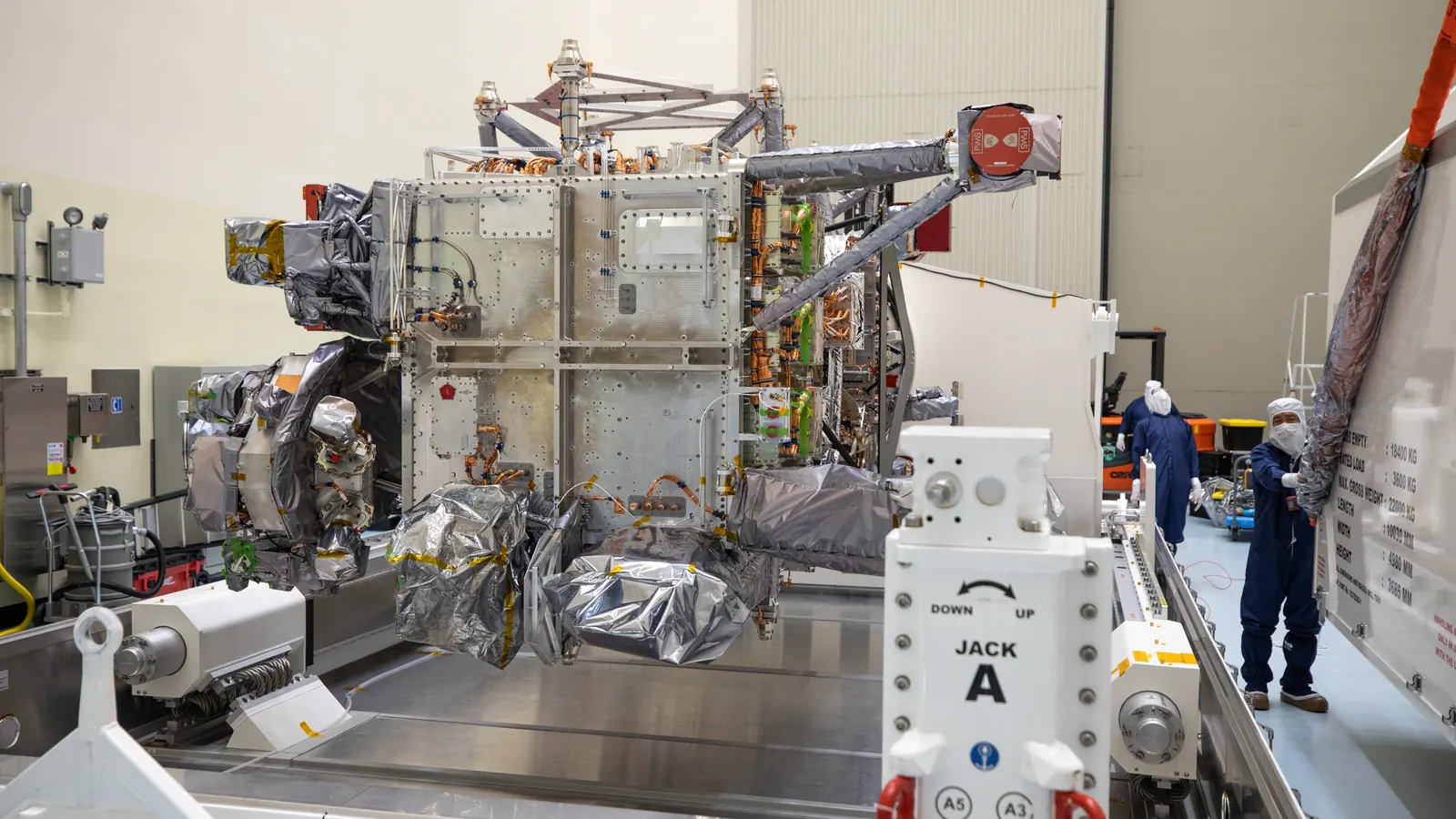
On October 11, 2026, NASA's Europa Clipper was 59.0 million km (36.7 million miles) from Earth and 0.854 astronomical units (AU) from the Sun. One AU is Earth's average distance from the Sun, so a spacecraft bound for Jupiter was closer to the Sun than Earth was. It's heading back toward Earth for a gravity assist on December 3, a close pass that uses the planet's gravity to change its speed and direction relative to the Sun without burning propellant. Until then it stays inside Earth's orbit.
Measured against the Sun, Clipper was moving at 39.01 km/s (87,260 mph) on October 11, faster than Earth's orbital speed of 29.84 km/s. Relative to Earth it was moving at 13.90 km/s, mostly toward the planet, so the gap was closing at 12.63 km/s, about 1.09 million km a day. Its radio signals took 3.28 minutes to reach Earth, a short wait next to Voyager 1, whose signals are about to take a full day.
Clipper launched on a SpaceX Falcon Heavy from NASA's Kennedy Space Center at 12:06 p.m. EDT (16:06 UTC) on October 14, 2024. NASA calls it the largest spacecraft the agency has built for a planetary mission, and puts the trip at about five and a half years and 2.9 billion km (1.8 billion miles). JPL's Horizons system, the lab's public source for where planets and spacecraft are, gives April 11, 2030, for Jupiter orbit insertion, the engine burn that lets Jupiter's gravity capture it.
How far is Europa Clipper from Earth?
Our deep space tracker follows Clipper with position and velocity tables from Horizons and subtracts Earth's position to get the distance. The October 11 figures come from Horizons' daily predictions, last downloaded on October 8, and our five saved refreshes since mid-September show the spacecraft closing in.
| Date (UTC) | From Earth | Signal time | From the Sun | Speed around the Sun |
|---|---|---|---|---|
| September 14 | 83.3 million km | 4.63 min | 0.975 AU | 35.56 km/s |
| September 21 | 78.2 million km | 4.35 min | 0.935 AU | 36.64 km/s |
| September 28 | 72.2 million km | 4.01 min | 0.900 AU | 37.63 km/s |
| October 5 | 65.4 million km | 3.63 min | 0.872 AU | 38.46 km/s |
| October 8 | 62.2 million km | 3.46 min | 0.863 AU | 38.76 km/s |
| October 11 (predicted) | 59.0 million km | 3.28 min | 0.854 AU | 39.01 km/s |
Over those 27 days Clipper came 24.3 million km closer to Earth and 18.1 million km closer to the Sun, and its speed around the Sun rose by 3.45 km/s. By our interpolation between Horizons' 10-day entries, it slipped inside Earth's distance from the Sun around September 9 or 10. Horizons' daily table puts perihelion, the closest point to the Sun on the whole route, at 0.839 AU (125.5 million km) around October 24. Clipper's speed around the Sun should peak then, at 39.50 km/s.
You won't find Clipper on our live satellite map. The map's positions come from two-line element sets (TLEs) run through the SGP4 orbit model, as our methodology page explains, and TLEs only describe orbits around Earth (our guide to TLEs covers the format). Clipper's marker is on our 3D solar system map instead.
When is the Europa Clipper Earth flyby?
Clipper's first gravity assist came at Mars on March 1, 2025. JPL's preview put closest approach at 17:57 UTC, 884 km (550 miles) above the Martian surface, with Clipper moving at about 24.5 km/s relative to the Sun. Horizons' 10-day table shows Mars taking energy out of Clipper's orbit. Its speed around the Sun dropped from 25.00 km/s on February 21 to 22.57 km/s on March 3.
After Mars, Clipper's orbit carried it out to 2.36 AU from the Sun around October 19, 2025. About ten days earlier it was at its farthest from Earth, 501.8 million km away, with signals taking 27.9 minutes each way.
NASA's mission timeline lists the Earth flyby in December 2026, with Clipper swinging about 3,200 km (2,000 miles) from Earth. JPL's 2024 press kit gave 3,140 to 3,450 km above the surface, depending on the launch date, and the Horizons record puts the flyby on December 3. NASA says this flyby, "along with the earlier Mars flyby, gives the spacecraft enough energy to reach Jupiter." In Horizons' planned trajectory, the flyby more than doubles the far point of Clipper's orbit, from 2.36 AU to 5.53 AU (827 million km) from the Sun, reached around October 8, 2029.
The NASA pages we checked don't give a time of day for closest approach, so we worked one out. Starting from Horizons' position at 16:17 UTC on December 3, about 173,000 km out, we stepped the spacecraft forward under the pull of Earth, the Moon and the Sun. That gives closest approach at about 20:16 UTC (3:16 p.m. EST), stable to about a minute. Treat it as our estimate, since the reference path may predate later course corrections. Our method can't pin down the height, so the 3,200 km figure is NASA's.
Adding up the path along the Horizons table, Clipper has flown about 1.34 billion km around the Sun so far. The whole route from launch to Jupiter orbit insertion comes to 2.87 billion km, close to NASA's round 2.9 billion. It has covered 47% of the route in 36% of the time, 727 of 2,005 days. The early lead comes from its first two years, which kept it within 2.36 AU of the Sun, where it moves faster than it will on the long climb to Jupiter. Near the top of that climb, its speed around the Sun drops to about 6.7 km/s.
Europa's ice shell and Jupiter's radiation
Europa is about 3,100 km (1,940 miles) across, roughly 90% the size of Earth's Moon, and orbits Jupiter about 671,000 km out every three and a half days, according to NASA. NASA's main goals for Clipper are to measure the thickness of the icy shell and how it interacts with the ocean below, and to study the moon's composition and geology. JPL says the magnetometer, helped by plasma measurements, should reveal the shell's thickness and the ocean's depth and saltiness.
The pre-launch estimates, based on NASA's earlier Galileo orbiter, were wide. A 2024 NASA/JPL feature put the ice at roughly 5 to 40 km (3 to 25 miles) thick and the ocean at 50 to 150 km (31 to 93 miles) deep. In January 2026, NASA and the Southwest Research Institute announced that NASA's Juno orbiter had measured the shell with its microwave radiometer. It found about 29 km (18 miles) of ice, give or take 10 km, in the one region it saw on a 2022 flyby. The figure assumes pure water ice, and salty ice would lower it by about 5 km.
Rather than orbit Europa, Clipper will loop around Jupiter on long, stretched orbits and make 49 close flybys of the moon, JPL says, limiting its time in Jupiter's radiation belts. Its electronics ride in a vault with aluminium-zinc walls about 1 cm thick, according to a 2023 JPL feature (the press kit gives 9.2 mm). A 2021 NASA engineering talk put the mission's dose behind 2.5 mm of aluminium at about 3 megarads (the rad is a unit of absorbed radiation dose). Inside the vault it drops to about 150 kilorads, half of the 300 kilorads its parts are built for.
NASA lists a launch mass of about 6,000 kg (13,000 lb) with propellant and 3,241 kg (7,145 lb) dry. With its solar arrays unfolded, Clipper spans about 30.5 m (just over 100 ft), and each array is 14.2 m long and 4.1 m high, JPL says. They're that big because Clipper will be 4.94 to 5.49 AU from the Sun during the Jupiter tour. By our arithmetic, sunlight there is 1/24 to 1/30 as strong as at Earth.
Europa Clipper and ESA's Juice
ESA's Jupiter Icy Moons Explorer, Juice, launched on an Ariane 5 from Kourou on April 14, 2023. It made its own Earth gravity assist on September 28, 2026, with closest approach at 11:45 UTC, 66 days before Clipper's. ESA says the flyby bent Juice's course by 20 degrees and added 3.5 km/s to its speed around the Sun.
Juice's arrival at Jupiter is planned for July 2031, about 15 months after Clipper's, and it's due to move into orbit around Ganymede in December 2034, according to DLR, Germany's space agency. ESA plans two Juice flybys of Europa, against Clipper's 49.
For Clipper, the next dates are perihelion around October 24 and the Earth flyby on December 3, 53 days after October 11. After that the distance from Earth starts growing again, as the deep space tracker will show. Jupiter orbit insertion, planned for April 11, 2030, is 1,278 days from October 11.
Sources
- NASA/JPL, Liftoff! NASA's Europa Clipper Sails Toward Ocean Moon of Jupiter, October 14, 2024, and NASA Science, Europa Clipper Lifts Off From Kennedy Space Center, October 14, 2024
- NASA Science, Europa Clipper Mission Timeline, Mission Overview and Meet Europa Clipper, undated
- NASA/JPL, Europa Clipper press kit, Quick Facts and Mission Overview, 2024
- NASA/JPL, NASA's Europa Clipper Uses Mars to Go the Distance, February 25, 2025
- JPL Solar System Dynamics, Horizons record for Europa Clipper (-159), state vectors used for WatchSat's figures, refreshed September 14 to October 8, 2026
- NASA/JPL, Can Life Exist on an Icy Moon? NASA's Europa Clipper Aims to Find Out, 2024
- NASA, Europa: In Depth, undated
- NASA/JPL, NASA's Juno Measures Thickness of Europa's Ice Shell, January 28, 2026; SwRI, NASA's Juno spacecraft measures thickness of Europa's ice shell, January 28, 2026; and the paper in Nature Astronomy, December 17, 2025
- NASA/JPL, How NASA Is Protecting Europa Clipper From Space Radiation, October 24, 2023
- NASA Electronic Parts and Packaging Program, Europa Clipper radiation keynote (McClure), June 14, 2021
- ESA, Successful Earth flyby improves Juice's course to Jupiter, September 2026, and Juice factsheet
- DLR, Juice: the journey from Earth to Jupiter in a roundabout way, undated
Follow by RSS. Share this post: Bluesky · X · Reddit · Email
More from the blog
-
What are the different types of satellites? Uses and counts
The types of satellites, by job. Communications are 80.2% of the 16,701 on CelesTrak's active list, Starlink alone 66.6%, while about 10% can't be identified.
-
Where does space begin? The Kármán line, 100 km or 80 km
Where does space begin? FAI's Kármán line is 100 km (62 miles), the US uses 50 miles (80 km), and no law sets it. Nothing in our Oct 11 data was below 164.7 km.
-
Where is New Horizons now? Distance, speed and what's next
New Horizons was 65.77 AU from the Sun on October 8, 2026, and its signals took 9 hours 6 minutes to reach Earth. It's still inside the heliosphere.
-
Can satellites connect directly to your phone? How it works
Satellites can connect directly to your phone for texts. Starlink says it has launched 650 direct-to-cell satellites. How it works and who offers it.
-
How do satellites stay in orbit? Speed, drag and fuel
How do satellites stay in orbit? They fall all the time but move sideways fast enough to keep missing Earth: about 7.7 km/s at the ISS's 420 km height.
Home · Live satellite map · Satellite directory · Starlink · OneWeb · Navigation satellites · Space stations · Other active satellites · Track the ISS · ISS visible passes · Starlink train · Rocket launches · Aurora forecast · Humans in space · Solar System · Deep Space · Embed widgets · Blog · Guide: spot the ISS · Guide: what is a TLE? · Guide: how many satellites? · Guide: satellite trackers compared · Discovery: Elias 2-24 b · About · FAQ · Data & methodology · Credits · Editorial policy · Accessibility · Contact · Privacy · Terms
© 2026 WatchSat · Not affiliated with any space agency or satellite operator.