WatchSat › Blog › How fast is the Parker Solar Probe? Top speed and orbit
How fast is the Parker Solar Probe? Top speed and orbit
At closest approach the Parker Solar Probe reaches about 430,000 mph (692,000 km/h) relative to the Sun. On Oct. 11, 2026, it was doing just 13.9 km/s.
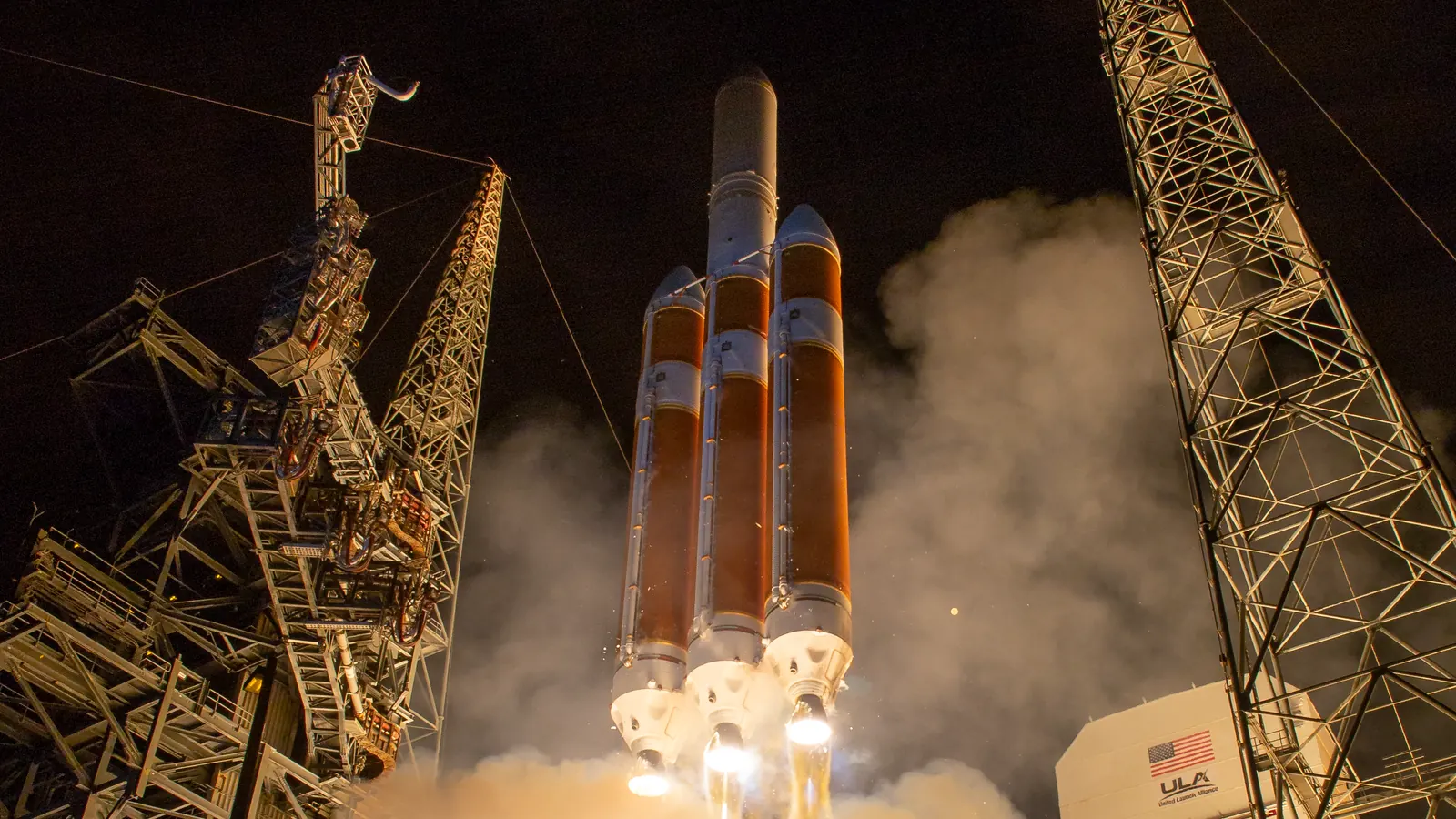
At its closest to the Sun, the Parker Solar Probe travels at about 430,000 mph (692,000 km/h), or roughly 192 km every second. NASA calls it the fastest object humans have ever built. It first hit that speed on December 24, 2024, and NASA says it matched the record again on September 4, 2026. By our model, though, it spends only about 107 hours of each 88-day orbit above 100 km/s. On October 11, 2026, the JPL data behind our deep-space tracker had it at 13.9 km/s, slower than Voyager 1.
All of these speeds are relative to the Sun, the frame NASA and Guinness World Records use. Parker's orbit is a long, narrow ellipse. It dips to about 6.1 million km above the Sun's surface and swings out to 0.73 astronomical units (AU) from its centre. One AU is Earth's average distance from the Sun. Our 3D solar system map shows where it is on that loop now.
Is the Parker Solar Probe the fastest human-made object?
Yes, by the measure NASA and Guinness use. Guinness lists 192.22 km/s at the December 24, 2024, closest approach, reached at 11:53:48 UTC, which matches the 6:53 a.m. EST time NASA gave beforehand. The previous record belonged to Helios 2, which reached 246,960 km/h (153,454 mph) relative to the Sun in 1976. Parker launched from Cape Canaveral on August 12, 2018, and had beaten Helios 2 within three months, AIAA reported on October 30 that year.
The frame matters because Earth moves too, carrying every spacecraft it launches around the Sun at about 29.8 km/s. Against the Sun, Parker at its peak is about 11 times faster than Voyager 1, which JPL's Horizons system had at 16.9 km/s on October 8, 2026. Our countdown to Voyager 1 reaching one light-day uses the same data.
How close does the Parker Solar Probe get to the Sun?
NASA puts Parker's closest approaches at about 3.8 million miles (6.1 million km) from the Sun's surface, and Guinness gives the December 2024 pass as 6,167,590 km (3,832,362 miles) above it. From the Sun's centre, that's about 6.86 million km, or 9.86 solar radii, counting one solar radius as the Sun's own radius of 695,700 km. UCAR's High Altitude Observatory, which plans observing campaigns around each pass, counts the September 4, 2026, pass as the eighth to reach 9.86 solar radii.
Parker first "touched" the Sun, in NASA's words, on April 28, 2021, during its eighth close pass. It crossed the Alfvén critical surface, where the Sun's outer atmosphere, or corona, gives way to the outflowing solar wind. The crossing came 18.8 solar radii, about 13.1 million km (8.1 million miles), from the Sun's centre. Parker spent about five hours in the corona, APS News reported, and dipped in and out more than once, which showed that the boundary has spikes and valleys. The result was announced in December 2021, and in December 2025 NASA reported that the boundary grows larger and spikier as the Sun's activity cycle advances.
NASA also says Parker traced switchbacks, sudden zig-zags in the solar wind's magnetic field, back to the solar surface. Our aurora forecast follows the Sun's effects closer to home, with NOAA's current Kp index of geomagnetic activity.
A carbon-composite heat shield takes the brunt. NASA says its sunward face reaches almost 2,500 °F (1,370 °C) at closest approach, while most instruments behind it stay near 85 °F (29 °C). A 2018 Johns Hopkins APL release gave almost 2,600 °F. NASA's explainer on why the probe won't melt hinges on heat versus temperature. The corona's particles are very hot, but they're spread so thinly that they deliver little energy.
Sunlight at closest approach is about 476 times as intense as at Earth, by our arithmetic, since it falls off with the square of distance. A perfectly black plate facing the Sun there, insulated so it could shed heat only from its sunlit face, would settle near 1,566 °C (2,850 °F). NASA's 1,370 °C for the shield's white-coated face sits below that, as you'd expect from a reflective surface.
Venus flybys built up the speed
Getting that close is the hard part, because a spacecraft leaving Earth has to lose most of Earth's 29.8 km/s of sideways speed around the Sun. By our calculation, a direct trip would have to shed about 21 km/s, or 70% of Earth's speed. NASA says reaching the Sun takes 55 times more energy than reaching Mars.
Parker did it in stages. Seven Venus flybys, from October 3, 2018, to November 6, 2024, each slowed it relative to the Sun so that it fell closer on the next orbit. The last went 376 km (233 miles) above Venus's surface, according to NASA's Scientific Visualization Studio. Each step down raised the top speed, because the deeper an orbit dips toward the Sun, the faster a spacecraft moves at the bottom.
We rebuilt the steps from JPL Horizons' table of Parker's position every five days, from launch through 2029. In the table, perihelion is the orbit's closest point to the Sun, and the figures are our rounded calculations, not NASA's.
| Close passes | Perihelion (solar radii from centre) | Speed at perihelion | Orbit period |
|---|---|---|---|
| 1 to 3 | 35.7 | 95 km/s | 150 days |
| 4 and 5 | 27.9 | 109 km/s | 130 days |
| 6 and 7 | 20.4 | 130 km/s | 112 days |
| 8 and 9 | 16.0 | 148 km/s | 102 days |
| 10 to 16 | 13.3 | 163 km/s | 96 days |
| 17 to 21 | 11.4 | 176 km/s | 92 days |
| 22 onward | 9.86 | 191 km/s | 88.4 days |
Each drop comes right after a Venus flyby. The prime mission ended in 2025 after 24 orbits, Johns Hopkins APL says, and every orbit since December 2024 has had the same low point.
Parker's speed today in our JPL Horizons data
Parker doesn't orbit Earth, so it has no two-line element set, the satellite orbit format our TLE guide explains. We track it instead with state vectors from JPL's Horizons system, which give its position and velocity relative to the Sun's centre. Our latest file is for October 8, 2026, with a six-hourly track to October 29.
At midnight UTC on October 11, 2026, Parker was 107.1 million km (0.716 AU) from the Sun's centre, moving at 13.9 km/s, or 50,154 km/h (31,164 mph). It was 127 million km from Earth, about 7 light-minutes away, and 36 days past its September 4 close pass. That put it 41% of the way around an 88.4-day orbit and still slowing. On October 18 it reaches aphelion, the far end of the orbit, 0.731 AU from the centre, at just under 12 km/s.
For most of October, then, the fastest spacecraft ever built is slower than Voyager 1. Our model has Parker below Voyager 1's 16.9 km/s from about October 6 to October 31, and below Voyager 2's 15.3 km/s from about October 8 to October 29. It drops under New Horizons, at 13.6 km/s, late on October 11 UTC and stays there until about October 25. It never falls behind the two Pioneers, at 11.9 and 11.1 km/s. Our explainer on where New Horizons is covers that probe.
Our Kepler model, which times an orbit from its shape, has Parker slower than Voyager 1 is now for about 63 of every 88.4 days, or 71% of the time. A day after perihelion it's down to 138 km/s, and ten days after to 47 km/s. Its average over the whole 277-million-km loop is 36.3 km/s.
From the October 8 state vector we also worked out Parker's orbital elements, the numbers that fix an orbit's size and shape. They give a perihelion 9.85 solar radii from the Sun's centre and an 88.4-day period. The vis-viva equation, which ties an orbit's speed at any distance to its size, then gives about 191 km/s at perihelion. That's within 1% of Guinness's 192.22 km/s, and for the December 2024 pass our distance from the Sun's centre matches the converted Guinness figure to 0.01%. We haven't pinned down the small speed gap, so the record we quote is NASA's and Guinness's, not ours.
Parker's 30th close pass is due in early December. Our two-body model, which ignores every pull but the Sun's, puts perihelion at 00:45 UTC on December 2, 2026. It ran 12 to 21 minutes early on three recent passes, so we expect about 01:00 UTC. We found no NASA time for the pass, so the estimate is our own.
NASA said on September 10, 2026, that the mission had been extended into 2029 and that Parker will stay in its current orbit. The extension followed the 2026 Heliophysics Senior Review, NASA's review of missions in extended operations. The JPL trajectory in our files keeps the same low point on every orbit through October 28, 2029, the last close pass in the table.
Sources
- NASA Science, NASA's Parker Solar Probe Makes History With Closest Pass to Sun, December 2024
- NASA Science, Parker Solar Probe Begins Record-Setting Closest Approach to the Sun, December 20, 2024
- NASA Science, After Latest Swing Past Sun, NASA's Parker Solar Probe Checks In, September 10, 2026
- NASA Science, Senior Review Reports, heliophysics missions in extended operations
- Guinness World Records, Closest approach to the Sun by a spacecraft
- AIAA, NASA's Parker Solar Probe Sets Record for Closest Approach to Sun, October 30, 2018
- NASA Image and Video Library, Parker Solar Probe Liftoff, August 12, 2018
- UCAR High Altitude Observatory, PSP 28th perihelion campaign and PSP 29th perihelion campaign, 2026
- NASA, NASA Enters the Solar Atmosphere for the First Time, Bringing New Discoveries, 2021
- APS News, A Spacecraft Has "Touched" the Sun for the First Time, December 2021
- NASA Science, NASA's Parker Solar Probe Helps Map Sun's Outer Boundary, December 12, 2025
- NASA Science, 10 Things to Know About Parker Solar Probe
- NASA, Traveling to the Sun: Why Won't Parker Solar Probe Melt?
- Johns Hopkins APL, news release on Fast Company's 2018 most innovative companies, February 22, 2018
- Johns Hopkins APL, NASA's Sun-Bound Parker Solar Probe Swings Through Final Venus Flyby, November 8, 2024; The Mission
- NASA Scientific Visualization Studio, Parker Solar Probe - Extended Mission, updated May 23, 2025
- NASA/JPL, Horizons System, heliocentric state vectors for October 8, 2026, and Parker's trajectory from August 12, 2018, to December 27, 2029
Follow by RSS. Share this post: Bluesky · X · Reddit · Email
More from the blog
-
What are Lagrange points? L1 to L5 and what orbits there
Lagrange points are five places where a small object can keep pace with two large ones. For the Sun and Earth, L1 and L2 lie about 1.5 million km from Earth.
-
When is the next total solar eclipse? August 2, 2027
The next total solar eclipse is on August 2, 2027. Totality crosses Spain, North Africa and Arabia, lasting up to 6 min 23 s in Egypt's desert near Luxor.
-
What are China's Qianfan and Guowang constellations?
China's Qianfan and Guowang satellite constellations had 477 satellites on CelesTrak's active list on October 11, 2026, toward plans of about 15,000 and 13,000.

-
What are the different types of satellites? Uses and counts
The types of satellites, by job. Communications are 80.2% of the 16,701 on CelesTrak's active list, Starlink alone 66.6%, while about 10% can't be identified.
-
Where does space begin? The Kármán line, 100 km or 80 km
Where does space begin? FAI's Kármán line is 100 km (62 miles), the US uses 50 miles (80 km), and no law sets it. Nothing in our Oct 11 data was below 164.7 km.
Home · Live satellite map · Satellite directory · Starlink · OneWeb · Navigation satellites · Space stations · Other active satellites · Track the ISS · ISS visible passes · Starlink train · Rocket launches · Aurora forecast · Humans in space · Solar System · Deep Space · Embed widgets · Blog · Guide: spot the ISS · Guide: what is a TLE? · Guide: how many satellites? · Guide: satellite trackers compared · Discovery: Elias 2-24 b · About · FAQ · Data & methodology · Credits · Editorial policy · Accessibility · Contact · Privacy · Terms
© 2026 WatchSat · Not affiliated with any space agency or satellite operator.