WatchSat › Blog › How does Starlink work? Orbits, dishes and laser links
How does Starlink work? Orbits, dishes and laser links
Starlink links a phased-array dish to more than 11,000 satellites, most in shells about 460 to 485 km up, which relay traffic by laser and through gateways.
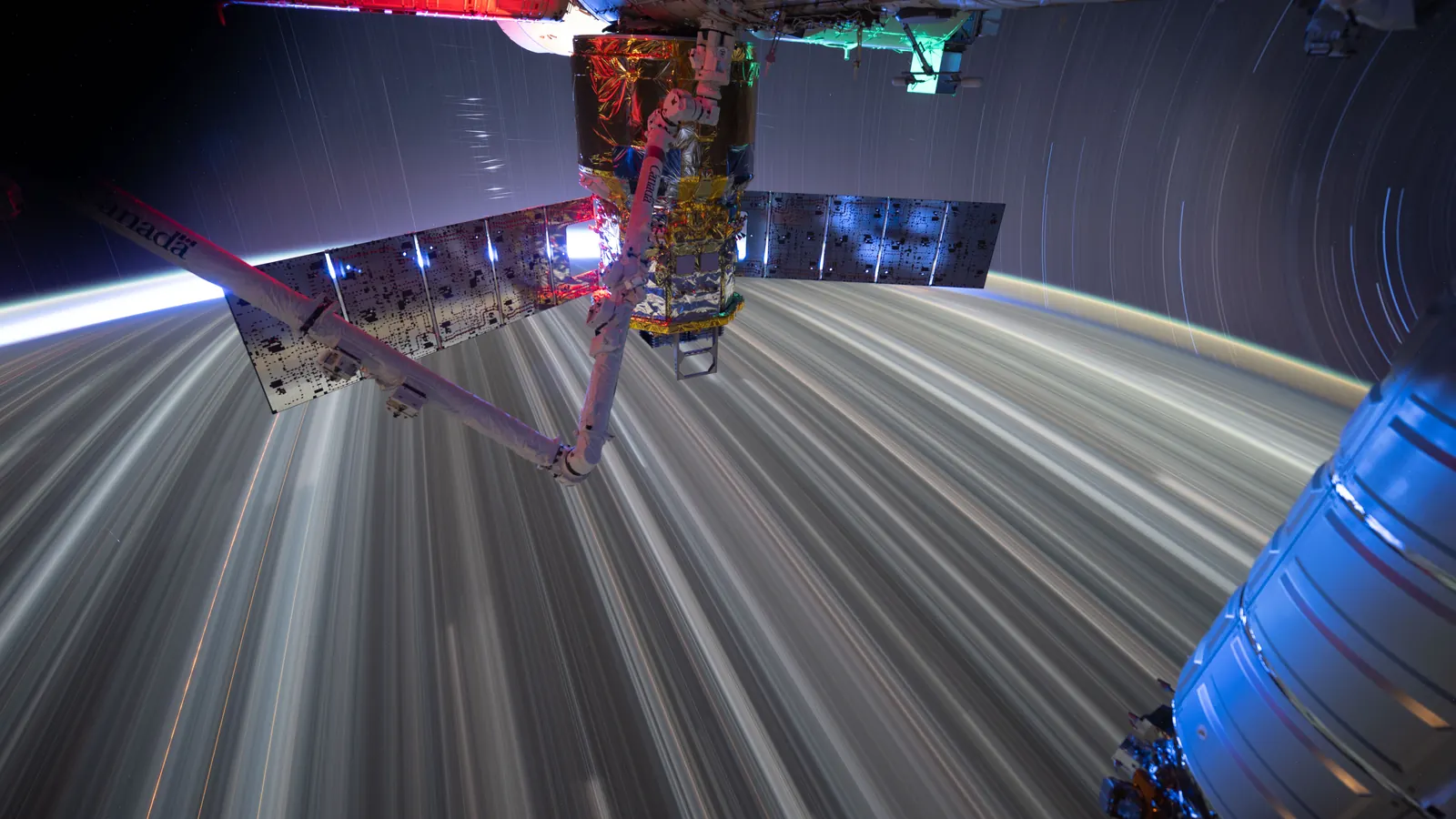
Starlink works by relaying internet traffic between a flat dish on the ground and satellites about 460 to 485 km up, which pass it down to gateway stations connected to the internet. Where no gateway is in reach, the satellites can relay the traffic to one another by laser. SpaceX said on October 6, 2026, that it operates more than 11,000 Starlink satellites, which it calls the largest satellite constellation ever built.
In its results for the second quarter of 2026, SpaceX reported about 12.0 million Starlink subscribers, 1.7 million more than a quarter earlier. In the snapshot of CelesTrak's public list of active satellites that we saved on October 11, we counted 11,129 Starlinks. Our Starlink census compares that with every other working satellite, and our post on satellite streaks and the Rubin Observatory looks at what the fleet does to telescope images.
How does a Starlink signal get from your dish to the internet?
Starlink's specification sheets describe the antenna in its Standard and Mini kits as an electronic phased array, a flat panel of many small antenna elements. By shifting the timing of the signal at each element, the panel steers its beam without moving. Both sheets list a 110-degree field of view, the cone of sky the beam can reach.
No satellite stays in that cone for long. By our estimate, with the dish pointing straight up, a satellite passing overhead at 463 km is inside the cone only while it's within about 580 km of the dish, measured along the ground. It crosses that stretch in about 2.7 minutes at most, so a dish can't stay with any one satellite for more than a few minutes and has to hand off to the next.
The satellites have phased arrays too. Starlink's technology page lists five Ku-band phased-array antennas on each satellite, plus three antennas for the Ka and E bands. Ku, Ka and E are standard names for slices of the microwave radio spectrum, with Ka and E at higher frequencies than Ku. Traffic comes down from the satellite to a gateway, a ground station whose dishes connect to the internet. As of June 2025, SpaceX said it had more than 100 gateway sites in the United States, with over 1,500 antennas.
Each satellite also carries three lasers that link it to its neighbours at up to 200 Gbps (gigabits a second), according to the same page. Together they form a mesh in space that SpaceX says keeps traffic moving where ground infrastructure fails. In a January 2024 talk reported by Hackaday, a SpaceX engineer said the fleet's 9,000-plus lasers carried about 42 petabytes, or 42 million gigabytes, of data a day. The longest link stretched more than 5,400 km.
Where Starlink works on the move depends on permission as well as coverage. Its aviation service covers all international waters and the polar regions, Starlink says, but over land and in a country's own waters, in-motion use needs that government's approval.
The satellites' low height keeps the delay short. SpaceX's network update put the median round-trip delay, or latency, at 25.7 milliseconds in the US at peak hours, with median downloads of nearly 200 Mbps (megabits a second), both as of June 2025. A request and its reply make four legs in all, from dish to satellite to gateway and back again. By our arithmetic, light covers those legs in 6.2 ms with the satellite overhead at 463 km, and in 13.3 ms with it 1,000 km away on each leg. Through a geostationary satellite, parked 35,786 km up so that it seems to hang still over one spot, the trip can't take less than 477 ms. About half or more of Starlink's 25.7 ms is therefore spent outside the radio links, in processing and the ground network.
How high do Starlink satellites orbit?
SpaceX's altitude table puts its V1 and V2 broadband shells between 462.5 and 485 km. A shell is a set of satellites at one height and one inclination, the tilt of the orbit against the equator. At 463 km a satellite moves at about 7.63 km a second, roughly 27,500 km/h (17,100 mph), and circles Earth every 93.9 minutes. In our data, nine in ten Starlinks fly above the International Space Station, about 420 km up.
Many used to fly higher. On January 1, 2026, Michael Nicolls, who leads Starlink engineering at SpaceX, posted that about 4,400 satellites would drop from about 550 km to about 480 km that year, Datacenter Dynamics reported. Below 500 km, he said, there are fewer debris objects and planned constellations, and a dead satellite falls faster. At 550 km it could stay up for more than four years while the Sun is quiet, but at the lower height it would come down within months.
SpaceX's space-safety pages now say it's moving all its satellites below 500 km and will finish lowering its shells by the end of 2026. At the end of a satellite's life, SpaceX says, a controlled descent on its own thrusters is much shorter and safer than an uncontrolled fall.
The newest satellites fly lower still. SpaceX's October 6 update says its first 26 Starlink V3 satellites were deployed at the end of September, on Starship's first orbital flight. Starlink's V3 page lists six 400-Gbps lasers on each and about 1 Tbps (a trillion bits a second) of downlink capacity, the rate at which a satellite can send data to the ground. SpaceX says that's about ten times what a V2 launched on Falcon 9 adds, Ars Technica reported. In our October 11 snapshot the 26 were at about 316 km. STARLINK-40083 is one of them, and our Flight 14 post follows their first days in orbit.
Starlink in our tracking data
WatchSat's live satellite map runs on CelesTrak's list of active satellites, built from US Space Force tracking data, and we keep snapshots of it. We work out each satellite's average height from its element set, the standard block of orbit numbers, and measure it above Earth's equatorial radius of 6,378 km, as CelesTrak's catalog does. On October 11 the 11,129 Starlinks fell into five groups by inclination.
| Inclination | Broadband Starlinks | Median altitude | Direct to Cell |
|---|---|---|---|
| 53.2° | 4,785 | 463 km | 310, at 360 km |
| 43.0° | 3,287 | 483 km | 327, at 356 km |
| 97.3° (polar) | 1,524 | 466 km | none |
| 70.0° | 870 | 478 km | none |
| 30.5° (V3) | 26 | 316 km | none |
Our medians for the two biggest shells agree with SpaceX's table to within 2 km. The 637 Direct to Cell satellites, tagged DTC in their catalog names, fly about 110 km below the rest, at a median 357 km. Our post on satellites that connect straight to phones explains how they work. You can watch the whole fleet move on our Starlink tracker or look up any satellite in the Starlink directory.
SpaceX's lowering shows up in our data. In the snapshot we saved on September 15, 731 Starlinks had an average altitude of 500 km or more, and by October 11 there were 503. The fleet's median stayed at 466 km, because the satellites coming down were a thin layer at the top. Of the 503 still above 500 km, 105 are descending. The other 398, all in the 70-degree shell, are holding steady, 320 of them between 566 and 600 km.
New satellites take weeks to reach their shells. Each Falcon 9 launch group in our data holds 24 to 29 satellites, which start low and raise their own orbits. One batch of 27 at 70 degrees, catalogued as 2026-219 by launch year and number, first appeared at 263 km on September 20. It reached 324 km by September 30 and 364 km by October 5, then held there through October 10. An earlier polar batch reached 466 km on September 30 and has stayed there, as the track of STARLINK-38024 shows.
Below 450 km, this year's satellites gained a median 5.9 km a day between snapshots while they were climbing. In about four in ten of the intervals we measured, they held still instead, at plateaus near 316 to 324, 344, 364 and 412 to 419 km. At 5.9 km a day, the roughly 200 km from where the rocket releases them to a working shell would take about 34 days of nonstop climbing. Add the pauses and our estimate is five to eight weeks. We haven't seen a figure from SpaceX. Our Starlink train page picks out batches that are still climbing in a line.
Satellites leave the fleet too. Between September 15 and October 11, 53 Starlinks dropped off the active list, about two a day. Every one had last been tracked with a perigee, the orbit's lowest point, under 300 km.
What to watch
- Launch Library, a public database of launches, lists the next Falcon 9 Starlink flight, Group 15-25, for October 12 at 23:00 UTC from Vandenberg Space Force Base in California, with 27 satellites. It was marked go for launch on October 10, though launch dates often slip.
- SpaceX's end-of-2026 deadline for lowering its shells is under three months away. Our snapshots will show whether the 398 satellites holding above 500 km in the 70-degree shell start down.
- SpaceX's altitude table lists a V3 shell at 330 to 360 km. The next element sets will show whether the 26 V3s climb there from 316 km.
Sources
- SpaceX/Starlink, Space safety update, October 6, 2026, and Starlink constellation altitudes (current in October 2026)
- Starlink, Network update, figures as of June 2025
- SpaceX, SpaceX Reports Second Quarter 2026 Results, 2026
- Starlink, Starlink technology and Starlink Version 3 satellites, undated
- Starlink, specification sheets for the Standard and Mini kits, undated
- Starlink, Aviation and help center article on in-motion use, undated
- Hackaday, Starlink's inter-satellite laser links are setting new record with 42 million GB per day, February 5, 2024
- Datacenter Dynamics, Starlink announces lowering of 9,300 satellite constellation in bid for space safety after another near miss, January 2026
- Ars Technica, Stephen Clark, Starship's first orbital launch gives lift to SpaceX's next-gen Starlinks, September 28, 2026
- CelesTrak, active satellites element sets, WatchSat snapshots of September 15 to October 11, 2026
- The Space Devs, Launch Library 2, upcoming launches as loaded on October 10, 2026
Follow by RSS. Share this post: Bluesky · X · Reddit · Email
More from the blog
-
Can satellites connect directly to your phone? How it works
Satellites can connect directly to your phone for texts. Starlink says it has launched 650 direct-to-cell satellites. How it works and who offers it.

-
How do satellites stay in orbit? Speed, drag and fuel
How do satellites stay in orbit? They fall all the time but move sideways fast enough to keep missing Earth: about 7.7 km/s at the ISS's 420 km height.
-
How long do satellites last? Lifespan by orbit and type
How long do satellites last? Most active ones are Starlinks, built for five years. New GPS satellites get 15, and Landsat 5, built for three, lasted 28 years.
-
When will the ISS be retired? Deorbit plan and what's next
NASA plans to retire the ISS after September 30, 2030, when operations end. A SpaceX-built vehicle then steers it into the South Pacific in about 2031.
-
How many rocket launches in 2026? The count so far
Rocket launches in 2026 reached about 240 orbital attempts by mid-October, one every 28.5 hours. How it compares with 2025's record and what the catalog shows.
Home · Live satellite map · Satellite directory · Starlink · OneWeb · Navigation satellites · Space stations · Other active satellites · Track the ISS · ISS visible passes · Starlink train · Rocket launches · Aurora forecast · Humans in space · Solar System · Deep Space · Embed widgets · Blog · Guide: spot the ISS · Guide: what is a TLE? · Guide: how many satellites? · Guide: satellite trackers compared · Discovery: Elias 2-24 b · About · FAQ · Data & methodology · Credits · Editorial policy · Accessibility · Contact · Privacy · Terms
© 2026 WatchSat · Not affiliated with any space agency or satellite operator.