WatchSat › Blog › What happens when a satellite reenters the atmosphere?
What happens when a satellite reenters the atmosphere?
When a satellite reenters the atmosphere it breaks apart about 78 km up and mostly melts away, though tanks can survive. About two Starlinks fall each day.
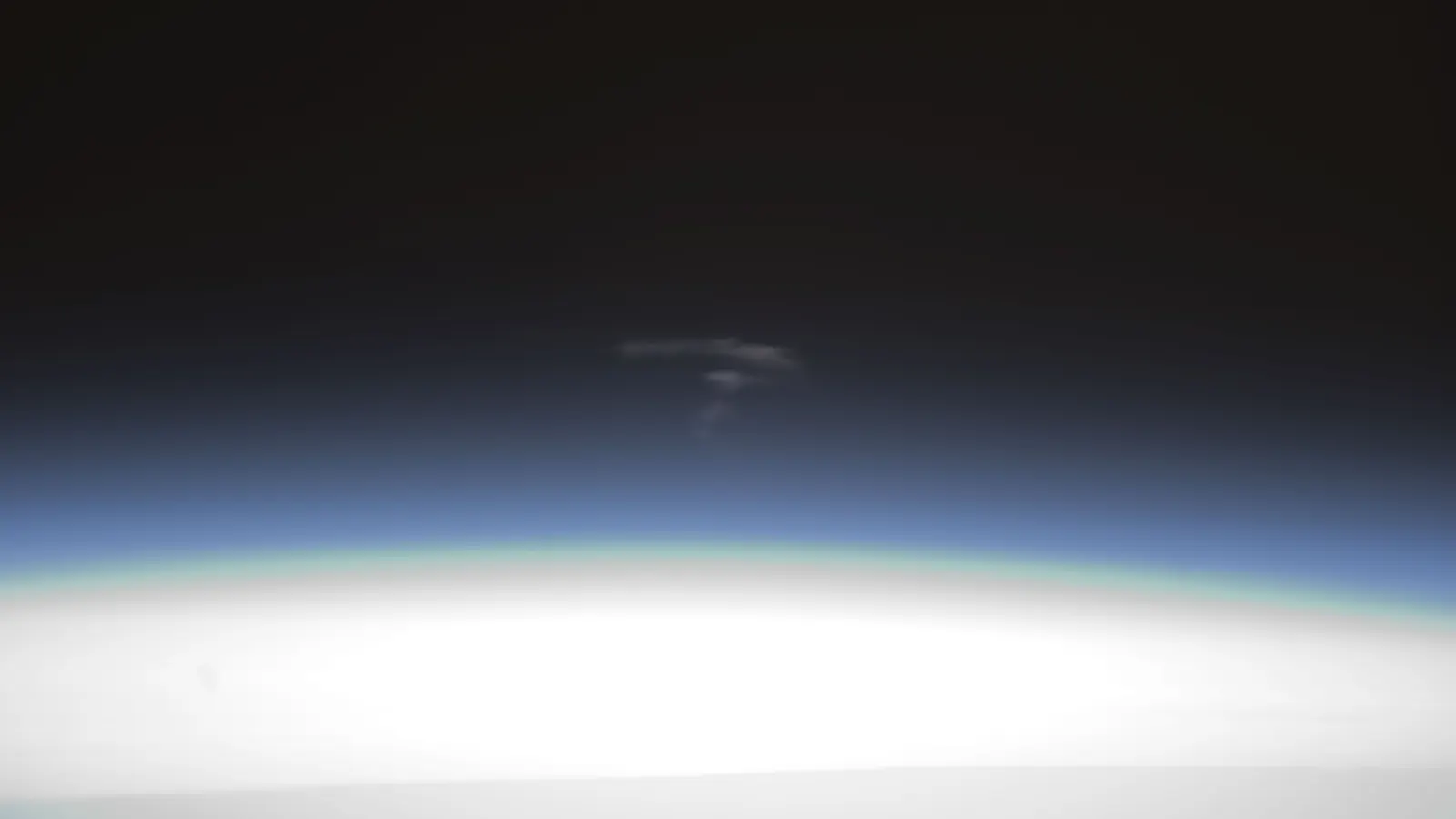
A satellite that falls back into the atmosphere is torn apart by the air it hits, usually between 84 and 72 km above the ground. NASA's Orbital Debris Program Office treats 78 km as the typical breakup altitude. Most of the pieces melt away below that, though parts that resist heat, such as steel and titanium tanks, can reach the surface. Exactly what happens when a satellite reenters the atmosphere depends on what it's made of, how big it is and whether anyone is steering it.
The fall starts slowly. On every orbit the thin air at the top of the atmosphere drags on a low satellite, so it sinks a little, and it sinks faster as the air around it gets denser. Even at 200 km it's still moving at about 7.8 km a second, roughly 28,000 km/h.
Do satellites burn up when they reenter?
Most of a satellite does, in stages that NASA's debris reentry page describes. Solar arrays often snap off first, around 90 to 95 km up. The main body comes apart lower, when aerodynamic loads exceed what its structure can bear. Aluminium generally melts away higher up than titanium, stainless steel or beryllium, and some light fragments slow so much that they reach the ground at very low speed.
ESA lists the parts most likely to survive as magnetotorquers, optical instruments, propellant and pressure tanks, the mechanisms that turn solar arrays, and reaction wheels. Tanks are the best-known survivors. A NASA technical paper says steel and titanium tanks hold up because their melting points are high. It also reports a check of NASA's ORSAT software, which models how objects heat up and break apart on the way down. ORSAT predicted that a spent Delta second stage's steel propellant tank and titanium pressure sphere would reach the ground, and both did.
Modern rules cap the danger. ESA says regulations aim to keep the casualty risk of each uncontrolled reentry, the chance that falling debris hurts someone, below 1 in 10,000. To get there, engineers "design for demise". They use joints that melt early or alloys that trigger the breakup sooner, so a satellite comes apart higher and its insides spend longer in the heat. SpaceX says no debris has been reported from the Starlinks it has deliberately deorbited.
Large spacecraft show how much can make it through. Before NASA's six-ton Upper Atmosphere Research Satellite fell on September 24, 2011, the agency estimated that 26 pieces weighing about 1,200 pounds (540 kg) in all could survive, roughly a tenth of the spacecraft. It came down over the Pacific, according to NASA's Orbital Debris Program Office. Long before that, on July 11, 1979, NASA's Skylab station fell after plans for a controlled deorbit were dropped. Most of its surviving debris landed in the Indian Ocean, but some fell over sparsely populated parts of southern Western Australia.
Where do dead satellites go?
In low orbit, the rules now push dead satellites down quickly. On September 29, 2022, the US Federal Communications Commission adopted a rule for satellites below 2,000 km that it licenses or that serve the US market. They must come down within five years of their mission's end, where the old guideline allowed 25 years.
Spacecraft too big to leave to chance are steered into the sea. An operator with fuel to spare lowers the orbit so the debris lands in what ESA calls the South Pacific Ocean Uninhabited Area, nicknamed the spacecraft cemetery. NOAA's satellite office says spacecraft are crashed there near Point Nemo, the most remote spot in the ocean, which NOAA's Ocean Service puts 2,688 km from the nearest land. Northrop Grumman's Cygnus XL cargo ship, packed with station trash, left the ISS on October 9 for a destructive reentry over the Pacific, as we reported in our story on the October crew swap.
The International Space Station is meant to end the same way. It's too big to be left to fall on its own, and NASA says an uncontrolled reentry would scatter very large debris over a wide area. The agency plans to end station operations in 2030. On June 26, 2024, it picked SpaceX to build a US Deorbit Vehicle, worth up to $843 million, to steer the station into an uninhabited part of the South Pacific. Some dead satellites are never brought down at all. NOAA's primer on the satellite afterlife describes graveyard orbits, where they're parked instead.
Counting Starlink reentries in WatchSat's catalog
Astronomer Jonathan McDowell estimated that one to two Starlink satellites fell back to Earth each day on average in 2025. The Register reported his figure in October 2025, and EarthSky repeated it in March 2026. We wanted to see how our own data compared. WatchSat saves CelesTrak's list of active satellites each time it refreshes its catalog, and we took eight of those snapshots, from September 15 to October 8, 2026. Then we looked for Starlinks that were present in the first and missing from the last.
Fifty were. None was still on the list under another name. Every one was low when we last saw it, with a perigee (the lowest point of its orbit) below 283 km, measured above Earth's 6,378 km equatorial radius as in CelesTrak's catalog. Forty-seven were below 250 km. Each set of orbital elements is dated to the moment it describes, and the typical dates in the first and last snapshots are 23.6 days apart. Fifty departures in that time comes to about 2.1 a day, close to McDowell's figure. A year at that pace would come to roughly 770.
Starting height predicted which ones would leave. On September 15, 140 Starlinks, 1.3 percent of those listed, had a perigee below 350 km, and 48 of them were gone by October 8. Of the 10,570 that started above that height, only two left, and both had dropped below it first. A satellite can fall off an active list for other reasons, and we haven't checked these 50 against official decay records. With orbits that low and dropping that fast, though, they almost certainly decayed.
Two of them show the shape of the fall. STARLINK-1171, launched in 2020, had an average height of 285 km in our September 15 snapshot. From there it went to 281 km on September 17, 256 km on September 24 and 246 km on September 27. It was down to 233 km on October 1 and 210 km on October 5, and by October 8 it was gone. Its descent sped up from about 1.5 km a day to nearly 6 km a day as it reached thicker air. STARLINK-31495, launched in 2024, traced the same shape from higher up. It stood at 378 km on September 15, 350 km on September 24, 310 km on October 1 and 261 km on October 5, then vanished too. Most of the 50 came from the early years of the constellation, with 32 launched between 2019 and 2021.
More are on the way down. In our October 8 snapshot, 168 of the 11,132 Starlinks averaged less than 350 km up. Sixty of those launched in 2026 and are holding steady or climbing. Of the 108 older ones, 107 had dropped more than 5 km since their first appearance in our snapshots. Their median height is now 315 km, and the typical one is sinking 0.76 km a day.
The lowest is STARLINK-4387, launched in 2022. In elements dated October 8 its orbit ran from 153 km at perigee to 164 km at apogee, its highest point. It averaged 315 km in mid-September and lost 53 km in under three days before that snapshot, so it may already be gone. While it's still listed, it and the rest of the sinking group show up in our Starlink directory and on the live globe.
Metals in the stratosphere
Satellites that burn up leave metal behind. In October 2023 a NOAA-led team reported in PNAS that about 10 percent of sulfuric acid particles larger than 120 nanometres in the stratosphere held aluminium and other metals from reentering spacecraft. Sampling from NASA's WB-57 research plane, the team found more than 20 such elements in ratios that match spacecraft alloys. The authors say that share could reach half as low-orbit fleets grow, and that no one yet knows how so much metal changes the particles.
Other researchers have looked at what the metal might do to ozone. A modelling study published in Geophysical Research Letters in June 2024 estimated that a typical 250 kg satellite makes about 30 kg of aluminium oxide nanoparticles as it burns. The particles may stay aloft for decades, the study suggested. By the authors' count, reentries in 2022 produced about 17 tonnes of it, and mega-constellations could push that past 360 tonnes a year. AGU, which publishes the journal, said aluminium oxide from reentries rose about eightfold between 2016 and 2022 and warned that it could put the ozone hole's recovery at risk. Neither study measured ozone loss directly.
McDowell expects the pace to pick up. He has projected about five reentries a day once roughly 30,000 satellites fill low orbit on five-year replacement cycles, PC World reported in 2025. Our snapshots will show whether the Starlink rate climbs toward that.
Sources
- NASA Orbital Debris Program Office, Debris Reentry, accessed October 11, 2026, and Orbital Debris Quarterly News on the UARS reentry, 2011; UARS reentry report, NASA Technical Reports Server, 2012
- NASA, 45 Years Ago: Skylab Reenters Earth's Atmosphere, 2024; NASA Selects International Space Station US Deorbit Vehicle, June 26, 2024, with the International Space Station Deorbit Analysis Summary and space station transition plan FAQs; Cygnus XL cargo spacecraft released from station by Canadarm2, October 9, 2026; NASA Technical Reports Server, paper on tank survival and ORSAT predictions
- ESA, Space debris: feel the burn, and ESA Clean Space blog, Basics about controlled and semi-controlled reentry, November 16, 2018
- NOAA, Where is Point Nemo?, Does Space Junk Fall from the Sky? and Graveyard Orbits and the Satellite Afterlife; NOAA Chemical Sciences Laboratory, news release on spacecraft metals in the stratosphere, October 2023
- FCC, FCC Adopts New '5-Year Rule' for Deorbiting Satellites, September 29, 2022
- Murphy and others, Metals from spacecraft reentry in stratospheric aerosol particles, PNAS, October 2023
- Ferreira and others, Potential ozone depletion from satellite demise during atmospheric reentry in the era of mega-constellations, Geophysical Research Letters, June 2024; AGU, Satellite "megaconstellations" may jeopardize recovery of ozone hole, 2024
- EarthSky, 1 to 2 Starlink satellites are falling back to Earth each day, March 2026; The Register, Starlink is burning up one or two satellites a day, October 6, 2025; PC World, At least one Starlink satellite burns up every day, and it's getting worse, 2025
- SpaceX, Updates
- CelesTrak, active satellites element sets, as saved in WatchSat's catalog snapshots of September 15 to October 8, 2026
Follow by RSS. Share this post: Bluesky · X · Reddit · Email
More from the blog
-
How many GPS satellites are there? Height and how GPS works
The U.S. Space Force counted 32 operational GPS satellites in April 2026, about 20,200 km up. How GPS works, and how Galileo, GLONASS and BeiDou compare.
-
How fast does the ISS travel? Speed, altitude and orbit
How fast does the ISS travel? About 17,100 mph (7.66 km/s), circling Earth every 93 minutes 420 km up. Why it sinks, and how it gets pushed back up.
-
Do satellites affect astronomy? Streaks, Starlink and Rubin
Do satellites affect astronomy? Streaks crossed 2.7% of Hubble exposures from 2002 to 2021, and Rubin simulates trails in about 10% of its survey images.
-
How do solar storms affect satellites? Drag, GPS, Starlink
Solar storms affect satellites by heating the upper air, which adds drag in low orbit, and by skewing GPS. A mild 2022 storm downed 38 of 49 new Starlinks.
-
How much space debris is in orbit? 2026 counts and risks
How much space debris is in orbit? The US catalog lists about 34,000 objects, ESA counts about 47,000 tracked, and models estimate 1.5 million of 1 to 10 cm.
Home · Live satellite map · Satellite directory · Starlink · OneWeb · Navigation satellites · Space stations · Other active satellites · Track the ISS · ISS visible passes · Starlink train · Rocket launches · Aurora forecast · Humans in space · Solar System · Deep Space · Embed widgets · Blog · Guide: spot the ISS · Guide: what is a TLE? · Guide: how many satellites? · Guide: satellite trackers compared · Discovery: Elias 2-24 b · About · FAQ · Data & methodology · Credits · Editorial policy · Accessibility · Contact · Privacy · Terms
© 2026 WatchSat · Not affiliated with any space agency or satellite operator.