WatchSat › Blog › How fast does the ISS travel? Speed, altitude and orbit
How fast does the ISS travel? Speed, altitude and orbit
How fast does the ISS travel? About 17,100 mph (7.66 km/s), circling Earth every 93 minutes 420 km up. Why it sinks, and how it gets pushed back up.
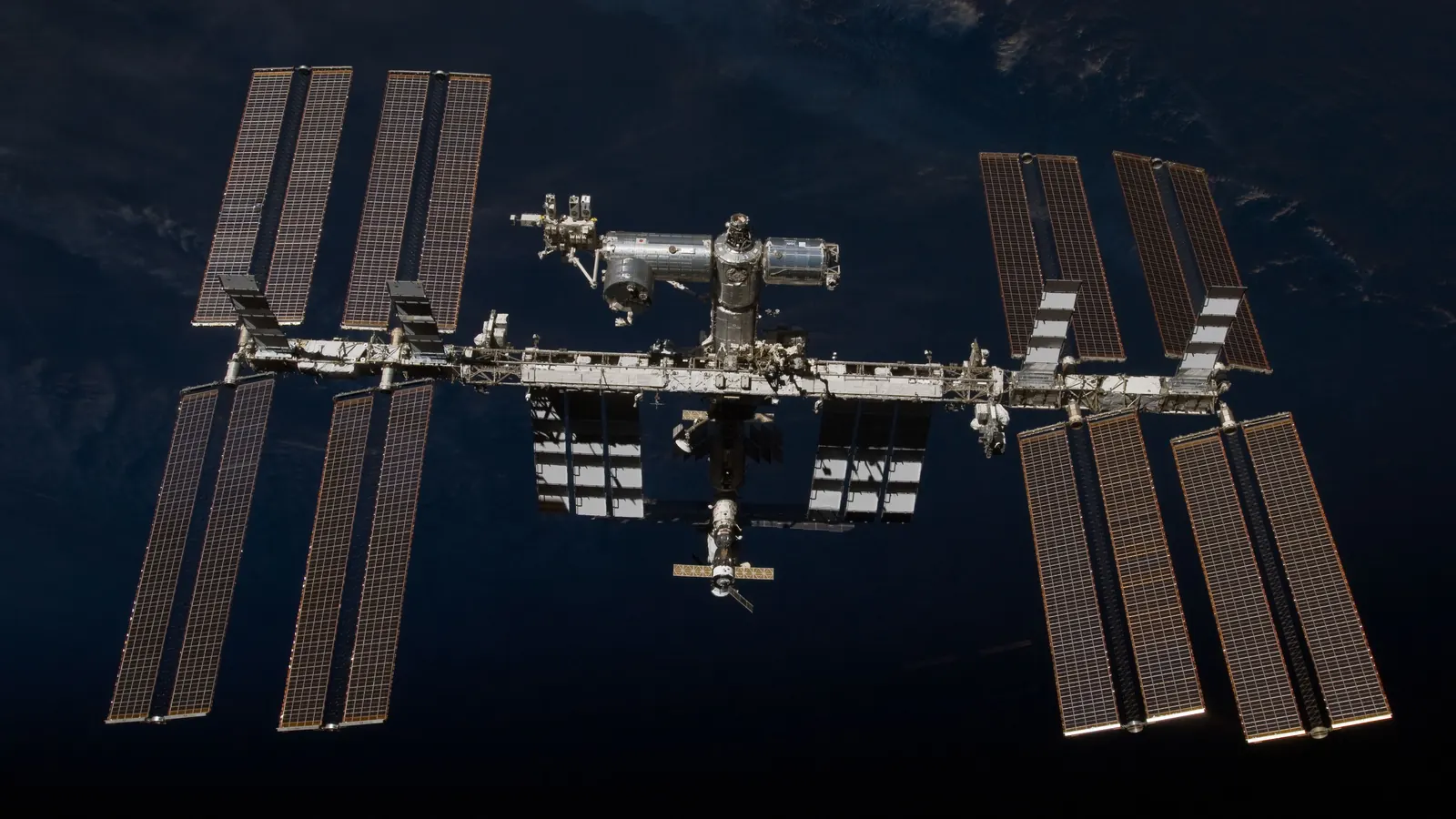
The International Space Station travels at about 7.66 kilometres per second, roughly 27,600 km/h or 17,100 mph. At that speed it circles Earth every 93 minutes, about 15.5 times a day, some 420 km (261 miles) up. NASA usually gives a rounder 17,500 mph. The station also sinks a little every day, and every few weeks a docked spacecraft has to push it back up.
The station currently has seven people aboard. To watch it pass over, see our guide to spotting the ISS, which covers when to look up.
How fast does the ISS travel?
We worked out the speed from the station's element set, the block of orbital numbers CelesTrak publishes for each satellite, dated October 7, 2026. It has the ISS completing 15.488 orbits a day. Kepler's third law, which ties the time an orbit takes to its size, turns that into an average orbital radius of 6,798 km. Anything circling at that distance moves at 7.657 km/s, or 17,128 mph.
NASA's own figures are round numbers. Its main station page says 17,500 mph, 2.2 percent above our figure, and its facts-and-figures page says five miles per second, or 18,000 mph. The facts page also gives about 90 minutes per orbit and 16 orbits a day, with 16 sunrises and 16 sunsets. The current orbit works out to 92.98 minutes and 15.49 orbits a day, so the crew sees a sunrise about every 93 minutes, roughly 5,660 a year.
Higher orbits are slower. In the same copy of CelesTrak's data, Hubble's orbit sits about 470 km up and carries the telescope at 7.629 km/s. China's Tiangong space station flies lower, at 387 km, and does 7.676 km/s. A GPS satellite some 20,200 km up manages 3.874 km/s, about half the speed of the ISS.
Over a day the ISS covers 661,572 km. NASA gives the Moon's average distance as 384,400 km, so the station flies the distance of a round trip to the Moon every 27.9 hours. Its speed is about 30 times the cruise speed of a Boeing 787, which the aviation reference SKYbrary lists as 490 knots, roughly 900 km/h. At that pace a jet would need some 44 hours to fly around the equator, while the ISS laps the planet in 93 minutes.
The station stays up because it's constantly falling around Earth. Gravity at 420 km is still 8.62 m/s², 88 percent of its pull at the surface. In each second the ISS drops 4.31 metres. Over the 7.66 km it travels in that second, Earth's curved surface falls away by the same 4.31 metres, so its height doesn't change.
How high is the ISS, and why does it keep dropping?
In the October 7 elements the station's average altitude is 420.3 km, ranging from 415.7 to 425.0 km over an orbit. Those heights are measured from Earth's equatorial radius of 6,378 km, the convention CelesTrak's data and most NASA figures use. NASA's general pages say "about 250 miles", or 402 km, well below the roughly 420 km that NASA itself has reported after recent boosts.
Height above the ground varies more, because Earth is slightly flattened. At 51.6 degrees latitude the surface is about 13 km closer to Earth's centre than at the equator, so the station's height above the ground swings between about 418 and 434 km on each orbit.
Because the orbit is tilted 51.63 degrees to the equator, the ISS's live position always falls between 51.6 degrees north and south, a band that holds 78.4 percent of Earth's surface. Earth turns underneath as the station flies, so each lap crosses the equator about 2,600 km west of the one before. The Conversation reported that the tilt was set higher than the latitude of Russia's Baikonur launch site, about 46 degrees north, partly so spent rocket stages wouldn't fall on China.
Even at 420 km there's a trace of atmosphere, and its drag slowly lowers the orbit. ESA has put the loss at about 2 km a month, though the rate depends on the Sun. As NOAA's Space Weather Prediction Center explains, solar activity heats and swells the upper atmosphere, putting denser air at the station's height.
As drag lowers the orbit, the station speeds up, because lower orbits are faster. Before the September boost its average speed in our snapshots crept from 7.6576 to 7.6579 km/s.
The September 25 reboost in our orbital data
WatchSat keeps a dated copy of CelesTrak's list of active satellites, the same data behind our live satellite map, and refreshes it every few days. Eight copies were saved between September 15 and October 8, 2026. We turned the ISS's two-line element set (TLE, the standard text format for those orbital numbers) in each one into an average altitude with the same Kepler calculation.
| Element set time (UTC) | Average altitude | Change from previous set |
|---|---|---|
| Sept 14, 03:26 | 419.34 km | |
| Sept 16, 20:27 | 419.23 km | −107 m |
| Sept 24, 03:24 | 418.89 km | −337 m |
| Sept 27, 04:10 | 420.63 km | +1,738 m |
| Sept 27, 04:10 (same set again) | 420.63 km | none |
| Sept 30, 20:27 | 420.53 km | −103 m |
| Oct 5, 01:07 | 420.41 km | −114 m |
| Oct 7, 19:42 | 420.33 km | −86 m |
Two copies hold the same element set, so there are seven independent readings. Each is good to roughly 50 metres, far less than the jump between September 24 and 27.
Over those three days the average altitude rose 1,738 metres. Add back the 44 metres a day the station had been losing, and the boost was worth about 1.87 km. NASA said Northrop Grumman's Cygnus XL cargo ship, berthed to the Unity module, fired for 18 minutes on September 25 to set up the arrival of Crew-13. By NASA's numbers the burn raised the orbit's high point by 1.5 miles and its low point by 0.8 miles, an average of 1.85 km, and our measurement agrees to within about one percent.
The decay rate changed too. Between September 14 and 24 the station sank 44 to 46 metres a day, or 1.35 to 1.41 km a month. From September 27 to October 7 it sank only 28 to 29 metres a day, 0.87 to 0.88 km a month, well under the 2 km a month ESA has quoted. The extra 1.7 km of height helps a little, but air density at that level also tracks solar activity, and our snapshots can't separate the two.
At those rates, the September burn's 1.85 km bought back one to two months of sinking. By our estimate the push changed the station's speed by about 1.05 m/s, or 2.4 mph.
Reboosts, debris and the 2030 deorbit
Russian Progress cargo ships, docked at the back of the Zvezda module, have traditionally done the pushing. Cygnus can do it from its berth on Unity. SpaceX's cargo Dragon can carry a boost kit in its trunk, with its own propellant and two Draco engines, and the CRS-33 Dragon used one for six reboosts between September 2025 and January 2026. One of them, on December 29, 2025, ran more than 19 minutes. Before its September burn, Cygnus XL had already boosted the station once, on August 27, 2026. Working from NASA's posted figures, we estimate that the December burn changed the station's speed by about 1.6 m/s.
Cygnus XL left on October 9, as we reported in our post on Crew-13's record docking. Until another Cygnus arrives, boosts will have to come from a Progress or a Dragon.
Some boosts are dodges. On November 19, 2024, the docked Progress 89 fired its thrusters for 5 minutes and 31 seconds to move the station out of the way of a fragment from a defunct defense weather satellite. That satellite broke up in 2015, and NASA said the fragment could otherwise have passed within about 2.5 miles (4 km). Another dodge followed on April 30, 2025, according to NASA.
NASA plans to operate the ISS through 2030 and then bring it down over a remote stretch of ocean. Its 2022 transition report assumed the station would come down in January 2031. The plan combines natural decay, lowering with propulsion already on hand, and a final burn after the crew has left. NASA's studies found that Progress ships lack the propulsion margin to keep the risk to people on the ground low enough. On June 26, 2024, NASA picked SpaceX to build a U.S. Deorbit Vehicle based on Dragon for the job. The contract is worth up to $843 million and doesn't cover the launch.
At the 28 to 44 metres a day we measured, the station's average altitude in CelesTrak's data should reach about 419.3 to 419.6 km by November 1. Any jump above that marks the next reboost. Our ISS pass predictions use fresh CelesTrak elements, so they include each boost once new elements come out.
Sources
- NASA: International Space Station Facts and Figures and International Space Station, both undated; FAQs: The International Space Station Transition Plan, updated July 2024; NASA Selects International Space Station U.S. Deorbit Vehicle, June 26, 2024; United States Deorbit Vehicle, Office of Procurement summary, June 2025; International Space Station Transition Report, 2022; Moon Facts
- NASA Space Station blog: NASA, Northrop Grumman Complete Cygnus XL Space Station Reboost, September 25, 2026; Cygnus XL cargo spacecraft released from station by Canadarm2, October 9, 2026; SpaceX Dragon Boosts Station's Orbit, December 29, 2025; NASA, SpaceX Complete Dragon Space Station Reboost, September 3, 2025; Station Maneuvers to Avoid Orbital Debris, April 30, 2025; Space Station Raises Orbit Avoiding Orbital Debris, November 19, 2024; image of Progress 93 docked to Zvezda during a reboost, November 2025
- ESA: ISS reboost, February 2016
- CelesTrak, active satellites element sets, eight WatchSat snapshots from September 15 to October 8, 2026
- Space.com, Cygnus "the Swan" lifts up the International Space Station, September 14, 2026
- The Conversation, The International Space Station: 100,000 laps and counting, May 2016
- NOAA Space Weather Prediction Center, Satellite Drag, accessed October 11, 2026
- SKYbrary, Boeing 787-8 aircraft data page
Follow by RSS. Share this post: Bluesky · X · Reddit · Email
More from the blog
-
What is a geostationary orbit? Height, speed and delay
A geostationary orbit is a circle 35,786 km above the equator where a satellite keeps pace with Earth's spin and seems to hang still. We counted 573 there.
-
How many GPS satellites are there? Height and how GPS works
The U.S. Space Force counted 32 operational GPS satellites in April 2026, about 20,200 km up. How GPS works, and how Galileo, GLONASS and BeiDou compare.
-
What happens when a satellite reenters the atmosphere?
When a satellite reenters the atmosphere it breaks apart about 78 km up and mostly melts away, though tanks can survive. About two Starlinks fall each day.
-
Do satellites affect astronomy? Streaks, Starlink and Rubin
Do satellites affect astronomy? Streaks crossed 2.7% of Hubble exposures from 2002 to 2021, and Rubin simulates trails in about 10% of its survey images.
-
How do solar storms affect satellites? Drag, GPS, Starlink
Solar storms affect satellites by heating the upper air, which adds drag in low orbit, and by skewing GPS. A mild 2022 storm downed 38 of 49 new Starlinks.
Home · Live satellite map · Satellite directory · Starlink · OneWeb · Navigation satellites · Space stations · Other active satellites · Track the ISS · ISS visible passes · Starlink train · Rocket launches · Aurora forecast · Humans in space · Solar System · Deep Space · Embed widgets · Blog · Guide: spot the ISS · Guide: what is a TLE? · Guide: how many satellites? · Guide: satellite trackers compared · Discovery: Elias 2-24 b · About · FAQ · Data & methodology · Credits · Editorial policy · Accessibility · Contact · Privacy · Terms
© 2026 WatchSat · Not affiliated with any space agency or satellite operator.