WatchSat › Blog › When will the ISS be retired? Deorbit plan and what's next
When will the ISS be retired? Deorbit plan and what's next
NASA plans to retire the ISS after September 30, 2030, when operations end. A SpaceX-built vehicle then steers it into the South Pacific in about 2031.
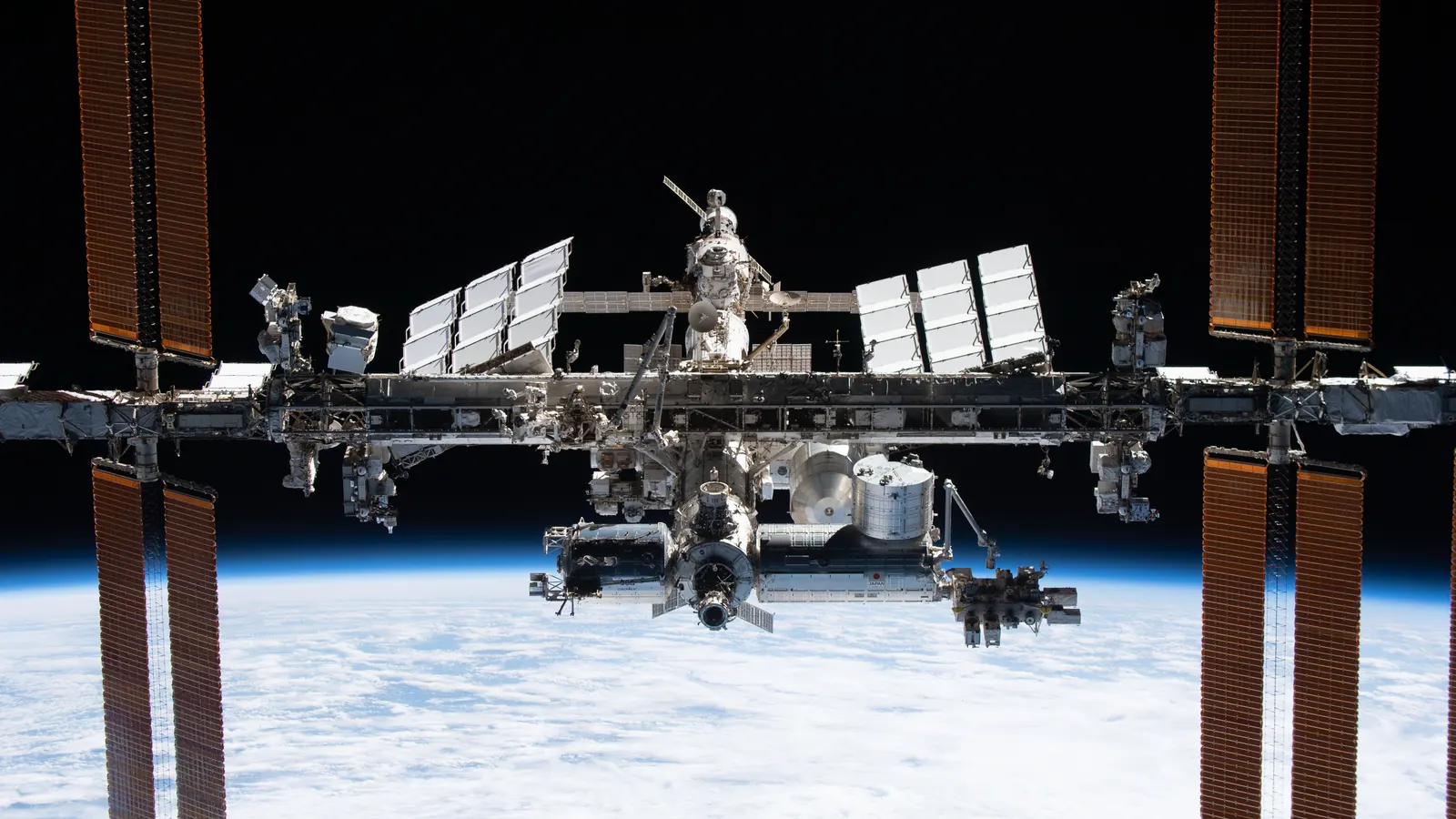
NASA plans to operate the International Space Station through at least September 30, 2030, following direction from Congress, so the short answer to when the ISS will be retired is 2030. The station itself comes down later, in a controlled reentry. NASA's 2022 transition report assumed that reentry would happen in January 2031, and in 2024 NASA's Office of Inspector General also placed it in 2031.
As of October 11, 2026, the station has 1,450 days of operations left, about 22,500 more orbits. NASA says the main structure of the U.S. segment could support flying beyond 2030 if necessary, and it has begun analysis to confirm that. Seven people are living aboard now, and our tracker shows the ISS's live position.
How will the ISS be deorbited?
NASA's facts page gives its mass as 419,725 kg (925,335 lb) and its width across the solar arrays as 109 m (358 ft), while the agency's transition FAQ says more than 430,000 kg. An uncontrolled reentry of something that heavy would scatter very large pieces of debris over a wide area, NASA says, so it plans a controlled one.
Under that plan, drag and the engines of docked ships such as Russian Progress cargo craft lower the orbit. After the last crew leaves, a final burn aims what survives at the ocean. The FAQ puts that burn at 57 m/s of delta-v, the change in velocity an engine has to deliver. NASA's 2024 deorbit analysis found that Progress ships alone lack the propulsion margin to keep the risk to people on the ground low enough, so NASA needed a dedicated vehicle.
On June 26, 2024, NASA picked SpaceX to build that U.S. Deorbit Vehicle, under a contract worth up to $843 million for developing and delivering it. The launch is bought separately, and NASA is to own and operate the vehicle. Citing SpaceX, TechCrunch reported on July 17, 2024, that the design is a modified cargo Dragon with six times the propellant and at least three times the power of today's Dragon. We found no announced launch date or rocket for it as of October 11, 2026.
NASA's target for the crash is "an uninhabited region of the South Pacific Ocean." Point Nemo, the spot in the ocean farthest from land, is the usual shorthand for that area, and our explainer on satellite reentry covers how spacecraft are aimed there.
NASA has also said why it won't boost the station higher and keep it. Crew and cargo ships are built for its present height of about 415 km, so a higher station couldn't keep a crew without new propulsion and tanker vehicles. Debris is a bigger hazard higher up, too. NASA estimates that the average time between debris impacts would shrink from about 51 years at today's altitude to under four years at 800 km (497 miles). The climb itself would cost far more than the 57 m/s needed to come down. Reaching an orbit that lasts 100 years would take 120 to 140 m/s of delta-v, and one that lasts over 10,000 years would take 760 m/s.
Russia's part in the plan
Russia's plans have been harder to pin down. NASA's 2024 deorbit-contract announcement listed the United States, Japan, Canada and ESA's participating countries as committed through 2030, without Russia. In September 2024 NASA's Inspector General said Russia hadn't committed to the 2030 timeline or the deorbit plan.
Roscosmos has since moved toward NASA's date. On July 29, 2025, Interfax quoted Roscosmos head Dmitry Bakanov saying Russia had agreed to operate the ISS until 2028 "and we will work on the issue of de-orbiting it by 2030." On July 14, 2026, Interfax reported Bakanov as saying Roscosmos and NASA had agreed to extend joint work on the station to 2030. We found no NASA statement confirming it.
Russia's next station depends on the ISS too. Interfax reported on April 7, 2026, that the first module of the Russian Orbital Station is planned for 2028. An official at Energia, the spacecraft maker, said Russia was "heavily dependent on our American colleagues" to deploy it beside the Russian segment.
What will replace the ISS?
NASA wants private companies to provide the stations it uses next, which it calls commercial low Earth orbit destinations. Its rules for choosing them keep changing. In late July 2025 a directive signed by Sean Duffy, then acting NASA administrator, dropped a planned fixed-price competition in favor of several funded Space Act Agreements, partnership deals rather than contracts. The directive argued that retiring the ISS by 2030 called for a cheaper, faster replacement.
In March 2026, under Administrator Jared Isaacman, NASA floated buying a core module, attached to the ISS, that commercial modules would dock with, SpacePolicyOnline reported. Companies objected, and in June 2026 NASA agreed to keep the existing plan for free-flying stations, according to the same outlet. A month later NASA released a draft request for proposals, with comments due July 27. The draft describes picking two or more companies for early development, then a competitive order for final design, certification and services. We couldn't confirm a final request or proposal deadline as of October 11.
None of the replacements has launched. Vast's Haven-1, a single-module station built to launch on a Falcon 9, was aiming for May 2026 after an earlier August 2025 target, Spaceflight Now reported in May 2025. Payload has since reported a slip to no earlier than the first quarter of 2027. In our October 11 copy of CelesTrak's active-satellite list, a text search of all 16,701 objects finds nothing named Haven, Vast, Axiom or Orbital Reef. The one "Starlab" match is an unrelated satellite, 6GSTARLAB.
For now, the ISS and China's Tiangong are the only crewed stations in orbit. NASA's Inspector General said in 2024 that the agency still needed a transition plan to avoid a gap in low Earth orbit once the ISS is gone.
The ISS and Tiangong in our orbital data
WatchSat saves dated copies of CelesTrak's active-satellite list, the data behind our space station tracker, and we have nine from September 15 to October 11, 2026. Each object on the list comes with an element set, a block of orbit numbers. The newest one for the ISS, timed 18:56 UTC on October 10, puts the orbit's lowest point (the perigee) at 415.6 km and its highest (the apogee) at 424.8 km. Like CelesTrak, we measure heights above Earth's 6,378 km equatorial radius. The orbit is tilted 51.63 degrees to the equator, a figure called the inclination.
From September 14 to 24 the station's average height fell 44 m a day. A Cygnus XL cargo ship then raised the orbit on September 25, a reboost covered in our explainer on the ISS's speed and altitude. From September 27 to October 10 the loss was 33 m a day. Drag swings with solar activity, so four weeks of data can't be stretched into a reentry date.
China's Tiangong station, with three people aboard as of October 9, flies lower. Its Tianhe core module orbits between 385.6 and 386.6 km up, about 34 km below the ISS, at an inclination of 41.47 degrees. Tiangong's average height dropped 97 m a day from September 14 to 23 and 105 m a day from September 30 to October 10. Over nearly the same spans the ISS lost 44 m a day (September 14 to 24) and 35 m a day (September 30 to October 10). Tiangong sank two to three times as fast. Thicker air lower down is one likely reason, though the two stations' sizes and masses differ too.
From NASA's published figures, we estimate the September 25 reboost changed the station's speed by about 1.0 m/s. A Dragon reboost on December 29, 2025, managed about 1.6 m/s. The 57 m/s deorbit burn is 36 to 55 times bigger than either. Simple orbit arithmetic that ignores drag suggests why NASA lowers the orbit before that burn. A single burn that drops the orbit's low point to 100 km takes about 93 m/s from today's 420 km, but about 59 m/s from a circular orbit at 300 km.
The catalog also shows what's docked, because visiting craft carry the station's element set while they're attached. On October 11, ten entries share the ISS's element set character for character. Six are modules (Zarya, Unity, Zvezda, Destiny, Poisk and Nauka), and four are visiting ships: Progress MS-34 and MS-35, Soyuz MS-29 and Crew Dragon 13. Soyuz MS-29 and Progress MS-35 first appear in our September 27 copy and Crew Dragon 13 in our October 5 copy, while Crew Dragon 12 is gone by October 8.
Our ISS pass predictions show when the station next crosses your sky.
Sources
- NASA, FAQs: The International Space Station Transition Plan, undated
- NASA, NASA Selects International Space Station U.S. Deorbit Vehicle, June 26, 2024, with the International Space Station Deorbit Analysis Summary, June 2024
- NASA, International Space Station Facts and Figures, undated
- NASA, International Space Station Transition Report, January 2022
- NASA Office of Inspector General, report IG-24-020 on sustaining ISS operations through 2030, September 2024
- NASA, NASA Seeks Industry Input on Next Phase of Commercial Space Stations, July 2026
- NASA Space Station blog, NASA, Northrop Grumman Complete Cygnus XL Space Station Reboost, September 25, 2026; SpaceX Dragon Boosts Station's Orbit, December 29, 2025
- NASA Watch, NASA directive on commercial LEO destinations, July 2025
- SpacePolicyOnline, NASA Agrees with Industry, Keep CLD Program As Is, June 2026
- Interfax, Bakanov on operating the ISS until 2028, July 29, 2025; on the Russian Orbital Station, April 7, 2026; on extending joint ISS work to 2030, July 14, 2026
- TechCrunch, SpaceX's vehicle to deorbit the International Space Station is a "Dragon on steroids", July 17, 2024
- Spaceflight Now, Vast to complete Haven-1 primary structure in July 2025, ahead of target May 2026 launch date, May 7, 2025
- Payload, Vast delays Haven-1 launch to 2027, undated in our search
- CelesTrak, active satellites element sets, nine WatchSat snapshots from September 15 to October 11, 2026
Follow by RSS. Share this post: Bluesky · X · Reddit · Email
More from the blog
-
How does Starlink work? Orbits, dishes and laser links
Starlink links a phased-array dish to more than 11,000 satellites, most in shells about 460 to 485 km up, which relay traffic by laser and through gateways.
-
How long do satellites last? Lifespan by orbit and type
How long do satellites last? Most active ones are Starlinks, built for five years. New GPS satellites get 15, and Landsat 5, built for three, lasted 28 years.
-
How many rocket launches in 2026? The count so far
Rocket launches in 2026 reached about 240 orbital attempts by mid-October, one every 28.5 hours. How it compares with 2025's record and what the catalog shows.
-
Where is China's Tiangong space station? Orbit and crew
China's Tiangong space station orbits about 386 km up on a 41.5° tilt, so it stays between 41.5° N and S. Who's aboard, its size, and where you can see it.
-
What are the types of orbits? LEO, MEO, GEO and HEO
The main types of orbits are LEO, MEO, GEO and HEO. Of 16,701 objects on CelesTrak's active list on October 11, 2026, 95 percent were in low Earth orbit.
Home · Live satellite map · Satellite directory · Starlink · OneWeb · Navigation satellites · Space stations · Other active satellites · Track the ISS · ISS visible passes · Starlink train · Rocket launches · Aurora forecast · Humans in space · Solar System · Deep Space · Embed widgets · Blog · Guide: spot the ISS · Guide: what is a TLE? · Guide: how many satellites? · Guide: satellite trackers compared · Discovery: Elias 2-24 b · About · FAQ · Data & methodology · Credits · Editorial policy · Accessibility · Contact · Privacy · Terms
© 2026 WatchSat · Not affiliated with any space agency or satellite operator.