WatchSat › Blog › When is the next total solar eclipse? August 2, 2027
When is the next total solar eclipse? August 2, 2027
The next total solar eclipse is on August 2, 2027. Totality crosses Spain, North Africa and Arabia, lasting up to 6 min 23 s in Egypt's desert near Luxor.
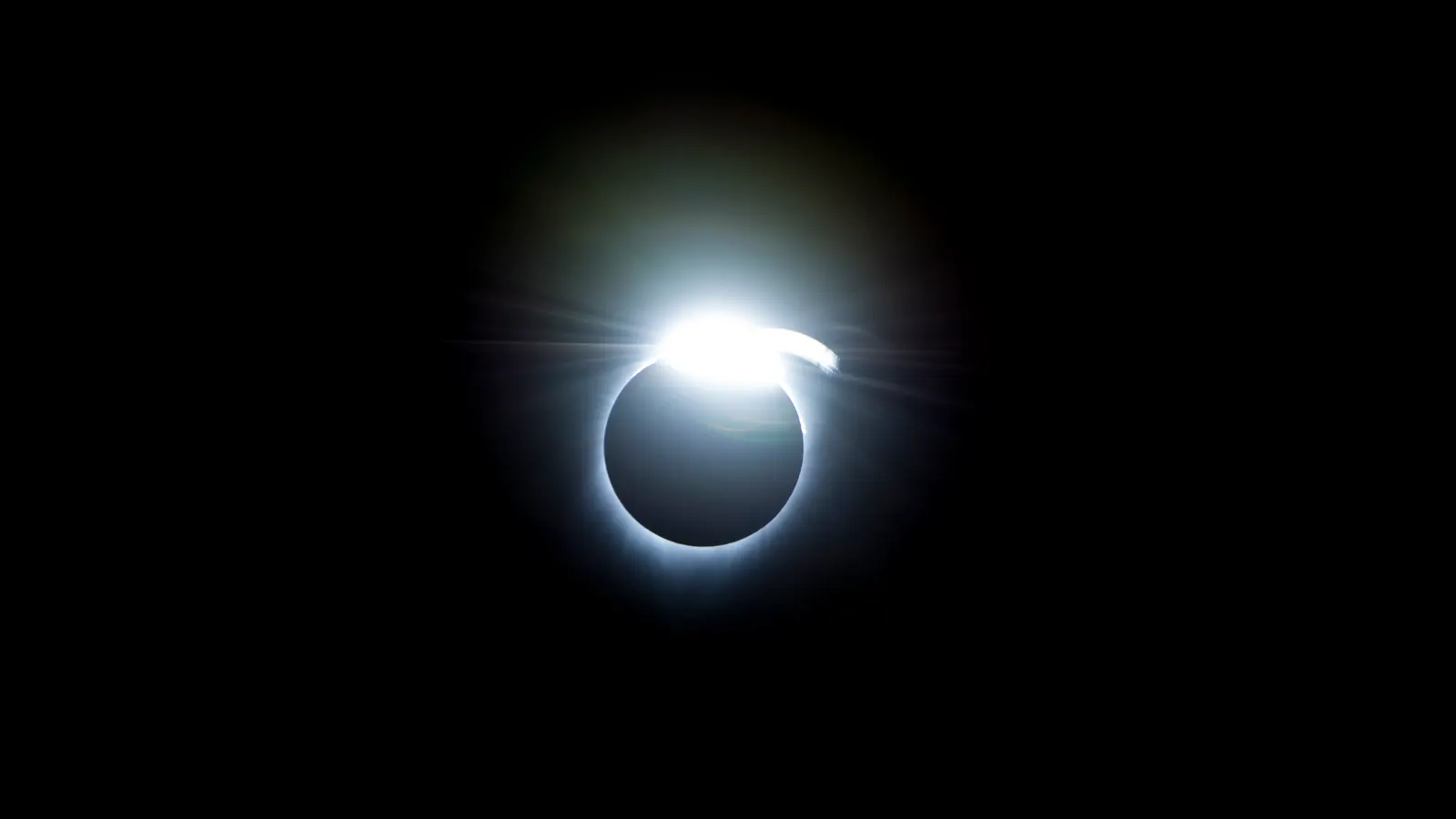
The next total solar eclipse is on Monday, August 2, 2027, when the Moon's shadow crosses southern Spain, North Africa and the Arabian Peninsula. NASA's predictions give a maximum of 6 minutes 23 seconds of totality, in Egypt's Eastern Desert about 60 km east of Luxor. Greatest eclipse, the moment the shadow's axis passes closest to Earth's centre, comes at about 10:06 UTC. It follows the last total eclipse, on August 12, 2026, and is now less than ten months away.
The 2026 eclipse crossed northern Russia, Greenland, Iceland and northern Spain. Near León, in Spain, totality began at 8:28 p.m. local time and lasted about two minutes, NASA's Earth Observatory reported. The 2026 maximum, just off western Iceland, was 2 minutes 18 seconds, according to NASA, and the 2027 eclipse lasts nearly three times as long at its best. Sky & Telescope calls 2027 by its popular name, "the eclipse of the century," while pointing out that one total eclipse this century lasted longer.
Where is the path of totality in 2027?
The shadow touches down at sunrise over the Atlantic and reaches land at the Strait of Gibraltar, where southern Spain, Gibraltar and northern Morocco see totality in the morning. From there the path, about 258 km (160 miles) wide at greatest eclipse, runs east through northern Algeria, southern and eastern Tunisia, Libya and Egypt. It crosses the Red Sea into Saudi Arabia and Yemen, clips the north-eastern tip of Somalia and ends at sunset in the Indian Ocean. NASA describes the eclipse as visible from southern Spain and northern Africa, and Fred Espenak's EclipseWise lists Saudi Arabia, Yemen and Somalia as well.
Outside the path, the Moon covers part of the Sun across Africa, Europe, the Middle East and western and southern Asia, according to EclipseWise. Inside it, the durations in NASA's 2027 predictions assume a smooth lunar edge, and mountains and valleys on the real edge can shift totality by a few seconds at any one spot.
Is 2027 the longest eclipse of the century?
No. NASA's catalogue of Saros 136 lists the total eclipse of July 22, 2009 at 6 minutes 39 seconds, 16 seconds longer than 2027, with its greatest point over the western Pacific. So 2027 is the second-longest total eclipse of the 21st century, and the longest since 2009. Our own ranking, in the next section, finds nothing longer until 2114.
The two are related through the saros, a cycle of about 18 years after which the Sun, Moon and Earth return to almost the same arrangement, so eclipses repeat in families. NASA lists 2027 as the 38th of 71 eclipses in Saros 136, a family that also includes 2009 and August 12, 2045. Each arrives 6,585 days and about seven and a half hours after the one before, a little over 18 years. Those extra hours of Earth's spin move each eclipse about 111 degrees west, from 144° E in 2009 to 33° E in 2027 and 79° W, near the Bahamas, in 2045. The family is slowly shortening, and NASA gives the 2045 eclipse 6 minutes 6 seconds, 17 seconds less than 2027.
Three conditions line up to make the 2027 eclipse long. The Moon is close. By our calculation it passes perigee, the nearest point of its orbit, at 06:24 UTC that morning, and at greatest eclipse it's 357,375 km (222,060 miles) from Earth's centre, so it looks big. Two weeks later, at apogee on August 15, it's 406,073 km away. Our live globe places the Moon at its real, changing distance, using the position tables described in our FAQ. The Sun, meanwhile, looks a little smaller than average, because Earth passed aphelion, its farthest point from the Sun, on July 5.
The shadow also falls almost square-on, near 25° N around local midday. EclipseWise gives the eclipse a gamma of 0.1421, a measure of how far the shadow's axis passes from Earth's centre, where zero would be dead centre. At that latitude Earth's rotation carries the ground east at 0.42 km/s, in the same direction the shadow travels, so the shadow moves more slowly across the ground and lingers over each spot.
Eclipse times, durations and sizes in our calculations
We ran the eclipse through astronomy-engine 2.1.19, the open-source library that also positions the planets on our 3D solar system map. Our methodology page explains how we test its sky positions. At the point of greatest eclipse the engine gives about 4 seconds more totality than NASA does, so read our durations as slightly generous. The table covers a dozen places, with times in UTC. "Covered" is the share of the Sun's disc hidden at maximum.
| Place | What you see | Maximum (UTC) | Totality | Sun's altitude |
|---|---|---|---|---|
| Cadiz, Spain | Total | 08:47 | 2 min 54 s | 37° |
| Gibraltar | Total | 08:48 | 4 min 29 s | 38° |
| Tangier, Morocco | Total | 08:47 | 4 min 54 s | 38° |
| Malaga, Spain | Total, near the edge | 08:49 | 1 min 50 s | 39° |
| Seville, Spain | Partial, 98.3% covered | 08:47 | none | 38° |
| Madrid, Spain | Partial, 86% covered | 08:51 | none | 40° |
| Benghazi, Libya | Total | 09:31 | 6 min 13 s | 68° |
| Luxor, Egypt | Total | 10:05 | 6 min 25 s | 82° |
| Cairo, Egypt | Partial, 95% covered | 09:56 | none | 78° |
| Jeddah, Saudi Arabia | Total | 10:25 | 6 min 3 s | 76° |
| Paris, France | Partial, 51% covered | 09:01 | none | 43° |
| London, UK | Partial, 42% covered | 09:00 | none | 40° |
Cadiz and Tangier are about 95 km apart across the Strait, yet Tangier, closer to the centre line, gets two minutes more totality. Seville, about 100 km north of Cadiz, misses totality altogether, with 98.3% of the Sun covered. In Algeria, Oran gets 5 minutes 11 seconds while Algiers stays just outside at 99.8%, and in Tunisia, Sfax and Djerba are in the path but Tunis isn't. Near either edge, check a detailed path map before choosing a spot.
Our run gives Luxor 6 minutes 25 seconds. Allowing for our 4-second excess, that agrees with the 6 minutes 22 seconds Sky & Telescope gives for the city. London and Paris see only a partial eclipse, and New York gets no eclipse at all that day.
We also ranked every eclipse the engine classes as total from 1950 to 2200 by the length of totality at greatest eclipse. In the 21st century, 2027 comes second, behind 2009 and ahead of May 22, 2096. The first eclipse longer than 2027 is on June 3, 2114. Every eclipse of 6 minutes or more on our list from 1955 to 2045 arrives 18 years after the one before it, which marks them all as Saros 136 eclipses.
Seen from Earth's centre on the day, the Moon measures 33.43 arcminutes across and the Sun 31.50, where an arcminute is a sixtieth of a degree. The Moon's disc is therefore 6.1% wider than the Sun's. The Moon was 6.2% wider in 2009 and will be 6.0% wider in 2045, against 4.0% for the eclipse of April 8, 2024 and 1.6% for August 21, 2017. A bigger Moon casts a wider shadow, and this one also moves slowly. At greatest eclipse its centre crosses the ground at 0.667 km/s, about 2,400 km/h. Over Iceland in 2026, at a high latitude with the Sun low, the shadow ran 43% faster, at 0.954 km/s.
Watching safely, and the total eclipses after 2027
Unlike a meteor shower such as the Geminids in December, a solar eclipse is safe to look at with the naked eye only during totality. By our calculation the partial phases in Luxor last 82 minutes before totality and 78 minutes after it, and in Cadiz 65 and 71 minutes. Throughout the partial phases, NASA says to use eclipse glasses or a handheld solar viewer that meets the ISO 12312-2 standard. You can take them off only during totality, and must put them back on as soon as any sliver of the Sun reappears. In places that see only a partial eclipse, such as Seville, Madrid, Cairo, Paris and London, the glasses stay on from start to finish. Ordinary sunglasses aren't safe, however dark. Don't look through a camera, binoculars or a telescope with eclipse glasses on, because the optics need their own solar filter on the front. The American Astronomical Society warns that an ISO label on the packaging isn't proof of safety, and it lists suppliers whose viewers have been tested.
Ahead of the August eclipse, a ring-shaped annular one on February 6, 2027 is centred over the South Atlantic, but the Moon is then too far away to cover the Sun completely. After August 2027, the next total eclipse is on July 22, 2028, across Australia and New Zealand. NASA gives it up to 5 minutes 10 seconds of totality, in northern Western Australia. In our calculation, Sydney gets 3 minutes 52 seconds at 04:01 UTC, with the Sun 29 degrees up.
For the United States, NASA says the next total eclipse visible from the contiguous states is in 2044, and only from Montana and North Dakota. Its date is listed as either August 22 or 23, because greatest eclipse, at 01:15 UTC on August 23, falls on the evening of August 22 local time there. Alaska gets a total eclipse sooner. In our calculation the shadow crosses western and northern Alaska on March 30, 2033, giving Nome 2 minutes 33 seconds and Utqiagvik 2 minutes 38 seconds, with the Sun low. The next member of the 2027 eclipse's saros, on August 12, 2045, crosses the country from coast to coast, the first total eclipse to do so since 2017. EclipseWise counts 15 states on its path.
Sources
- NASA Goddard Space Flight Center (Fred Espenak), Total Solar Eclipse of 2027 Aug 02, Total Solar Eclipse of 2026 Aug 12 and Total Solar Eclipse of 2028 Jul 22, undated
- NASA Goddard Space Flight Center, Catalog of Solar Eclipses of Saros 136, undated
- NASA Science, Future Eclipses, Eclipses Frequently Asked Questions and Eclipse Viewing Safety, undated
- NASA Earth Observatory, A Sunflower's View of Totality, 2026
- EclipseWise (Fred Espenak), Total Solar Eclipse of 2027 Aug 02 and Total Solar Eclipses in the USA, undated
- American Astronomical Society, How can you tell if your eclipse glasses or handheld solar viewers are safe?, undated
- Sky & Telescope, Plan for the 2027 "eclipse of the century" one year from now, 2026, and Luxor 2027
- Don Cross, astronomy-engine 2.1.19, used for all WatchSat calculations in this post
Follow by RSS. Share this post: Bluesky · X · Reddit · Email
More from the blog
-
When is the Geminid meteor shower 2026? Peak times and Moon
The Geminid meteor shower peaks the night of December 13-14, 2026: NASA says 40 to 50 meteors an hour under dark skies, and the crescent Moon sets early.
-
What are Lagrange points? L1 to L5 and what orbits there
Lagrange points are five places where a small object can keep pace with two large ones. For the Sun and Earth, L1 and L2 lie about 1.5 million km from Earth.
-
How fast is the Parker Solar Probe? Top speed and orbit
At closest approach the Parker Solar Probe reaches about 430,000 mph (692,000 km/h) relative to the Sun. On Oct. 11, 2026, it was doing just 13.9 km/s.
-
What are China's Qianfan and Guowang constellations?
China's Qianfan and Guowang satellite constellations had 477 satellites on CelesTrak's active list on October 11, 2026, toward plans of about 15,000 and 13,000.
-
What are the different types of satellites? Uses and counts
The types of satellites, by job. Communications are 80.2% of the 16,701 on CelesTrak's active list, Starlink alone 66.6%, while about 10% can't be identified.
Home · Live satellite map · Satellite directory · Starlink · OneWeb · Navigation satellites · Space stations · Other active satellites · Track the ISS · ISS visible passes · Starlink train · Rocket launches · Aurora forecast · Humans in space · Solar System · Deep Space · Embed widgets · Blog · Guide: spot the ISS · Guide: what is a TLE? · Guide: how many satellites? · Guide: satellite trackers compared · Discovery: Elias 2-24 b · About · FAQ · Data & methodology · Credits · Editorial policy · Accessibility · Contact · Privacy · Terms
© 2026 WatchSat · Not affiliated with any space agency or satellite operator.